



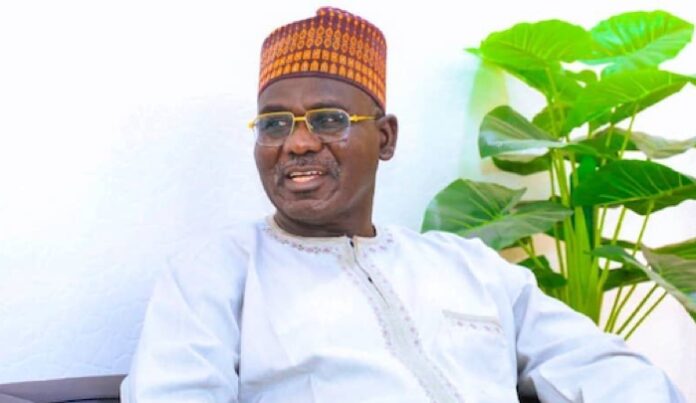
Security agencies can locate bandits if they want to – Buratai
Former Chief of Army Staff, Lieutenant General Tukur Buratai (retd.), has questioned claims that security agencies are unable to track bandits and kidnappers who openly share videos and communicate from their hideouts.
Buratai, who also served as Nigeria’s ambassador to the Republic of Benin, maintained that security agencies possess the capacity to locate criminal groups that publicise their activities online.
He spoke during an interview on TVC on Monday while reacting to concerns over the growing use of social media and video recordings by criminal gangs operating across the country.
His remarks come amid renewed concerns over insecurity following the abduction of schoolchildren and teachers from three schools in Orire Local Government Area of Oyo State, where one of the abducted teachers was later beheaded.
The retired army chief dismissed suggestions that security agencies lacked the technical ability to trace bandits who frequently showcase their activities online.
“I don’t think they failed to locate. If they can locate ordinary citizens or social media influencers, I don’t believe they can’t locate these bandits that flaunt their loot or whatever activities they do,” he said.
While refraining from directly blaming security agencies, Buratai suggested that operational considerations may influence their actions.
“I would not like to say it is a capacity-building challenge, but I think they may have their reasons,” he said.
He stressed the need for continuous investment in Nigeria’s security architecture through recruitment, training and improved welfare for personnel across security agencies.
“There must be capacity building of all the security agencies, and continuously,” he said. “There is a need for more operatives. We need more troops to be recruited, more operatives and more policemen.”
Buratai also emphasised the importance of regular retraining and adequate living conditions for security personnel.
“They should be trained and retrained. Their welfare is very important. Let us have good accommodation. They must have good accommodation,” he said.
On whether the country possesses specialised units capable of conducting high-risk hostage rescue missions, Buratai said such capabilities already exist within the military.
“I will not tell you exactly or be specific, but generally we have within the military specialised units trained for such rescue missions,” he said.
According to him, both the Nigerian Navy and the Nigerian Army maintain elite units equipped for rescue operations and VIP protection duties.
“The Special Boat Service is trained for such rescue missions. Even the Nigerian Army has Special Forces. They have rescue and VIP protection capabilities,” he said.
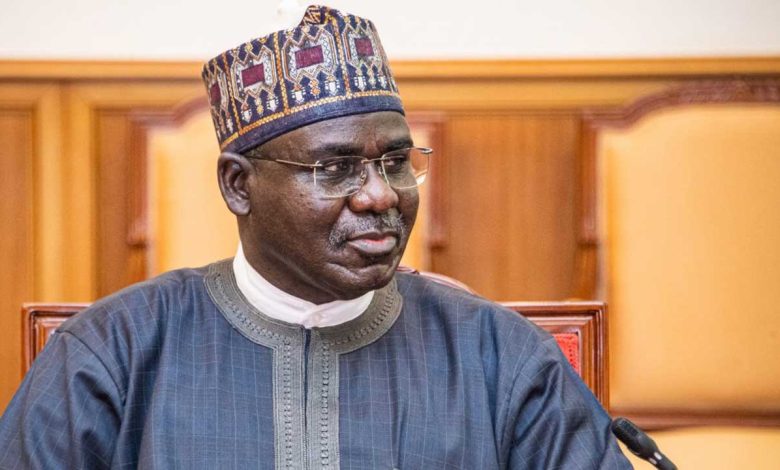
However, he noted that decisions surrounding kidnapping cases are often influenced by concerns over the safety of hostages and the potential for collateral damage.
“The sensitivity of that type of kidnap, the location and those involved, and the danger of collateral damage may play a very important part,” he added.
Buratai further called for the expansion of the National Counter Terrorism Centre under the Office of the National Security Adviser, arguing that stronger coordination and enhanced technological capabilities would improve efforts to combat terrorism and kidnapping.
“The Office of the National Security Adviser has a Counter Terrorism Centre. I think the commander there is a professional and highly strategic officer,” he said.
He proposed establishing state branches of the centre, equipped with advanced technology and modern operations facilities, to support intelligence gathering and coordination among security agencies.
“If it can be further expanded to have state branches of the Counter Terrorism Centre with highly technical equipment and very good operations centres or situation rooms, they will be able to do a lot in coordination with the security agencies and the military,” Buratai said.


, has questioned claims that security agencies are unable to track)