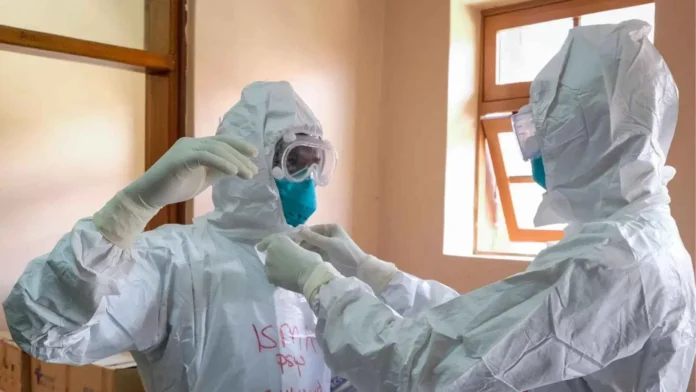
The Nigeria Centre for Disease Control and Prevention (NCDC) said the patient arrived in Nigeria on October 3, prompting efforts to trace people who may have been exposed to the deadly virus.
Nigeria has confirmed its first case of the Bundibugyo strain of Ebola, with the infected patient, a diplomat who travelled from Uganda to Abuja, reportedly suffering from multi-organ failure.
The Nigeria Centre for Disease Control and Prevention (NCDC) disclosed that the patient arrived in Nigeria on October 3, prompting efforts to trace people who may have been exposed to the deadly virus.
Director of the NCDC’s public health laboratory service, Olajumoke Babatunde, said the diagnosis was established through molecular testing.
“We did three levels of tests, but all molecular. The strain was Bundibugyo,” she said.
The World Health Organization (WHO) also confirmed the strain, for which no approved vaccine or specific treatment is currently available.
An official who disclosed the patient’s diplomatic status said the condition had deteriorated into “multi-organ failure”. The official, however, did not reveal the diplomat’s nationality.
The development comes amid an expanding Ebola outbreak in the Democratic Republic of Congo (DRC), where health authorities have reported more than 9,000 confirmed cases and 4,381 deaths.
The outbreak, which was declared in mid-May, has spread beyond central Africa to countries in the eastern and western parts of the continent.
Africa Centres for Disease Control and Prevention Director General Jean Kaseya warned on Tuesday that the outbreak posed “an extremely serious threat”.
He urged the international community to respond urgently, saying: “My appeal to the international community is urgent: ACT NOW,”
Kaseya also described the outbreak as unprecedented in its geographical spread.
“This Ebola Bundibugyo outbreak has already become the most geographically widespread Ebola outbreak in history, affecting multiple countries across three regions of Africa,” he said.
Nigeria has identified 44 contacts linked to the confirmed case, while health officials continue efforts to locate others who may have been exposed.
The WHO said infection prevention and control measures were being “ramped up” at the private hospital where the patient sought medical attention.
Uganda was declared Ebola-free by the WHO in August after recording 20 cases, most of them involving people who had travelled from the DRC.
Kenya has also reported its ninth Ebola case and death, according to the Africa CDC warning cited in the report.
Nigeria last experienced an Ebola outbreak in 2014, when authorities contained the spread of the virus.
A civil servant, Anthony Ojogho, expressed confidence in the government’s ability to manage the latest case, citing its previous response to public health emergencies.
“Nigerian governments have always been equal to the task. We contained Ebola, we contained coronavirus and the few cases we have now,” he said.
He added: “If the right steps are being taken, I’m very sure that we’re going to contain to a large extent the spread of Ebola virus in Nigeria.”