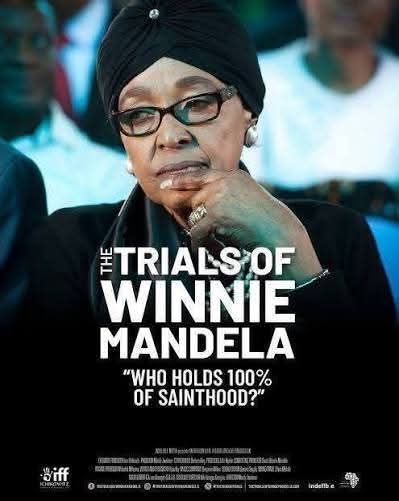
MOVIE REVIEW: The Trials of Winnie Mandela
By Zikora Ibeh
How do you ask your grandmother if she is a murderer or a kidnapper? This uncomfortable question opens Netflix’s documentary The Trials of Winnie Mandela (2026).
Framed through the intergenerational dialogue between Winnie Madikizela-Mandela and her granddaughters, Princess Zaziwe Manaway and Princess Swati Mandela-Dlamini, the film revisits the fraught and contested legacy of “Big Mummy” as they fondly call their grandmother. As one can imagine, it is an emotionally punishing task given the blood relationship, yet the documentary largely resists the temptation of defensiveness, even when some questions appeared almost too painful for the granddaughters to pursue or interrogate fully.
The seven-part film reconstructs Winnie’s life through archival footage from the anti-apartheid struggle, interviews with former comrades, state security operatives, journalists, family members, and Winnie herself, while simultaneously interrogating the political atmosphere that produced both her heroism and excesses.
What makes the documentary especially powerful is that it refuses to reduce Winnie to a saint or monster but instead allows viewers to arrive at their own conclusions from the testimonies and facts laid before them.
In my opinion, Winnie Mandela was a powerhouse and a deeply contradictory political figure shaped by her family background, the brutal realities of apartheid, gendered persecution, and revolutionary commitment.
Not only was she far ahead of her time, she was also politically sharper than her ex-husband, Nelson Mandela, and I do not say this to diminish Madiba’s brilliance. I say it because Winnie’s ideological clarity, which would later become one of the fractures within their marriage, was forged in the fire of everyday organising, surveillance, torture, banishment, and desperate survival.
During Mandela’s twenty-seven years in prison, Winnie endured repeated arrests, solitary confinement, psychological harassment, police raids and state-sponsored humiliation as she sustained a global campaign for his release. Those experiences shaped her political consciousness in ways prison and exile politics never could. Mandela became an imprisoned icon, but Winnie became the living wound of apartheid.
As she rightly said in the documentary, there was perhaps no woman more persecuted for her beliefs and activism than she was in that era. The apartheid state understood very early that Winnie was politically dangerous not just because she was Mandela’s wife but because she had become a mobilising force in her own right. The state monitored her constantly because she represented continuity that kept the struggle for black liberation alive.
She was also judged more harshly because she was a woman occupying a space historically coded as masculine. Winnie disrupted the image of acceptable femininity within both a patriarchal society and politics. Patriarchy often tolerates politically active women only when they remain morally restrained, nurturing, forgiving, and symbolically soft. Winnie violated all those expectations.
A man with her militancy would have been called strong, fearless, or revolutionary. African liberation history is filled with men celebrated precisely because of their hardness and uncompromising militancy. But Winnie was labelled unstable and uncontrollable. The language used against her often revealed less about her actions than society’s discomfort with women who wield power without apologies.
Watching the documentary and gaining deeper glimpses into her private life, one cannot help but feel a tinge, or perhaps even a heavy sadness depending on what spectrum your emotions permit, at the collapse of her union with Mandela after all her sacrifices.
By the time Mandela walked out of prison, he was no longer the man who went in, and Winnie was no longer the woman he left behind. History had worked on both differently.
Mandela returned from prison willing to pursue reconciliation and a unity government with sections of white capital and the apartheid establishment. Understandably, these were also conditions surrounding his release and the negotiated transition from apartheid rule.
It also did not help that the African National Congress (ANC), the political home that both Winnie and Mandela belonged to, had itself begun shifting toward respectability politics during negotiations for democratic transition.
As the ANC moved closer to state power, Winnie increasingly became politically inconvenient. Her radicalism embarrassed a national party trying to present itself as moderate and reassuring to both white South Africa and the international community. Mandela, as both symbol and eventual president, ultimately aligned himself with that political direction.
Winnie, however, believed too much had already been surrendered by the oppressed Black majority. She belonged to a strand of anti-colonial resistance that viewed the reconciliation as a premature compromise that failed to fully reckon with the scale of violence and dispossession Black South Africans had endured for generations.
In her view, Mandela conceded too much and, in doing so, betrayed the struggle’s radical promise of full economic and social justice for the oppressed class. She warned him that the freedom he negotiated was a hollow one, devoid of real empowerment, and that years later the people would once again be back in the streets protesting the same poverty and exclusion.
Thirty years later, Winnie’s prophecy rings true. South Africa remains one of the most unequal societies in the world. Those unresolved grievances have fed recurring service-delivery protests — and, more tragically, waves of xenophobia and Afrophobia, in which poor Black South Africans turn their frustration against fellow African migrants, scapegoating them for scarce jobs.
Yet one of the documentary’s remarkable revelations about Winnie is her maturity and emotional discipline whenever she reflects on the differences that led to an eventual split with Mandela. At no point does she descend into bitterness or open resentment. She rarely spoke of Mandela as a personal enemy, even though history gave her every reason to do so. Instead, she presents their divergence as the outcome of the impossible choices made under immense pressure by key actors navigating an extraordinarily complex political moment.
The documentary reaches an emotional peak during Mandela’s presidential inauguration in 1994. After all Winnie had sacrificed, after years of carrying Mandela’s name through the darkest seasons of apartheid repression, she arrived at the historic ceremony only to find herself displaced within the very victory she helped achieve.
In footage shown in the film, Winnie is seen searching almost awkwardly for a place to sit in the crowded venue, several rows behind ANC officials because no seat had been reserved for her at the official family section. The irony of the scene is impossible to miss.
There are those who insist that Winnie and Mandela’s relationship broke down irretrievably because of her relationships with other men during Mandela’s imprisonment, particularly Dali Mpofu, who was considerably younger than her.
In fact, Mandela cited infidelity as one of his reasons for divorcing her. Yet even in this argument, one can still see the long arm of patriarchy at work. Winnie was still a young woman when Mandela was imprisoned, and even before his arrest, theirs was hardly a conventional marriage because he was constantly underground, moving from place to place to evade the state.
After his imprisonment, she spent nearly three decades living through fear, loneliness, single parenthood and relentless state persecution. To expect her to remain emotionally suspended for twenty-seven years was to demand something fundamentally inhuman. Meanwhile, the same moral scrutiny was rarely applied to male comrades whose extra-marital affairs were often treated as normal and without consequences.
Mandela himself was not a saint in his relationship with other women. As Winnie jokingly asked her granddaughters in the documentary, “Do you think he would have waited for me? He would have never waited for me, that ladies’ man. You think too much of him” Beyond Winnie, there were other women in Madiba’s life, yet this rarely became central to his political image because he was a man.
Society often demands impossible and absolute sexual loyalty from women while extending endless understanding to men. The old saying that “what is good for the goose is good for the gander” quickly loses meaning once gender enters the picture.
This hypocrisy was visible even after their divorce. Mandela later married Graça Machel, a close family friend and the widow of former Mozambican president Samora Machel. Yet Mandela’s remarriage was never moralised with the same intensity that Winnie’s relationships were.
After all said and done, Winnie’s greatest trial was her role in the perpetuation of black-on-black violence, particularly the murder of 14-year-old activist Stompie Seipei, who was accused of being an apartheid informant, abducted, beaten at her house, and finally killed by members of the Mandela United Football Club, the radical youth wing she built. Although she was never convicted of the murder and consistently maintained her innocence, allegations surrounding her knowledge of the killing continued to shadow her political legacy.
Equally devastating to her public image was her 1986 speech defending the practice of “necklacing,” a brutal form of execution in which suspected informants or collaborators of the apartheid state were executed by having petrol-filled tyres placed around their necks and set on fire.
In viewing this part of the documentary, one senses in Winnie a slightly unsettling indifference, almost a defiant refusal to perform remorse in the way the public expected her to. Even while denying responsibility for the murders and violence associated with her politics, she maintained that South Africa was at war and that many actions later condemned as barbaric were inseparable from the violence and paranoia of that historical moment.
Her insistence on the reality of that era despite the deeply questionable nature of some actions taken, pushes the viewer toward critical questions. Can liberation struggles produce both justice and brutality at the same time? Is it possible for multiple truths to exist at once? Can someone be both victim and perpetrator within the same historical process?
One of the most fascinating parts of the documentary for me was its rawness. You see people who once deeply and physically harmed each other, people who at some point could have killed one another, now sitting at the same table laughing and discussing casually about tensions that nearly destroyed them. That honesty was made possible largely through South Africa’s Truth and Reconciliation Commission (TRC), which forced the country to publicly confront the emotional and political wounds of apartheid. It created a space where people could speak openly about why certain choices were made, even terrible ones.
Watching clips of South Africa’s TRC, I wished Nigeria had something similar, especially with regards to the civil war, which remains one of the deepest untreated wounds in our history. We need a national platform where people can speak truthfully before memory dies with them. A country cannot heal from what it refuses to examine.
Back to Winnie, she remains a heroic figure of the anti-apartheid struggle despite her excesses. As a young girl thrust into the heart of the fight, she carried a heavy burden. However, she bore it with courage, wit, stubbornness, and a very human mix of strength and fallibility.
Ibeh, a movie critic, is a researcher, writer who currently serves as Assistant Executive Director at Corporate Accountability and Public Participation Africa (CAPPA)