



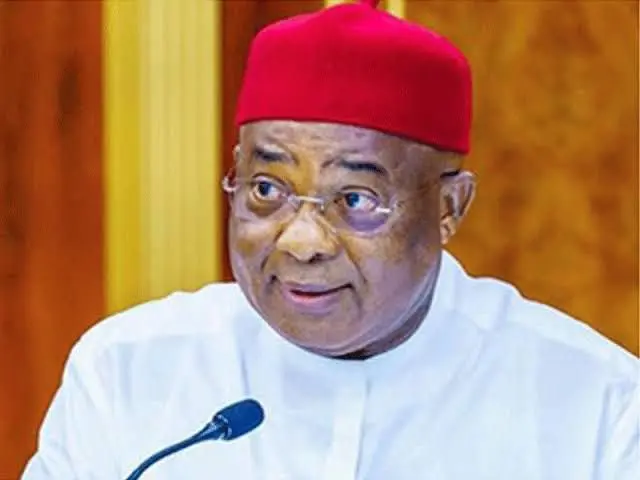
Hope Uzodimma and politics of survival, loyalty, legacy
By Ogechi Okoro
Nigeria’s politics has always rewarded resilience, calculation, and the ability to adapt. Few politicians in recent years embody those traits more clearly than Hope Uzodimma. The outcome of the APC primaries once again revealed a political reality many underestimated for too long: Governor Uzodimma has steadily evolved from a contested political figure into one of the most influential voices in the Southeast.
From the beginning, he was often dismissed by critics who doubted both his staying power and political appeal. Yet, time after time, he has managed to outmaneuver opponents and silence sceptics. His rise has not been accidental. It has been built on persistence, strategic discipline, and an ability to learn quickly from the demands of power.
When he first became governor, public speaking was hardly considered his strongest attribute. But politics rewards adaptation, and Uzodimma adapted. Over time, he developed the confidence and composure required to navigate national conversations and command attention in elite political circles. Today, he fits comfortably into virtually any political forum, speaking with the assurance of a man who understands both the language of governance and the realities of political survival.
Perhaps the biggest test of his career came during his re-election bid. Many predicted defeat. Many believed the political environment had turned against him. Yet he survived, and in doing so strengthened his position not only in Imo State but across the Southeast. Today, whether one agrees with his politics or not, it is difficult to deny that he has emerged as one of the region’s dominant political figures.
Now, with the APC primaries concluded, speculation naturally shifts toward the future. If Governor Uzodimma eventually makes his way to the Senate, few would expect him to remain an ordinary legislator for long. Nigerian politics has shown repeatedly that ambition gravitates toward influence, and influence gravitates toward leadership. It would not be surprising if he eventually positions himself for the highest office within the Senate hierarchy.
But power alone is never enough. The next stage of Uzodimma’s political journey should not merely be about political advancement; it should be about legacy. Nigerian politics is filled with powerful men who occupied high office but left behind little that could outlive them. The real challenge before the governor is whether he can build institutions, strengthen accountability, and create a political legacy that history will remember positively.
The Imo primaries also offered broader lessons about the nature of Nigerian politics. In today’s political climate, loyalty often triumphs over unchecked ambition. Discipline tends to prevail over recklessness. Duty frequently outweighs ego. Political outcomes are rarely spontaneous; they are usually the result of careful planning, alliances, and calculated execution.
The defeat of Rochas Okorocha serves as a reminder that political relevance is never permanent. Times change. Alliances shift. Yesterday’s political giant can quickly become tomorrow’s cautionary tale. That same reality applies to Governor Uzodinma himself. No politician remains undefeated forever, and no political dynasty lasts indefinitely.
That is why humility and accountability matter. The true test of leadership is not merely how power is acquired, but how it is exercised and eventually remembered. If Governor Uzodimma understands this moment correctly, he has an opportunity to shape not only his own future but also the political direction of the Southeast.
For now, however, the momentum is clearly with him.
Congratulations, Your Excellency.
- Dr. Ogechi Okoro reflects from Hamilton, New Zealand.


