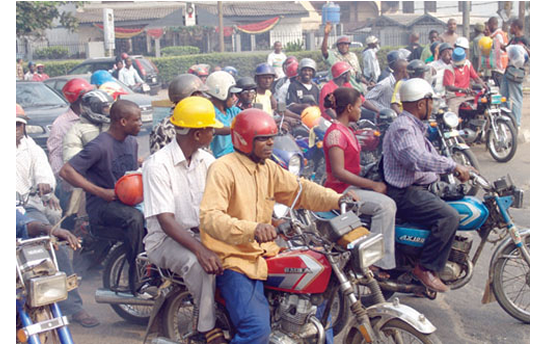
RULAAC calls on Lagos Assembly to hold public hearing on okada ban enforcement
The Rule of Law and Accountability Advocacy Centre (RULAAC) has called on the Lagos State House of Assembly to convene a public hearing on the state’s regulation of commercial motorcycles, popularly known as Okada, and the manner in which the restrictions are being enforced.
RULAAC, in a statement signed by Executive Director Okechukwu Nwanguma said the proposed hearing was necessary amid persistent controversies, allegations of abuse, violent confrontations and conflicting accounts involving enforcement agencies, commercial motorcycle operators and communities across the state.
The call came following renewed controversy over a recent Lagos State Taskforce operation at Agric Farm Estate in Ojo.
According to RULAAC, the Taskforce said the operation followed petitions from Community Development Associations and surveillance of motorcycle operators allegedly using communities as bases to access prohibited highways.
However, RULAAC said other accounts had questioned whether enforcement officers entered private premises or areas outside the routes covered by the restrictions to seize motorcycles.
RULAAC said it was not seeking to prejudge the competing claims surrounding the Agric Farm Estate incident, but argued that the controversy highlighted the need for an independent and transparent review of both the legal framework and its implementation.
The organisation said its field research on Okada enforcement in Lagos had documented allegations of indiscriminate seizure of motorcycles, enforcement on streets and in communities allegedly outside restricted areas, extortion for the release of impounded motorcycles, inconsistent enforcement hours and dangerous pursuits of fleeing riders.
It also cited allegations of injuries to riders and passengers, physical abuse and the use of civilians in enforcement operations.
At the same time, RULAAC acknowledged concerns raised by communities and security agencies over reckless riding, road obstruction, accidents, criminal activities allegedly involving motorcycles and resistance to lawful regulation.
The organisation noted that police authorities had also raised concerns that motorcycles were sometimes used in the commission of robbery and other crimes, while enforcement personnel had reportedly been attacked, injured or killed in the course of their duties.
“These competing concerns demonstrate why the issue should no longer be treated simply as a contest between enforcement agencies and Okada riders,” RULAAC said.
The group urged the House of Assembly to use a public hearing to determine whether the existing regulatory framework remains clear, effective and proportionate, and whether it can be enforced consistently without creating opportunities for corruption, arbitrary enforcement or violence.
RULAAC proposed that the hearing should bring together the Lagos State Government, Ministry of Transportation, Lagos State Taskforce, Lagos State Traffic Management Authority (LASTMA), the Lagos State Police Command, commercial motorcycle operators and their associations, Community Development Associations, transport unions, commuters, civil society organisations, human rights groups, road-safety experts, lawyers and academics.
Among the issues it wants examined are the geographical limits of the Okada restrictions, the procedures governing arrests and motorcycle seizures, allegations of corruption and extortion, the use of force during enforcement operations and accountability for alleged abuses by enforcement personnel.
The organisation also called for greater transparency over enforcement statistics, including the number of operations conducted, arrests and prosecutions made, motorcycles seized or forfeited, complaints against enforcement personnel and disciplinary or criminal proceedings involving officers.
RULAAC further urged the Assembly to examine the socioeconomic impact of the restrictions, particularly in communities where commercial motorcycles remain an important means of last-mile transportation and for families whose livelihoods depend on the sector.
It proposed alternative regulatory measures that could include registration and biometric identification of riders, rider databases, designated operating areas, stronger safety requirements, training and licensing, identifiable uniforms or identification numbers, and increased cooperation between communities, riders’ associations and enforcement agencies.
A major concern raised by RULAAC is what it described as a lack of comprehensive publicly accessible data for assessing the effectiveness of the Okada restrictions.
The organisation said Lagos residents should be able to determine whether years of enforcement have significantly reduced motorcycle-related accidents and crime, how many motorcycles have been seized or disposed of, how many offenders have been prosecuted and how many enforcement officers have faced disciplinary action over alleged misconduct.
“Public policy should be evaluated on evidence, not assumptions,” RULAAC said.
The group also called on the Assembly to clarify whether Lagos operates a total ban on commercial motorcycles or a restriction applicable only to specified areas, highways and bridges.
It argued that if the latter is the case, enforcement agencies must operate strictly within the legally defined limits. If the government considers a broader prohibition necessary, RULAAC said the policy should be openly debated and established through a clear legal framework.
The organisation stressed that its proposed public hearing should not be interpreted as opposition to road safety, security or public order.
Rather, it said the process would provide an opportunity to determine whether the current system is achieving its objectives while protecting the rights of residents.
RULAAC also maintained that accountability should apply to both riders and enforcement personnel, stressing that allegations of enforcement abuse should not justify attacks on police officers, Taskforce personnel or public property.
“The objective should be neither to demonise Okada riders nor to undermine enforcement agencies,” the organisation said. “It should be to develop a clearer, safer, more transparent and accountable regulatory system that protects public safety while ensuring that enforcement remains firmly within the law.”
RULAAC said the recent Agric Farm Estate controversy should serve as an opportunity for institutional reflection rather than another round of accusations between the parties.
It urged the Lagos State House of Assembly to exercise its legislative and oversight responsibilities by convening a comprehensive public hearing, arguing that the state could enforce its laws while preserving due process, accountability and respect for human rights.