By Jeph Ajobaju, Chief Copy Editor
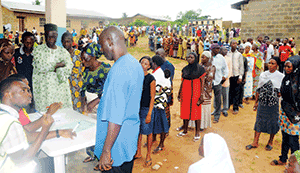
Voters turned out in huge numbers in the presidential and National Assembly (NASS) ballot in the Ojodu area of Lagos, with long but peaceful queues as everyone was determined to cast their vote.
In some places, people starting queuing an hour before the official voting time of 8am. Trickles extended into long lines.
The Independent National Electoral Commission (INEC) says it will extend voting beyond 2pm for all those on a queue to cast their ballot.
Ojodu residents volunteered canopies and chairs for both INEC officials and voters who mass up from the neighbourhood.
Some who relocated to other parts of Lagos after they had registered to vote returned with their Permanent Voter Card (PVC) to cast their ballot.
Among them were Tony Okoro and his wife, Nelly, who came back to vote at a polling unit on Moses Adebayo Street where they registered before they relocated in November 2011.
At polling units, voters’ lists were pasted on walls showing someone’s name, picture, voter identification number (VIN), year of birth, occupation, and polling unit.
People checked the list first, and after seeing their name, join the queue to vote.
However, some voters across Lagos complained on Channels Television that, even with their PVC in hand, they could not cast their ballot because of two main reasons:
- The computer in the polling unit showed their correct personal details but their name was missing on the voters’ list on display.
- Their name was not on the voters’ list and computer database at the polling unit where they registered.
Some found their name in another polling unit and eventually voted. But some did not find theirs at any other unit.
TheNiche interviewed 12 voters all the way from around Adebowale bus stop near Saabo Junction to Grammar School bus stop on Isheri Road. Some had voted, others were on their way to vote.
Of the interviewees, seven were men and three women.
Ten of them said they voted or would vote Atiku Abubakar, presidential candidate of the People’s Democratic Party (PDP); one said he would vote Omoyele Sowore, one Kingsley Moghalu.
Sowore is the presidential candidate of the African Action Congress (AAC), Moghalu is that of the Youth Progress Party (YPP).
None of the 12 people TheNiche interviewed said he or she voted or would vote Muhammadu Buhari of the All Progressives Congress (APC).
Among the men are Tony, Andrew Oki, and Moses Ezeigbo. The three women are Nelly, Favour Chukwuka, and Anita Osakwe.
Reasons they voted Atiku
Both Tony and Nelly said they voted Atiku because they want change.
The man who supports Sowore said he chose him because only the young people like Sowore can take Nigeria forward.
“I know that Sowore does not stand a chance to win [because he is not in a major party] but I just want to make my point,” he explained.
His friend said he supports Moghalu for the same reason, despite realising that he is campaigning on the platform of a minor party.
One man explained that he would vote Atiku because he wants change for at least four years, and if Atiku fails to deliver, he too would be voted out in 2023.
Another man said he would pick Atiku because he too wants change and, even if Buhari and his people rig the election “I would have satisfied my conscience.”
Oki
“I am on my way to the polling unit to vote for Atiku because Buhari has failed to fulfil his promises. He promised to fight corruption, but where is the money he recovered from those who stole public funds?”
Chukwuka
“I am going to vote for Atiku because I want change. If he fails to live up to expectation, we can vote him out in 2023.
”I will vote for Atiku and wait and pray. I would have done my own part, even
if they rig the election for Buhari.”
Osakwe
“Buhari’s wife, Aisha, said we should vote for wealth. Just as she advised, I will vote for Atiku because he promises to create wealth.”
Ezeigbo
“I am going up to vote for Atiku because I want change. He may be tainted with corruption but Peter Obi [Atiku’s running mate] is there with him and can help make things right.
“I am a pastor. I told my church members to go and collect their PVC and vote. I did not tell them who to vote for but I myself will vote for Atiku.”
The huge turnout is partly due to advocacy by Churches that have been urging their members for three years to register to vote, collect their PVC, and make sure they vote.
Allegations of rigging plot by APC, PDP
However, the two major parties, the PDP and the APC, accuse each other of plotting to rig the ballot, regardless of huge voter turnout for or against their main man.
Collation (form EC8D), result (form EC8E) sheets, and other election materials are being hoarded by the INEC in states considered strongholds of Atiku, the PDP alleged on February 22.
Certain INEC officials, the PDP alleged, are working with agents of the APC to withhold the materials to facilitate fictitious results for Buhari and APC National Assembly candidates.
The party said, 24 hours to the vote, collation forms and result sheets had not been received for senatorial election in Abia, and result sheets for all elections had not been received in Delta and other states.
Kola Ologbondiyan, PDP National Publicity Secretary and Director, Media & Publicity PDP Presidential Campaign Organisation alleged that, for instance, in Kano State
- Only 105 Senate result sheets had been received in Garko Council instead of 144.
- Rogo Council received 106 Senate result sheets instead of 141.
- Danbatta Council received 28 cartons of House of Representatives ballot papers instead of 29.
- Tofa Council received 18 cartons instead of 19.
“This scenario is playing out in many other states,” the PDP alleged.
It urged INEC Chairman, Mahmood Yakubu, to immediately release the materials to their designated points, and pledged not to allow anybody to use any means to rig it out in these elections.
On February 15, the APC alleged that the PDP is inducing major stakeholders with money because it fears it will lose the election.
APC National Publicity Secretary, Lanre Issa-Onilu, said the PDP “resolved to monetarily induce major actors and institutions in the electoral process with a view to compromising them ahead of the elections.”
He alleged that the PDP planned to distribute between $5 and $10 million to states for “logistics and mobilisation” and to target INEC officials, security agencies, and observers to buy them into its rigging plot.
In February alone, INEC offices in Plateau, Abia, and Anambra States were destroyed by fire, burning up voting materials.
The PDP countered by accusing the APC of carrying out these incidents in order to disenfranchise voters in states likely voting Atiku.
It accused the APC of planning to use the INEC and the security agencies to rig the election in favour of Buhari.
The PDP plans to establish election collation centres, saying it does not trust the INEC to produce credible vote figures.