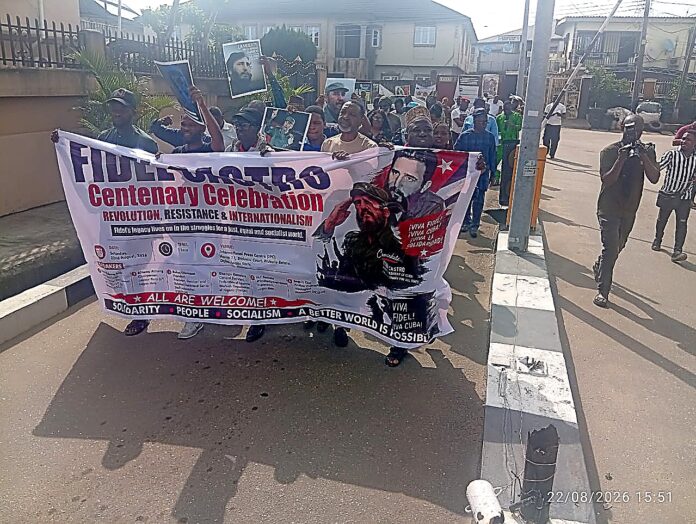
The U.S. objective goes beyond Cuba itself. It is not just about defeating Cuba. It is about defeating socialism. And that is the plan of the West, and they must not be allowed to get through – Falana
By Ishaya Ibrahim
Human rights lawyer and Senior Advocate of Nigeria, Femi Falana, on Saturday joined other socialist activists to condemn the United States’ economic blockade of Cuba, which they described as an attempt to strangle the socialist government which provides free healthcare and education to its over 10.9 million people and replace it with a capitalist oligarchy.
Cuba has faced more than 60 years of U.S. economic blockade that has cost the economy over $150 billion in losses. The blockade worsened in January 2026 after the U.S. President Donald Trump’s administration tightened restrictions on shipments of fuel, food and medicine to the country, causing electricity shortages.
The Cuban Ambassador to Nigeria, Mrs. Miriam Morales Palmero said Cuba is faced with an attempt by the United States to collapse the country through a tightened blockade.
Speaking at the event in Lagos on Saturday, Palmero said the celebration was more than a tribute.
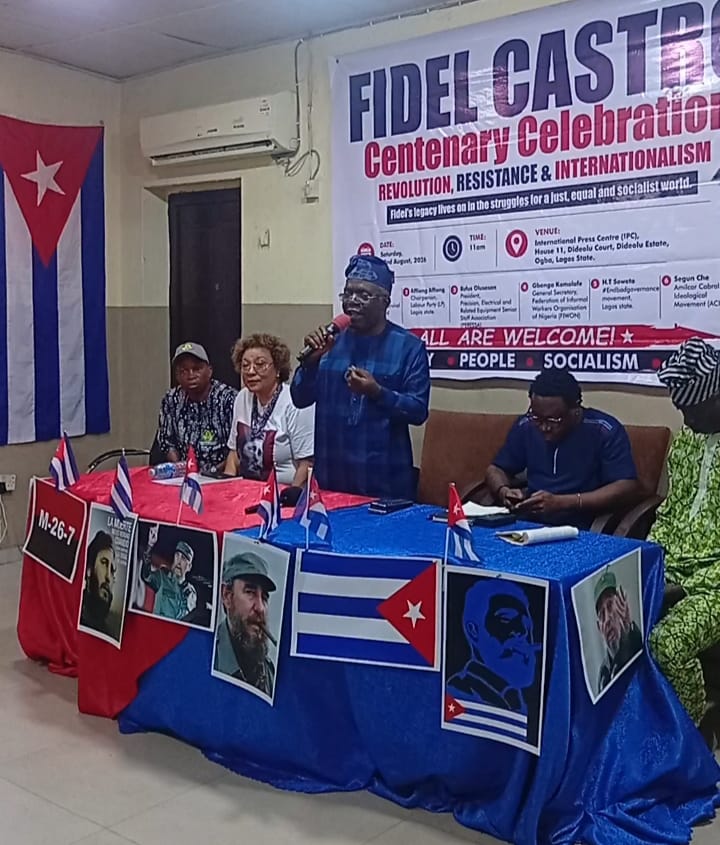
“A few men and women are born whose work and legacy become permanently cemented in world history. One such figure is without any doubt our Commander-in-Chief Fidel Castro, whose centenary is being honoured by all Cubans and revolutionaries across the globe,” she said.
She said the centenary, which has run from August 2025 till date, “is not merely a tribute to his immense legacy. It is also a call to recite his ideals in a world defined by crisis and confrontation.”
Palmero accused the administration of U.S. President Donald Trump and Secretary of State Marco Rubio of devising “a criminal plan to suffocate an entire people and fabricate pretense to justify a military intervention in Cuba.”
She said the executive orders of January 29 and May 1, 2026 had triggered a humanitarian crisis.
“If they approve the full blockade, they condemn my people. If you cut more than 60% of the fuel the country needs, and they don’t receive any fuel in more than 200 days, six months till now, since January now, they want to make a collapse,” she said.
The ambassador listed the impact of the blockade on healthcare, saying: “Mortality rates from 4.0 to 9.9 represent the death of over 18,000 children so far this year. Last week, 27 children died… 25 infants under the age of one died due to lack of electricity and medicine.”
She added that life expectancy for children with cancer had dropped from 85% to 65%, and that over 10,000 patients, including more than 12,000 children and 5,152 cancer patients, were waiting for surgery because hospitals lacked power to operate.
“In the majority of cases, our doctors finalize the surgery by the light of the phone,” she said.
Palmero said Washington was also blocking renewable energy options and humanitarian aid, including 3.5 million syringes and needles held in Jamaica after French shipping company CMA CGM refused to transport containers to Cuba.
She renewed Cuba’s call for “the total, unconditional and immediate lifting of the economic, commercial and financial blockade” and for Cuba’s removal from the U.S. list of State Sponsors of Terrorism.
The envoy thanked the Nigerian government and the Nigerian-Cuban solidarity movement for their support at the United Nations General Assembly and the African Union.
“We wish to express on behalf of my government and the Cuban people, our thanks to the government of Nigeria because they accompany us at the multilateral level,” she said, adding that “Fidel as a centenary is no ordinary celebration.”
Senior Advocate of Nigeria, Femi Falana, said Cuba’s survival despite the U.S. blockade is proof that a society organized around people can solve problems that Nigeria has failed to solve.
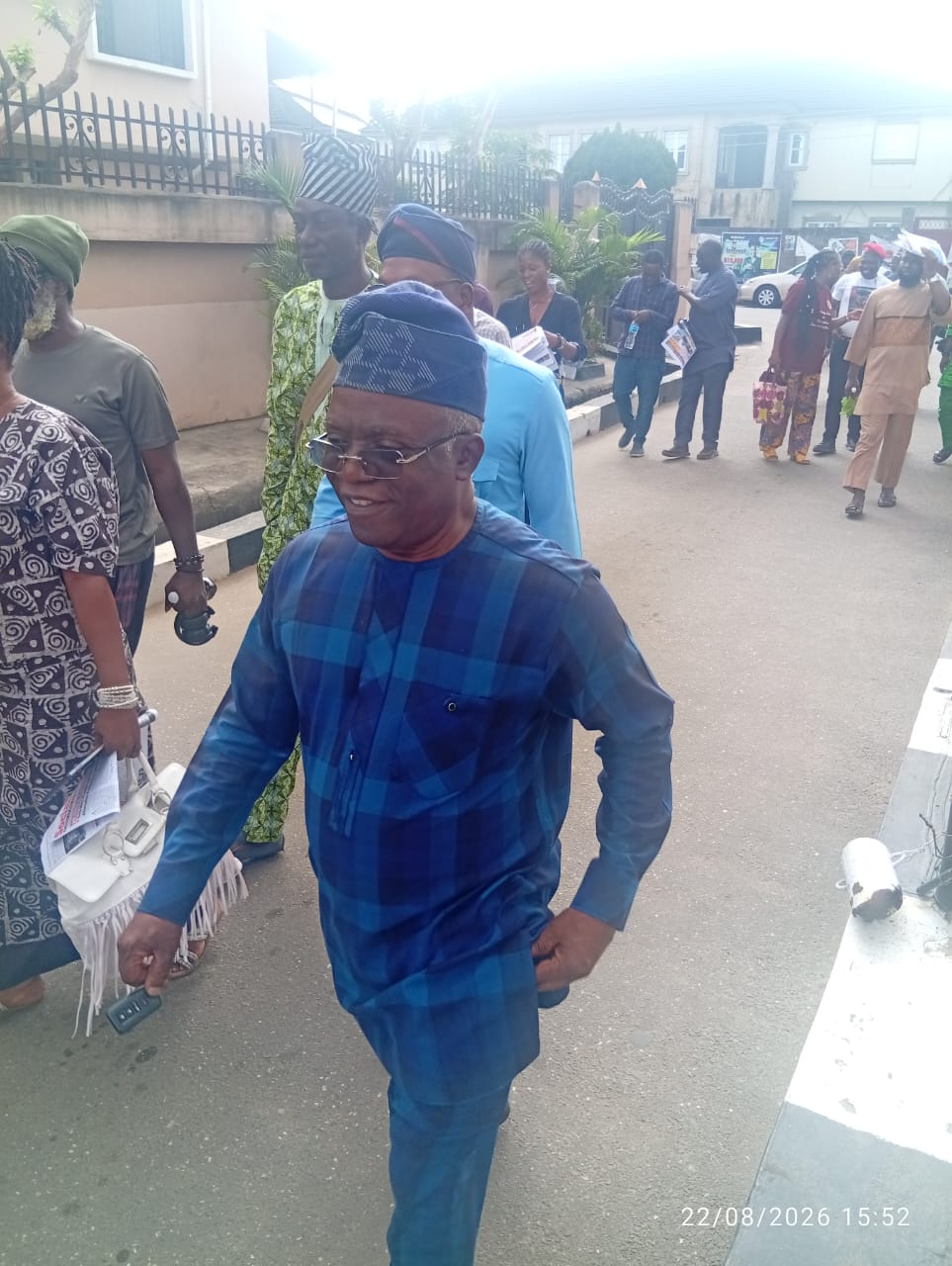
Falana, who said he last visited Cuba in 2021, drew parallels between the U.S. hostility to Cuba and U.S. interventions in Africa and the Middle East.
“What Comrade spoke about (invasion of Cuba) was actually under President Kennedy. How many of you are aware that some of these guys are criminals? Obama for instance, Obama and Hillary Clinton that coordinated the invasion of Libya. So we must all know when the rain began to beat us,” he said.
He contrasted Nigeria’s approach to malaria with Cuba’s, which he said abolished the disease in 1967.
“I met somebody yesterday, those who are controlling diseases in Nigeria. I said, ‘Gentleman, you guys are still controlling malaria, why don’t we abolish it?’ He said, ‘Well, it’s difficult now.’ Cuba abolished malaria fever in 1967,” Falana said.
“It’s not about building mosquito nets. Because the West tells Nigeria, ‘Take a loan and build mosquito nets.’ How many homes can mosquito nets cover? But Cuban people have developed a type of vaccine.
“If you land in Cuba today, you are tested at the airport and if you have malaria, you are going to be quarantined. They won’t allow you to take it to town. So that is a society where people are organized,” he added.
Falana described Cuba as a country that prioritizes its people over luxury, noting that during his 2021 visit, the only SUVs he saw were driven by ambassadors.
“In fact, Cuba still has the 1950 Pontiacs as taxis. The U.S. has tried to buy off those vehicles, and they said, ‘No, we want to retain them.’ So it’s a country that addresses problems of the people,” he said.
He said the U.S. objective goes beyond Cuba itself. “It’s not just about defeating Cuba. It’s about defeating socialism. And that is the plan of the West, and they must not be allowed to get through,” Falana said.
“Airlines no longer going there. Ships can’t go to Cuba. But the people are ready to suffer to defend their revolution.”
Linking the Cuba solidarity to Nigeria’s own crises, Falana said Nigeria should learn from Cuba’s 1961 literacy campaign, when the country shut down schools for one year and sent students to rural areas to teach, defeating illiteracy in one year.
He said Nigeria is facing a national tragedy of out-of-school children. “In Lagos State, over five hundred thousand children are out of school. It’s not a local problem; it’s a national tragedy that a country of immense resources has about twenty million children who are out of school,” he said.
“We have suggested that Youth Corps members be deployed to combat illiteracy in our country, but they don’t want our people educated. They want them to remain illiterate.”
Falana said at the state level, about N250 billion meant for Universal Basic Education Commission (UBEC) has not been accessed because state governments have refused to pay counterpart funds.
“It’s not a priority for them. What are their priorities? Going to states where there are elections to buy votes… Look at what happened recently. You are told by somebody that they spent fifty billion. Another person says one hundred and ten billion. Another one says forty billion. What it all means is that billions of naira that could have been deployed to improve the lives of the people were wasted on the day of the election.”
Also speaking at the event, one of the coordinators of the #EndBadGovernance Movement, Lagos chapter, Comrade Hassan Soweto, said the current suffering in Cuba is a deliberate attempt by U.S. imperialism to destroy the entire legacy of the Cuban revolution.
Soweto traced the hostility to the 1959 revolution which transformed Cuba from a U.S. playground for prostitution and casinos into a socialist state.
“We are worried about the suffering going on in Cuba right now because of the decision of U.S. imperialism to snuff out the Cuba revolution. This is not just an attack. It is an effort to destroy the entirety of the legacy of the Cuba revolution,” he said.
He recalled that after the revolution led by Fidel Castro and Che Guevara nationalized multinational firms, the U.S. launched the Bay of Pigs invasion to wipe out the revolution.
“The revolution of 1959 was what changed that, economically, politically and socially. And the fear of how far that revolution could go, the example of socialism it could present on the shores of the United States, was what created the U.S. imperialist hostility,” Soweto said.
He noted that after the failure of the invasion, where Cuban forces defeated the U.S.-backed forces in 72 hours, the U.S. carried out more than 600 assassination attempts against Fidel Castro.
Despite decades of military and economic blockade, Soweto said Cuba was able to build a model that Nigeria has failed to achieve:
“For every Cuban person, education is free. Healthcare in Cuba is not like what we have in Nigeria where you go to the hospital to wait for your doctors. Doctors go from street to street to visit the people. That is the kind of public healthcare that the Cuban revolution established.”
He warned that the gains are now being reversed. “Today, because of the embargo, because of the attempt by U.S. imperialism to snuff out that revolution, all of this is now in reverse. Now you have cases of malnutrition in Cuba. Prostitution, which had been abolished, has now resurrected. Any society where prostitution resurrects is a sign of complete social decay and crisis,” he said.
Soweto said Nigerian workers have a duty to defend Cuba, both out of gratitude for Cuba’s role in fighting apartheid in Africa, and out of self-interest.
“What we have to say in this room today is that the Nigerian working people, the Nigerian youth, and the Nigerian oppressed people, will not stand by and allow the Cuban revolution to be destroyed,” he declared.
“In standing with Cuba, we are saying that in Nigeria, we have a right to overthrow oppression and no country can come to attack us because of that. That is what sovereignty means – the right and the power to determine your own destiny.”
He called for a concrete solidarity campaign including a nationwide hands-off Cuba campaign to be taken to campuses and communities to educate young Nigerians on Cuba’s history; a day of action across Africa, involving protests and “occupation of the U.S. Embassy to send a clear message to Donald Trump that if there is any attack on Cuba, the Cuban people will not be alone and a one-day solidarity strike by labour.
He said: “Labour has the power. It is labour that controls the ports. It controls production and distribution. The NLC and TUC need to go beyond diplomatic solidarity. If there is a one-day strike in Nigeria for Cuba, it will be one of the ways of restoring the traditional spirit of international solidarity that used to be part of the labour movement.”
Lagos State Chairperson of the Labour Party, Comrade Affiong Affiong, said Nigerians must move from analysis to action against neo-colonialism.
“We’ve heard the history, we’ve heard the politics, we’ve heard the analysis. But how are we going to do this? We describe these neo-colonialists in government, in power, all over us, as criminals. Of course they are criminals. So what are we going to do about them?” she said.
Affiong said the ruling class will not reform itself, so the people must look inwards.
“Who will bell the cat? Who will lead the revolution? Who will start it? Where am I in the picture of struggle? Where am I in the making of the revolution? It’s not enough for us to come out, be educated, be informed, maybe be entertained. The question is, what is to be done?”
Other speakers at the event include the National President of the Precision, Electrical and Related Equipment Senior Staff Association (PERESSA), Comrade Rufus Olusesan, human rights lawyer Malachy Ugwummadu and socialist activist Comrade AJ Dagatola.