Communities, activists reject Lagos water metering system
By Ishaya Ibrahim
Residents of Baruwa in the Alimosho area of Lagos State struggle daily to access safe water for drinking and cooking. Their natural water sources have been contaminated by petrol leaking from buried pipelines that transport fuel from the Mosinmi Oil Depot to the Ejigbo Oil Facility. This has forced residents to seek alternative sources of water for their daily needs.
The government connected the communities to the state’s water grid but installed prepaid meters on their taps. This means residents must pay before they can access water. Yet, payment does not guarantee a steady supply. Water is pumped only three times a week. On days when there is no electricity, residents get no water. If there’s a problem recharging meters, it also cuts off supply.
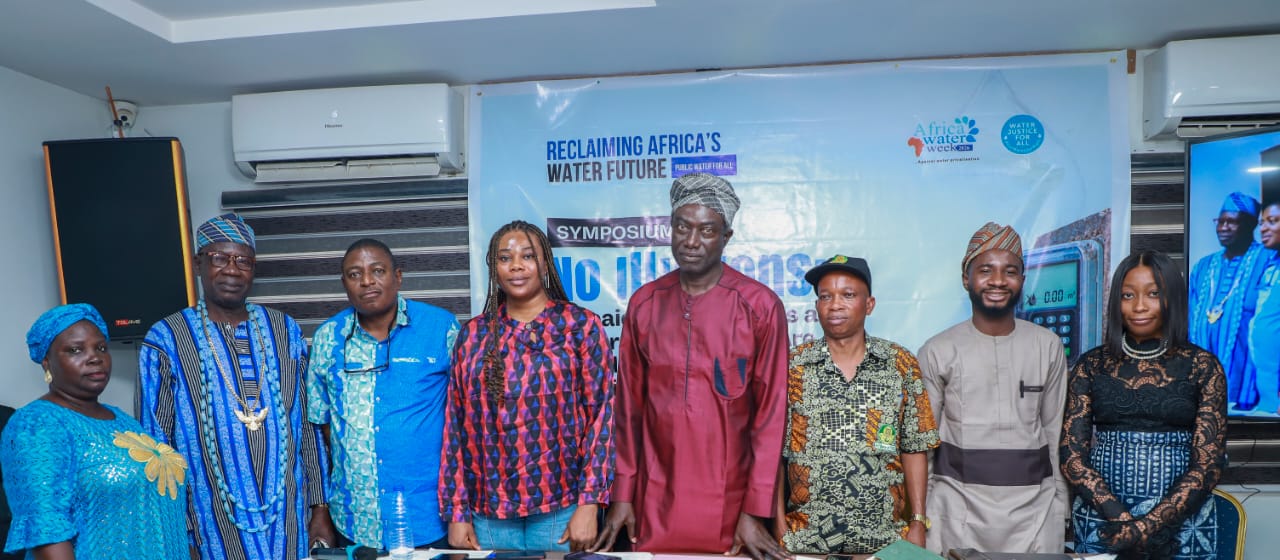
At a symposium hosted by the Corporate Accountability and Public Participation Africa (CAPPA) as part of the 2026 Africa Week of Action Against Water Privatisation, community representatives, activists and others rejected the Lagos State’s government water metering projects which it already started piloting in Baruwa, Akilo and others.
A fiery activist Dagga Tolar insisted on a publicly funded water system that guarantees access to clean water, rather than one that requires residents to pay before accessing the essential resource.
Tolar argued that prepaid metering would not resolve Lagos’ water crisis, accusing the government of neglecting public water infrastructure while pursuing a model that could make access dependent on residents’ ability to pay.
“This water scheme process, its aim at shutting people out from public water, aims to deny them access to one of their fundamental human rights to freely access water to meet all of their human needs,” he said.
He called on the state government to rehabilitate existing waterworks, expand mini waterworks and develop a comprehensive public water supply programme to guarantee access across Lagos.
“We must reject this current plan,” he said, urging the government to develop a Lagos water for all plan of action rather than rely on privatisation and prepaid meters.
Drawing parallels with the electricity sector, Tolar questioned whether the metering model would deliver improved services, arguing that privatisation had failed to guarantee reliable electricity supply.
He also urged residents, activists and trade unions to organise against the scheme and make access to water a central public issue.
“The state and society we live in has the fundamental duty to ensure that it provides not just access to water, but free, healthy, clean water,” he said.
Executive Director of Corporate Accountability and Public Participation Africa (CAPPA), Akinbode Oluwafemi, said prepaid water metering and privatisation could deepen inequalities by making access to water dependent on residents’ ability to pay.
“When a meter cuts off supply because credit has expired, it cannot distinguish between leaking pipes or a family waiting for daily wages. It cannot account for unemployment, illness or an emergency. It simply enforces exclusion,” Oluwafemi said.
Oluwafemi also raised concerns about the proposed water concessions, including reported plans for 20-year agreements and tariffs that reflect costs, with periodic reviews and foreign exchange protections for investors.
He said residents should be allowed to scrutinise the agreements and understand how the terms could affect their water bills and the state’s finances.
“Residents are entitled to see the agreements and know whose interests they protect,” he said.
CAPPA Assistant Executive Director Zikora Ibeh said Lagos State’s water privatisation drive had weakened public water services, citing the dismissal of more than 800 Lagos Water Corporation workers.
She criticised prepaid meters for ignoring families’ economic circumstances. She warned that water access must not be determined by people’s ability to pay.
National President of the Precision, Electrical and Related Equipment Senior Staff Association (PERESSA), Rufus Olusesan, called on organised labour and communities to resist water privatisation, warning that it could increase tariffs, exclude low income households and threaten workers’ jobs and pensions.
“Water is public. Water is life. And life is not for sale,” he said, urging governments to prioritise public investment, democratic accountability and affordable access to water.
Other speakers at the event include Water Campaign Officer at CAPPA, Holiness Segun Olufemi, Founder and Executive Director of Sustainable Futures Development Initiatives Favour John, among others.