



By Emeka Alex Duru
Not a few analysts are surprised at the uncertain dimensions of the Muhammadu Buhari presidency, more than two years after its inauguration. If anything, rather, the rancour and in-fighting within and among the various arms of the administration, lend credence to initial fears by critics on the government not being adequately prepared for the huge task of repositioning the country.
Signs of the prevailing uncertainties began to manifest early in the life of the administration. In fact, while the All Progressives Congress (APC) coasted home to victory in the March 28 national and April 11/25, 2015 state elections, perceptive analysts had celebrated the feat with a great deal of caution.
Ordinarily, the party’s outing at the polls, had called for rolling out drums in excitement.
For APC, which had come on board, barely a year before the election to rout the Peoples Democratic Party (PDP) that had been in the saddle since the onset of the present democratic dispensation in 1999, there was much to celebrate.
It was also the first time, in the nation’s history that a party in opposition was taking power from a ruling party.
On account of these considerable historical landmarks, APC leaders had reasons to prance about. And they actually did.
But even as they enthused on their courageous outing, concerned analysts had nursed a hunch on the post-election management of the party’s electoral fortunes.
The major concern was that some of the elements that constituted the nucleus of the party, did not have credible antecedents of election victory management.
This, particularly, appeared the greatest undoing of the Alliance for Democracy (AD), that over time, evolved to Action Congress (AC), later Action Congress of Nigeria (ACN) that played major role in the evolution of APC.
Back in the early days of the current dispensation, AD, had virtually ran over the politics of the South West on the mantra of progressive ideology, a claim that critics had actually doubted.
But rather than proving its mettle, the leadership of the party got alienated from the electorate, with the result that by 2003, the party had lost out to the rampaging PDP, retaining only Lagos out of six states that were originally in its column.
Imposition of candidates and absence of internal democracy, were identified as the factors that primarily worked against the party.
But by 2011, the party had through transformation, metamorphosed into ACN that served as the vehicle for it to regain some lost grounds. The renewed fervor and accompanying good will, also provided the artery for the formation of APC.
Cashing in on the rulership deficit of the PDP, APC easily chanted ‘change’ as its slogan. That, readily fell into the expectations of Nigerians.
Yet there were fears of its leadership being carried away by the allure of victory.
Things fall apart
Signs of chieftains of the APC working at cross purposes began to manifest shortly after the inauguration of the National Assembly, when the leadership, in a manner that was not elaborately explained to some members, had settled for Ahmed Lawan and George Akume for senate leadership, while Femi Gbajabiamila and Ali Monguno were anointed for the House of Representatives leadership.
The decision did not go down well with the Bukola Saraki group in the Senate nor the Yakubu Dogara elements in the House. The aggrieved elements who clearly had been schemed out of APC consideration, went into alliance with their PDP colleagues, thus giving rise to Saraki/Ike Ekeremadu victory in the Senate and Dogara emergence in the House.
Ever since the cross-fire, the legislature has literarily been in a battle of wits with the executive and APC leadership.
Enter Magu confirmation controversy
But at no time was the frosty relationship between NASS and the presidency been more pronounced as on the non-confirmation of the Acting Chairman of the Economic and Financial Crimes Commission (EFCC), Ibrahim Magu.
Twice, President Buhari had forwarded the name of Magu, who has been functioning in acting capacity to the senate for confirmation. But on each occasion, the lawmakers had turned him down, explaining their action on a report from the Department of State Security (DSS), that had pronounced Magu lacking in integrity required to head the organisation.
The 14-paragraph confidential report said that Magu failed the integrity test and that if confirmed, he could eventually constitute a liability to the anti-corruption drive of the administration.
The report, among others alleged that Magu was occupying a N20 million per year accommodation, allegedly rented for him by someone under EFCC investigation; lived a flamboyant lifestyle and flouted the President’s order against public officers flying first class when he went on pilgrimage.
Magu however put a lie to the DSS report, insisting that none of his actions nor lifestyle had portrayed him as lacking in integrity. He further threw the allegation of integrity deficiency back on the DSS.
Buhari in charge?
While supporters of the president blamed the lawmakers for non-confirmation of Magu, questions of whether he was actually in charge of developments in the administration, arose.
The poser gained currency on ground that both the DSS Director-General and EFCC chairman were appointees of the President. Both report directly to him. One of the agencies writing a damning report on the headship of the other, thus, readily became an issue that critics flaunted as indicative of an administration in disarray.
“That was a clear case of a divided house. It showed an administration lacking in harmony. How could the DSS Director-General who was appointed by the President, allow a damning report on a nominee from the same man that appointed him? Was it not akin to an employee waging war against his employer? Was it that the President, even with his famed military background, did not run the necessary checks on Magu before nominating him for the job?”, asked a Senior Lecturer in Department of History and International Relations, Lagos State University, Ojo.
“Alli must go campaign” kicks off
The heat generated by the Magu confirmation controversy was yet to die down when another face-off involving the senate and executive arm of the government broke out. At the centre of the running battle, was the Comptroller-General of Customs, Colonel Hameed Alli, over appearing on Customs uniform in answering to summons from the lawmakers.
The senators had invited Alli to appear before it to explain a controversial directive by the Customs on vehicle owners in the country to report to designated points to verify payment of customs duties on their vehicles, or do so, within a specific period to avoid the vehicles being impounded by operatives of the agency.
While the customs rolled out the directive, Nigerians rose in anger, especially over the retroactive dimension of its implementation. In a bid to get to the root of the matter, the lawmakers directed Alli to suspend the directive and appear before them to explain the rationale behind the action. It was in the process that the senators insisted that the Customs CG must appear before them in uniform.
Alli however scoffed at the directive, arguing that having served in the military, he found no need putting on customs uniform on retirement.
Bent on his position, the CG honoured the senate invitation but failing to appear on uniform, the lawmakers walked him out. An order on him to make a repeat appearance before the lawmakers, was not kept. The CG explained his action on advice from the Attorney-General and Minister for Justice. The lawmakers however would not accept the explanation but went ahead to ask him to resign. Alli did not, has not and may not.
Kachikwu, Baru enter the ring
What appeared a momentary reprieve for the rancorous presidency, was however shattered early in October, when the Minister of State (Petroleum), Ibe Kachikwu and the Group Managing Director, Nigerian National Petroleum Corporation (NNPC), Maikanti Baru, engaged one another in a battle of supremacy.
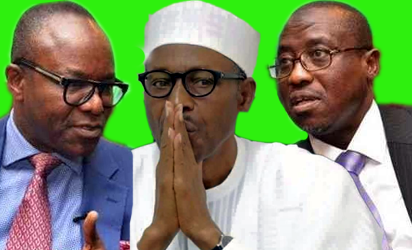
In a leaked memo to the President, the minister accused the NNPC boss of labelling him as corrupt, anti-north, and also being in collusion with militants, in order to convince the president on the need to sideline him in the decision-making process in the organisation.
He also alleged that Baru awarded about $24 billion major contracts without his input or review by the NNPC board.
The minister added that he wrote the letter to the president after concerted efforts to have a one-on-one appointment with him at the State House failed. He made an allusion of the president giving endorsement to the actions of the GMD.
But in his reply, Baru denied the allegations by the minister, adding that the NNPC board chaired by him ( Kachikwu) had no powers to regulate or approve contracts awarded by the corporation.
He accused the minister of bandying “humongous” contract figures to incite the public, and described the allegations of award of contracts without regard to due process as “unfounded and unfortunate”.
That no move has been made to investigate these allegations and proper actions taken, more than one month after, adds to the insinuation of lethargy on the presidency by Nigerians.
Maina’s reinstatement and matters arising
But what currently seem to lay bare the disharmony in the presidency are issues arising from the controversial reinstatement of the former chairman of the Presidential Task Force on Pension Reforms, Abdulrasheed Maina, by officials of the administration.
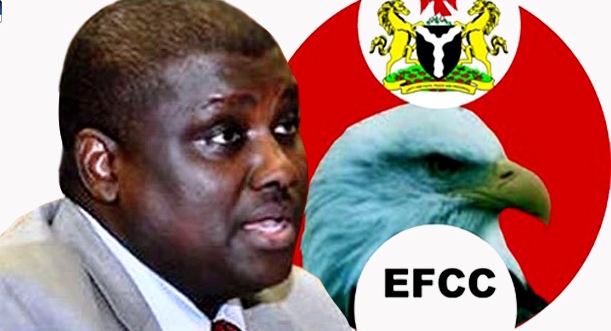
Perhaps, more than any other development in recent time, the Maina episode has exposed the Buhari anti-corruption agenda to ridicule. Maina, a fugitive, who ran away from the country because he was indicted for dipping hands into the pension reform funds, was smuggled back by senior officials of the government, paid salary arrears and reabsorbed into the civil service with double promotion.
When the matter blew up late in October, the Head of Service, Winifred Oyo-Ita, Minister for Interior, Abdulrahman Dambazzau and Attorney General of the Federation, Abubakar Malami, were accused of collusion, prompting the president to direct a query to the HoS on the circumstances behind Maina’s return.
Curiously, Oyo-Ita, in her response, indicated that Buhari was in the know of Maina’s return and that she warned him of the consequences. Since the letter, nothing has been heard from the presidency on the Buhari angle to the impasse.
What rather played out on Wednesday, November 1, 2017 and the Federal Executive Council (FEC) meeting was an altercation between Oyo-Ita and Buhari’s Chief of Staff, Abba Kyari, apparently on the office or person responsible for leaking the HoS’ response to the press.
The opposition PDP has described the unfolding developments as huge shame to the nation. Critics of the government are in agreement with the view, adding that the latest episode has added in widening the uncertain dimensions of the Buhari presidency.


