



By Jeph Ajobaju, Chief Copy Editor
Aso Rock has asked the Senate to approve plans to raise N2,343,387,942,848 from multilateral and bilateral lenders and the international capital market (ICM) through issuance of Eurobonds to finance the deficit in the 2021 budget.
The amount is equivalent to $6,183,081,643.40 at the budget exchange rate of $1/N379 and captured as new external borrowing in the 2021 Appropriation Act meant to part-fund the N5.602 trillion deficit.
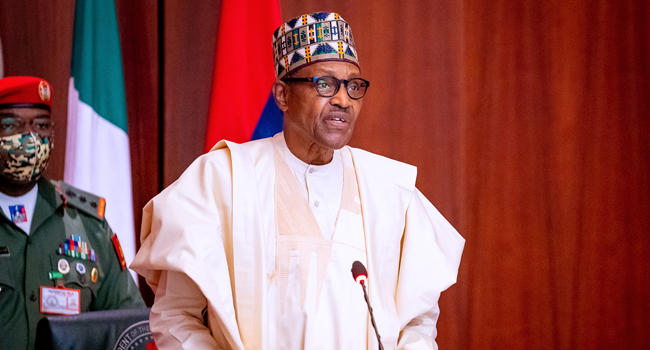
A letter on the request that President Muhammadu Buhari wrote to lawmakers was read out at plenary by Senate President Ahmad Lawan.
Buhari said he made the request in line with Sections 21(1) and 27(1) of the Debt Management Office (Establishment) Act, saying $3 billion or more may be raised in a combination of tenors between five and 30 years.
He explained that the decision to raise the loan from the ICM was due to the recent monetary policy that provides for very low interest rates and ease of moderating debt service cost.
Loan utilisation
He said the $6.183 billion (N2.343 trillion) loan would be used to fund specific capital projects in priority sectors of the economy.
The sectors include Power, Transportation, Agriculture and Rural Development, Education, Health, Provision of Counterpart Funding for Multilateral and Bilateral projects, Defence, and Water Resources.
Section 21(1) of the DMO says, “no external loan shall be approved or obtained by the Minister unless its terms and conditions shall have been laid before the National Assembly and approved by its Resolution.”
Section 27(1) adds that “the National Assembly may by a resolution approve, from time to time, standard terms and conditions for the negotiation and acceptance of external loans and issuance of guarantees”.
External borrowing
In the letter, Buhari reminded the Senate that the 2021 Appropriation Act provides for N4,686,775,885,696.00 as new external borrowings to part-finance the deficit, of which 50 per cent or N2,343,387,942,848.00 ($6,183,081,643.40 at the budget exchange rate of $1.00/N379) is specified as new external borrowing.
He also stressed that the allocation of N2.343 trillion to new external borrowing is consistent with the Nigeria’s Debt Management Strategy, which seeks, among other objectives, to moderate debt service costs by accessing relatively cheaper external funds, and to free-up space in the domestic market for other borrowers.
“From recent bends in the ICM, it is now possible for Nigeria to raise funds in the ICM and this explains why we are proposing that the New External Borrowing in the 2021 Appropriation Act should include issuing Eurobonds in the ICM.
“We estimate that Nigeria may be able to raise $3 billion or more, but not more than $6.183 billion (the amount provided in the 2021 Appropriation Act) in a combination of tenors between 5 and 30 years; the outcome would, however, be determined when Nigeria approaches the market.
Buhari said not only is the ICM now open to issuers like Nigeria and interest rate lower than the levels in 2020, given the recent monetary policy stance, as well as rising levels of inflation, the level of liquidity in the domestic market has decreased while domestic interest rates are beginning to rise.
“Therefore, accessing the ICM will be relatively cheaper thereby moderating debt service cost, and it will also contribute to the level of external reserves.”


