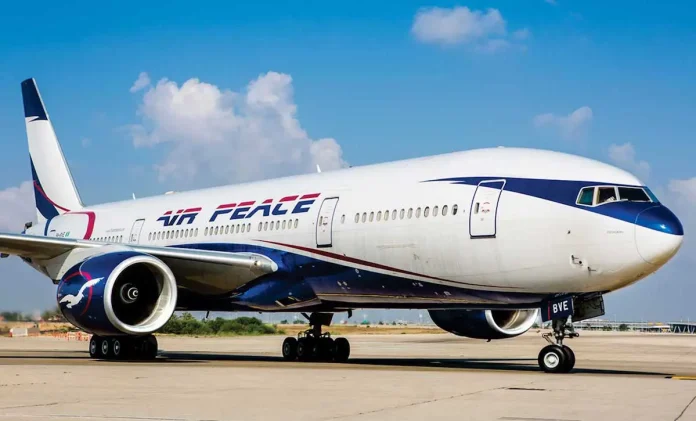
The targeted violent disruption of Air Peace operations by the unions may have disappeared from public consciousness, but the consequences remain. Air Peace has put its losses at about N2 billion. Passengers were stranded and flights disrupted. The Ministry of Aviation and Aerospace Development and the Nigeria Civil Aviation Authority (NCAA) have not condemned what happened, fuelling questions about the motives behind the action.
By Fred Chukwuelobe
The targeted violent disruption of Air Peace operations by the unions may have disappeared from public consciousness, but the consequences remain. Air Peace has put its losses at about N2 billion. Passengers were stranded and flights disrupted. The Ministry of Aviation and Aerospace Development and the Nigeria Civil Aviation Authority (NCAA) have not condemned what happened, fuelling questions about the motives behind the action.
The meeting convened by the Minister, Festus Keyamo, may have produced a temporary truce, but it did not answer the question: Why Air Peace? When did industrial unions become debt-collection agents of the NCAA? Why did the Federal Airports Authority of Nigeria (FAAN) allow unions to invade its facilities, disrupt an airline’s operations and allegedly assault workers and damage equipment?
If what happened was picketing, was it consistent with the law? Section 43 of the Trade Unions Act permits peaceful picketing to communicate information or peacefully persuade people. It does not authorise force, intimidation or restrictions on another person’s freedom.
The episode is particularly difficult to understand against the background of a Federal High Court judgment obtained by the employees of Air Peace restraining the unions perpetually from picketing Air Peace and/or using coercion to force the employees and their employer, Air Peace, to join any union. What happened on August 11, 2026, was a total disregard and violation of that judgement. What we told the world on that day was that we are a lawless country. Nigeria embraced anarchy on that day.
READ ALSO:
Industrial action in aviation cannot be treated casually. Disrupting an airline affects passengers, schedules, international connections, lessors, financiers and confidence in the market.
The most revealing part of the episode was the meeting between the unions, the Ministry and the airlines. Air Peace Chief Operating Officer, Mrs Toyin Olajide, reportedly presented the airline’s position on its alleged indebtedness to the NCAA. She disclosed that Air Peace had paid about N17 billion to the NCAA in 2025 alone. She said the alleged outstanding amount arose from international-operation invoices the NCAA had failed to provide despite repeated requests over about one and a half years. The authority subsequently produced an invoice said to be about N13 billion.
A payment plan was agreed and Air Peace began paying. Olajide reportedly said the airline was paying more than N1 billion monthly and had already paid about N7.5 billion this year. Air Peace had also reportedly received a letter of commendation from the NCAA for prompt payments in the past.
Unions are not debt collectors. If the NCAA believes an airline owes it, there are lawful avenues for recovery: statutory notices, enforcement or the courts. Why turn a regulatory disagreement into an industrial confrontation?
Air Peace says the alleged debt was not the result of a refusal to pay, but arose because the regulator failed to provide the relevant invoices on time. Once presented, the airline entered into a payment arrangement and began paying.
Again: why picket Air Peace?
I am also told Air Peace is not the only airline with outstanding obligations to the NCAA. If that is so, why single out one airline? Selecting one airline and sending unions after it is neither sound regulation nor responsible industrial relations.
There is also the claim that what happened was ordinary picketing. I disagree. There was a total forceful lockout of Air Peace from operating in both Lagos and Abuja airports. The airline’s operations in both airports were massively disrupted. The staff of the airline were attacked by the unions. The evidence of their actions manifested everywhere. Passengers were stranded. Peaceful picketing could not have resulted to all these. Why has the Ministry not condemned such conduct? Why has the NCAA not condemned the disruption? Where were the security agencies? An airport is a sensitive security environment. No group should be allowed to shut down an airline’s operations and create an atmosphere of confrontation and chaos.
Air Peace was also targeted in Lagos in 2024. Its operations were brazenly disrupted while their equipment damaged. What was the airline’s offence? The NLC and the unions claimed that Air Peace operated a scheduled flight into Owerri when, in fact, they, the unions, called for a total boycott of Imo State following a dispute they had with the Governor of the state! Why target a Nigerian airline for operating a legitimate domestic route?
Regulatory and labour disputes affect the industry generally. Yet Air Peace repeatedly finds itself at the centre of such confrontations.
Why?
The unions say they are fighting for workers’ rights. But Air Peace workers have indicated that they were not interested in being unionised. Section 12(4) of the Trade Unions Act makes union membership voluntary and bars forcing or victimising an employee over union membership. If workers do not want a particular union, is shutting down their employer the answer?
There is another question concerning FAAN. If FAAN officials were involved in locking facilities or obstructing Air Peace’s operations, Nigerians deserve to know why, who gave the instruction and under what law. This matters because we cannot build a serious aviation industry where an airline’s operations can be paralysed by an industrial dispute.
This is bigger than Air Peace. Nigerian airlines depend on international lessors, financiers, insurers and partners. If an airline can be shut down during a labour dispute, investors will question the safety of their investments.
The unions also need to address the plight of former Nigeria Airways workers. Nigeria Airways was liquidated in 2003, yet more than 4,000 former workers are still awaiting entitlements, according to concerns raised by the Aviation Safety Round Table Initiative. Many are elderly. If workers’ welfare is the principle, it should apply to all workers.
There is also the subsisting Federal High Court injunction following the 2024 picketing. Why was it allegedly disobeyed, and why did government agencies allow the situation to proceed? There are courts, regulators and established procedures. Use them.
I have also heard allegations that some unionists involved were sponsored. That is serious and should be investigated. If nobody sponsored them, let that be established; if somebody did, Nigerians deserve to know who and why. The Ministry, NCAA and FAAN owe explanations. The unions do too.
What could have been resolved through documents, meetings and the normal regulatory process ended with passengers stranded and an airline losing billions of naira.
And so, I return to the question that refuses to go away: Why Air Peace? Until Nigerians receive convincing answers, I would not describe what we are seeing as a resolution. It is only a lull.
The industry is quiet, but being quiet as in this case, does not necessarily mean the matter being settled. Sometimes, it is simply the peace of the graveyard.
Fred Chukwuelobe, fnipr, wrote from Lagos