




Amuta pays homage as he returns to familiar places
By Ikechukwu Amaechi
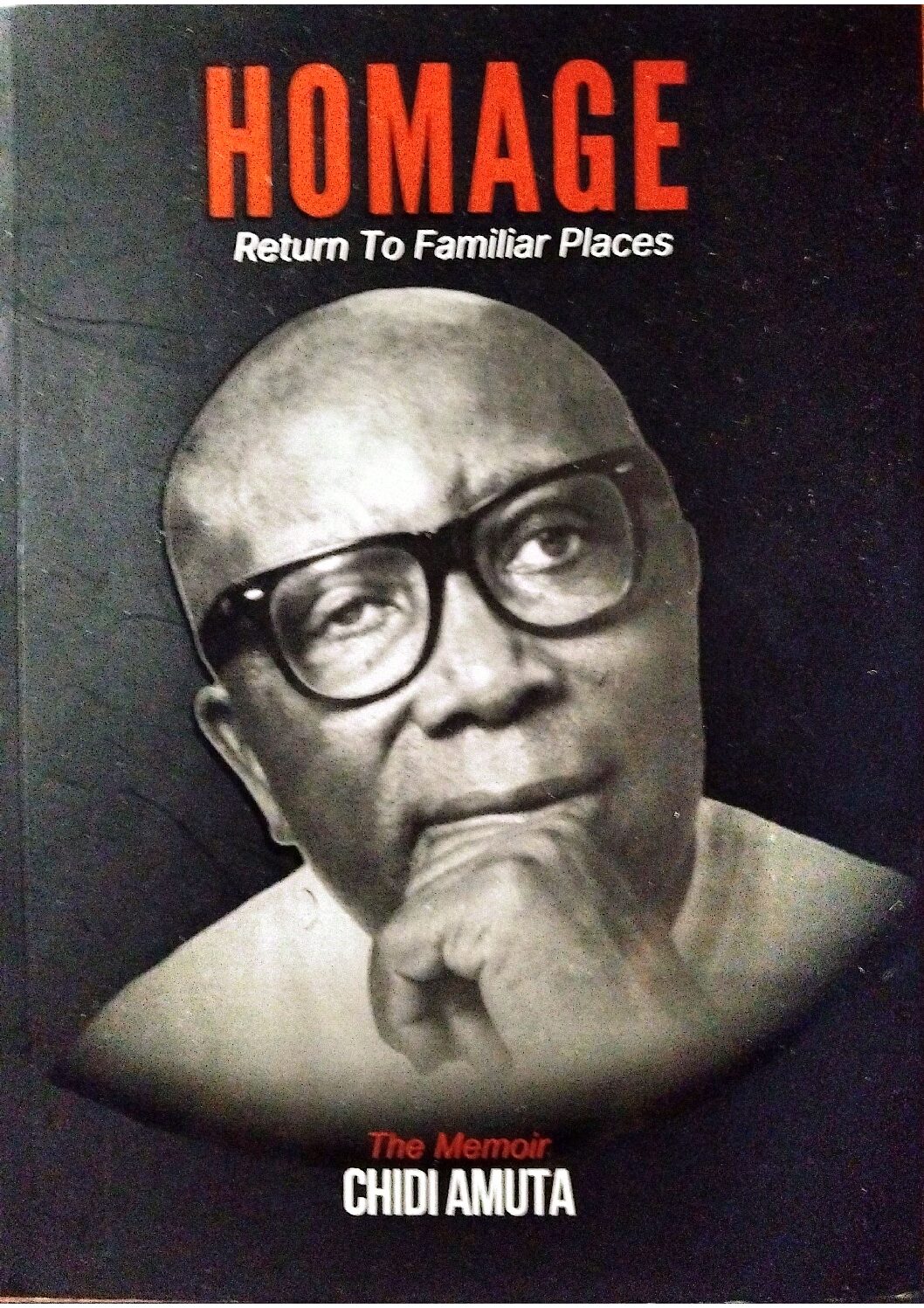
On Saturday, September 12, 2026, family and friends of Dr. Chidi Amuta converged at the Mövenpick Hotel Ikoyi Lagos, for the presentation of his latest literary offering, HOMAGE: Return To Familiar Places. It was, indeed, an august gathering in the month of September.
Though it was a public presentation, the usual razzmatazz associated with a book launch was absent, the hall being just big enough to accommodate the limited number of invitees. As the author noted in his welcome speech, the audience comprised mainly of family and friends: his wife, Jane; children – Uzoma, Ugochi, Kelechi, Obioma and two sons-in-law.
A man whose relationships endure, his friends at the event included people he had known for over half a century. So, we had the chairman of the occasion, Dr. Yemi Ogunbiyi, who, together with Profs Wole Soyinka, Ola Rotimi, Akinwunmi Ishola, Kole Omotosho, were in the Department of Dramatic Arts, University of Ife, when Amuta, a First Class graduate, joined the Department of Literature in English as a graduate assistant. He was barely 25 years. There were also Mr. Ray Ekpu, one of the founding fathers of the transformative Newswatch magazine, Dr. Dakuku Peterside, former federal lawmaker and Director-General of the Nigerian Maritime Administration and Safety Agency (NIMASA) and Segun Adeniyi, chairman Editorial Board of THISDAY newspapers, who reviewed the book. Former military president, General Ibrahim Babanginda, who was represented by Abbey Ibrahim, was the special guest of honour. One thing was common: he had personal cum professional relationships with all. He was a professional colleague either in the classrooms or newsrooms to many in the room. Others he either taught as a lecturer or mentored in the delicate art of writing.
When Amuta decided to leave the University of Ife for the University of Port Harcourt, it was, according for him, both a personal voyage and a professional academic awakening.
“It was in many ways a sort of coming of age in terms of both my personal maturation and my academic career. As it were, it was an opportunity to stand up and ‘answer my own name.’ It is often said that you never grow up living under the shadow of your parent,” he explained.
But there was a more personal reason for the relocation. Having lived outside the shadows of his parents and grown up to become his own man, it was now time to keep his eyes trained on them by becoming their protective shield in obedience to nature’s most profound and inevitable role reversals.
“My parents were getting older and less independent. My father was retiring from UAC but was still very healthy and active. My mother was less active on the farms. She needed more regular medical attention and better companionship. I needed to be near enough to answer to their needs,” he enthused.
He accomplished both goals. But his sojourn at the University of Port Harcourt yielded unintended outcomes, one of which was the fact that some of the students he mentored to take after him in academia – Rotimi Chibuike Amaechi, Timipre Sylva, Alex Otti, etc. – ‘rebelled’ and went into politics instead. Amaechi became Speaker of Rivers State House of Assembly, governor, minister and now vice presidential candidate of the African Democratic Congress (ADC) in the 2027 elections; Sylva was governor of Bayelsa State and minister and Otti is the governor of Abia State. He still rues what the academia lost. But he, nevertheless, glories in their accomplishments in public service. Amaechi and Otti were at the book presentation in solidarity with their mentor in what has become an enduring relationship between him and his mentees.
To be sure, HOMAGEis not Dr. Amuta’s first book. Before now, there were Theory of African Literature: Implications for Practical Criticism, a 1989 groundbreaking work that challenged the conventional critical assessment of African literature; Towards a sociology of African literature, published in 1986; Prince of the Niger: The Babangida years, published in 1992 and Writing the Wrongs, a 1065-page tome, which is a collection of essays.
Though the 492-page memoir, HOMAGE: Return To Familiar Places, is not as voluminous as that, it is a most compelling and profound story of a village boy, who grew up in his ancestral village of Umuguru, a bucolic community in Ngwaland, Abia State, with nothing other than the dreams and blessings of his parents – Madam Grace, a peasant farmer, and Wilson, the Old soldier who fought for the British in far-flung places during the Second World War – to become a global citizen, literally, who taught literature and communications in universities in Nigeria and the U.S., worked for over 35 years in active journalism in Nigeria, interviewing several world leaders and writing columns and articles for numerous newspapers worldwide, including TheNiche.
Dr. Amuta prefers to call the HOMAGE a memoir rather than an autobiography. The two in a sense mean the same thing. Granted, there are those who will argue that an autobiography covers a person’s entire life in chronological order, spanning from the author’s birth up to the time of writing and thus covering the full arc of a life, while a memoir focuses on a single specific theme, time period, event or a particular set of experiences in the author’s life, the book straddles both fields. It is the story of Amuta’s life right from birth to now that he is 73 years.
A memoir can be tricky because of the tendency of the author to remember only what is convenient, which most times creates the faux pas of presenting opinions as facts. But HOMAGE is refreshingly different because the author remembered everything, and left out no details no matter how inconvenient, which makes the book truly inspirational. Nothing was romanticised or looked at with rose-coloured glasses. The book is plain, unvarnished reality.
A 24-chapter book, arranged in six carefully conceived sections, complete with a Processional and Invocations at the beginning and ending with a Recessional, it is rather evocative and sobering.
As Prof Charles Okigbo of the University of North Dakota noted in his blurb, “Here is a testament to good fortune, honest living and hard work. This riveting narrative follows how a village boy, with no godfather, rose to become a role model for young Nigerians.”
It is the quest by his children to be led into this iconic journey in life that gave fillip to the book. Amuta explains how in the first stanza of the Processional, titled “The Awakening.”
“My dear Uzo, you have asked me on behalf of all your siblings: which road shall we follow to the depths of your journey? I replied: the highway backwards to the place of memory, the dark palace of all beginnings. Your questions will not go away because you will not stop asking. So by way of a response delayed but not forgotten, I retell here the outlines of my journey through a life you met midway. What I lay out here is an outline, a sketch of a journey that was mostly a burden that I bore with the help of guardians of my sacred quest for myself.”
But the book offers more than an explanation to children questing for their roots. It may not have been deliberate. But for a man born on July 24, 1953, seven years before Nigeria’s independence in 1960, 13 years before the debilitating civil war and whose journalism career gave him a seat at the table, the book, in addition to being a journey of remembrance, is also a chronicle of national and world history. HOMAGE is much about Chidi Amuta’s life journey as it is about the world. Therein lies its transcendental allure.
Amuta, the literary master craftsman, to whom the written word is an elixir, captured the essence of the book, thus: “HOMAGE… is not just a memoir. It is a journey in many dimensions… Backwards to the place of ancestral memory where all experience lives… It is a constant exploration of the deep present to see what’s left… it is a trembling encounter with the future of the self and the community. It is a return to the familiar places and personages that have shaped my personal journey across time, generations, places and my encounters with people and situations. Here is a permanent homage to each and to all.”
Months before the public presentation, he invited me to his house and gave me a copy of the book that had just rolled off the press. For that, I remain grateful.


