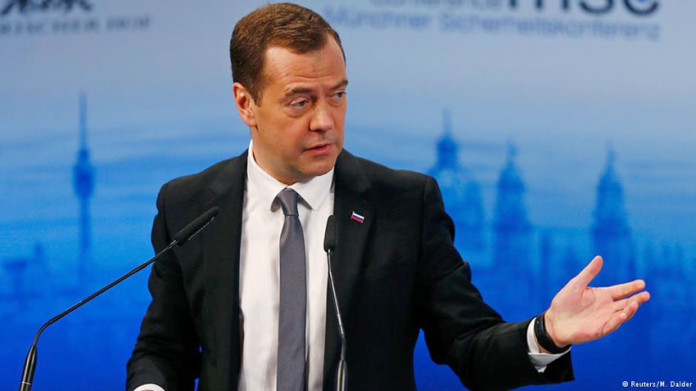
Russian Prime Minister Dmitry Medvedev has said tensions between Russia and the West have reached Cold War levels. Other leaders also warned of dangerous divisions within Europe.
Speaking at the Munich Security Conference on Saturday, Medvedev said the world had “slid into a new period of Cold War” as differences grew between the West and Russia over conflicts in Syria and Ukraine.
“Almost every day we are accused of making new, horrible threats either against NATO as a whole, against Europe or against the US or other countries,” he told delegates at the meeting in the southern German state of Bavaria.
Medvedev said, however, that in the face of the challenges currently facing the world, such as regional conflicts, terrorism and the migration crisis, Russia needed to be regarded as a partner. He added that differences between Moscow and the rest of the world were not unbridgeable.
“Our positions differ, but they do not differ as much as 40 years ago when a wall was standing in Europe,” he said, and cited several instances of agreements that had been achieved since then, including on issues such as disarmament, Iran’s nuclear program and piracy.
Sanctions ‘mutually damaging’
The Russian prime minister accused the West of expansionist policies toward formerly Soviet-ruled eastern Europe since the end of the Cold War, saying they were deepening the rift with Moscow.
“European politicians thought that creating a so-called belt of friends at Europe’s side, on the outskirts of the European Union, could be a guarantee of security, and what’s the result? Not a belt of friends but a belt of exclusion,” he said.
Medvedev also called into question the sagacity of sanctions imposed on Russia by the West over its annexation of Crimea and its support of pro-Moscow rebels in eastern Ukraine, saying they damaged both sides and calling instead for global cooperation to combat what he referred to as a widening economic crisis in the world.
In response to Medvedev’s comments, NATO’s supreme Allied Commander General Philip Breedlove told DW that the alliance’s actions are “defensive” and that they are “proportionate in size and capability.”
“No one in NATO wants to return to a Cold War,” Breedlove insisted.
“We are taking those actions because we have seen a nation to the east that for two decades we were trying to [become partners with], and this nation has recently demonstrated that is does not want to be a partner,” he argued, adding that Russia had shown that it is willing to “use force to change internationally recognized borders.”
Medvedev denies Syria accusations
Following his speech on Saturday, Medvedev also denied accusations that Moscow was attacking civilians in Syria as part of its military offensive there to prop up the government of President Bashar al-Assad.
Russia’s military operations in Syria are a cause of concern in many Western countries, who fear that civilians and “moderate” rebels opposed to Assad’s rule might be targeted. Moscow says its airstrikes aim only to combat radical Islamist forces such as “Islamic State.”
‘European project could disappear’
Earlier, French Prime Minister Manuel Valls also mentioned Russia’s bombing campaign in Syria, reiterating the accusation that civilians were being killed in the attacks. Valls said Moscow’s airstrikes were an obstacle to efforts to bring peace to the country, which has been wracked by five years of civil war.
Valls also warned that European unity was under siege amid economic challenges and the difficulties posed by the massive influx of refugees and migrants, mostly coming from the Middle East and Africa.
Steinmeier and Valls both stressed the need for unity
“The European project can go backwards or even disappear if we don’t take care of it,” he said. “If Europe doesn’t show it can respond not only to economic challenges but also to security challenges, then the European project will be finished, because the people won’t want it anymore.”
German Foreign Minister Frank-Walter Steinmeier also called for more European unity in “stormy times.”
“External crises and inner strength are obviously inseparable,” he said. “We can defy the storms that are raging outside the EU only if we stand together in the EU.”
The remarks come as the EU’s Schengen zone, which allows free travel between member states, comes under increased threat as ever more countries close their borders in view of the number of refugees and migrants attempting to enter the bloc.
…Russian rhetoric jeopardizes Syria peace deal
* We need to avoid a new Cold War – Frank-Walter Steinmeier
Things have changed in Munich just one day after a peace deal for Syria was finally reached. The mood was cautiously optimistic on Friday, but Russia’s stance appears to have made peace in Syria elusive all over again.
German Foreign Minister Frank-Walter Steinmeier tried to soften the blow dealt by the remarks of Russian Prime Minister Dmitry Medvedev, who on Saturday told the Munich Security Conference (MSC) that the world had “slid into a new Cold War.”
Steinmeier rejected that notion, saying that “what Medvedev meant to say is that we need to avoid a new Cold War.”
And Philip Breedlove, NATO’s supreme allied commander for Europe, did not appear too keen on the idea either. “We don’t look at what is happening as a Cold War,” he told DW, “and no one in NATO wants to return to a Cold War.”
But the damage was already done.
‘Pouring gasoline’
It wasn’t just that one statement by Russia’s prime minister that altered the sentiment at the MSC. More concretely and more importantly, Medvedev denied outright that Russia was targeting civilians in Syria, a remark that makes the negotiated end of hostilities in the country within one week appear almost impossible.
“I’ve got to say I was quite shocked by that statement,” Kenneth Roth, Executive Director of Human Rights Watch, told DW. “It’s as if Medvedev is living in an alternate reality.”
Nicholas Burns, a former US underSecretary of state and now a scholar at Harvard University, told DW that he found Medvedev’s remarks cynical: “They profess to have peace in mind, and yet they are pouring gasoline on the fire.”
If Medvedev’s remarks hadn’t already dampened the mood at the MSC, Russian Foreign Minister Sergey Lavrov further dashed hopes for a quick truce in Syria – as well as hopes for an improvement in his country’s international relations. Lavrov said the United States and Russia would first have to establish a regular military dialogue in order for a cessation of hostilities to be put in place in Syria.
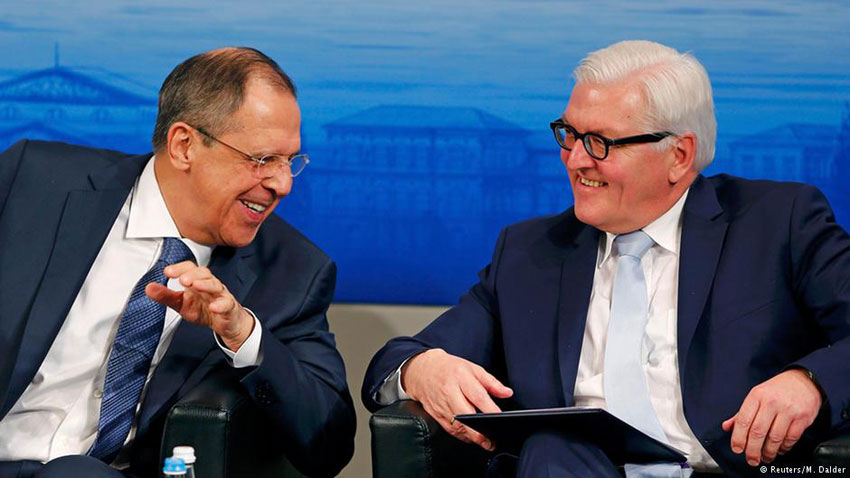
Despite the MSC’s tribulations, Lavrov (left) and his German counterpart, Steinmeier, found time to share a collegial grin
Lavrov also urged the United States and Europe not to write off Syrian President Bashar al-Assad, arguing that “no one should be demonized – except the terrorists.”
When asked by MSC chief Wolfgang Ischinger to rate the likelihood of an end of hostilities as put forth in the plan by the International Syria Support Group, Lavrov, after a long statement, said 49 percent. To which his British counterpart, Philip Hammond, replied that, judging by Lavrov’s remarks, the real percentage was closer to 0. The British foreign secretary himself estimated the likelihood for success at 51 percent.
Asked about his perception of the lenghty remarks by Russia’s top diplomat, Burns said: “Lavrov seemed to indicate in his speech here that he is upset that people want to convince Russia to stop bombing.”
The statements made by the Kremlin’s emissaries overshadowed US Secretary of State John Kerry’s final appearance at the MSC as President Barack Obama’s top diplomat. Deservedly so, because Kerry’s remarks were pretty much standard fare as he went down the laundry list of international issues that the United States was dealing with – from the civil war in Ukraine, the refugees in Europe and a possible Brexit to the Transatlantic Trade and Investment Partnership and Syria. To be sure, though, without naming Russia, Kerry called on the country to stop its bombing campaign in Syria.
The general message that Kerry and his German and British colleagues were trying to send was one of hope and conviction that their trans-Atlantic union could weather the current crises. “We are doing just fine,” Kerry said in his closing remarks.
This message of hope, however, appears increasingly out of touch, especially as an end to the carnage in places such as Aleppo is still not in sight. That it has come to this is also the fault of the United States and Europe, Burns said: “We elected not to be significant players in Syria, we have avoided engagement there, and that left the field open to Russia.”
Given today’s developments at the MSC, it seems like the fate of the peace plan may be sealed just days after it was signed after a late-night session also here in Munich. “I would be surprised if this agreement would be fully implemented,” Burns said, “and that’s a tragic situation for the people on the ground.”
Human Rights Watch chief Roth agreed: “I fear that this cessation of hostilities is never actually going to take hold, and then we’re back to square one.”
-DW.COM