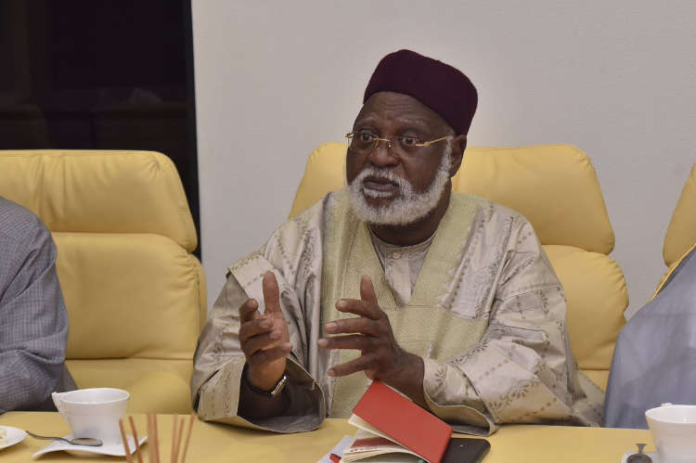
Former military Head of State, Gen. Abdusalami Abubakar (rtd) yesterday said that former President Goodluck Jonathan was persuaded to concede defeat to President Muhammadu Buhari after the 2015 presidential election. The former Head of State, who made the disclosure at the 2018 Annual General Conference of the Nigerian Bar Association (NBA), noted that the genesis of Africa’s political problems was “the action of its sit-tight leaders, who do all they can to amend the constitution in order to perpetuate themselves.” According to him, “These leaders have the tendencies to manipulate very vital democratic organs, particularly the legislature and even some times, the judiciary to suppress any dissenting voice.
“Despite all these, however, Africa is now harvesting an influx of leaders and politicians. These young people who are emerging are more educated and internationally exposed than the current old leaders we have all over Africa. And these young men and women are trying to make their marks
“However, as you know, they are hampered by the high cost of electioneering in developing countries and indeed the world,” he stated. Abubakar, who delivered a keynote address on “Political Transitions in Africa: Lessons to Learn”, gave credit to former President Jonathan for not only conceding defeat, but for congratulating President Buhari, who was a candidate of the opposition party.
“All analysis of political trends in the run up to Nigeria’s 2015 national election pointed to above scenario playing out. Very early on, I teamed up with some well-meaning nonpartisan stakeholders and elder statesmen to engage the key contestants and party leaders with a view to forestalling such a scenario
“Under the auspices of a Peace Initiative, we brokered the acceptance by leading contestants of some form of a Memorandum of Understanding with them to agree to accept the outcome of the elections, preach cordiality in relations and conduct peaceful campaigns. “It is gratifying to note that, courtesy of our humble effort and the goodwill extended to it by the contestants and the Nigerian public, the 2015 national elections were conducted peacefully.
“To his eternal credit, the then incumbent President, Goodluck Jonathan, who lost the polls, had the magnanimity to concede defeat and congratulate the candidate of the opposition party. In the end, peace, amity and political stability prevailed in the land.” He further disclosed how the process that led to the transfer of power to a democratically elected leader in 1999 came about. He narrated that when he was appointed to lead the country in 1998; it was observed that there was political apathy and that the political class was already fatigued, with some voices wanting a return of the country to parliamentary system.
In his own presentation, a former Chairman of the Independent National Electoral Commission (INEC), Prof. Attahiru Jega, stressed that while strong leaders and institutions were important for political transition, emphasis should not be placed on the strength of the leader at the detriment of the leader’s competence and disposition.
According to him, “To my mind, we need strong institutions. We need strong leadership, but it is not just the strength of the leader that we require. What we require most is the competence and the capacity of that leader to take decisions and to be assertive in ensuring that those decisions are actually implemented.
“So, we have to be very careful in thinking that strong leaders can really help. Just as a weak leader can wreck an institution, a strong leader who has just that power and courage, if he lacks capacity, ability and competence to lead, he could also wreck strong institutions. So, it is very important that we recognize this important aspect of the leadership that we require.”
.new telegraph