Trump says U.S. and Iran will sign a peace deal today
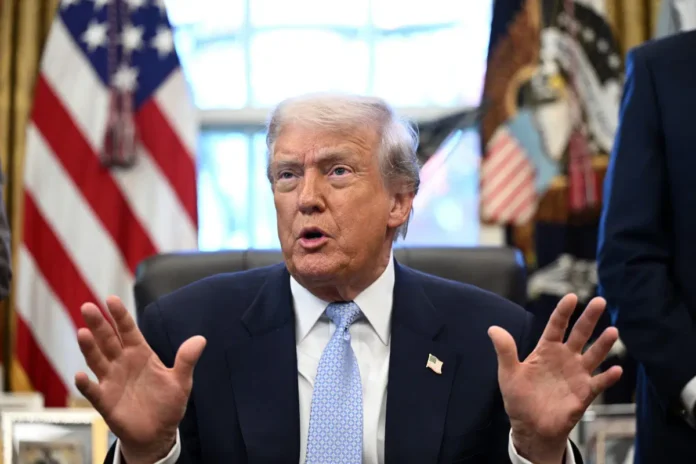
President Trump said Saturday that the United States and Iran will sign a peace deal on Sunday.
In a Truth Social post, Trump said Iran had agreed to give up its pursuit of a nuclear weapon “through purchase, development, or any other form of procurement,” and that the Strait of Hormuz, the chokepoint through which roughly a fifth of the world’s oil flows, would reopen the moment the deal is signed.
“The Deal is scheduled to get signed tomorrow, and immediately after it is signed, the Hormuz Strait is OPEN TO ALL,” Trump wrote.
A memorandum of understanding between the two countries could be signed as early as Sunday in Geneva, with Vice President JD Vance and Iran’s Parliament Speaker Mohammed Baqer Qalibaf in line to sign, Reuters reported Friday. Under the draft framework, as Reuters has described it, Washington would gradually unfreeze a portion of Iran’s seized assets and lift restrictions on Iranian oil exports, while Tehran would reopen the Strait of Hormuz. Nuclear program negotiations would follow over the next 60 days.
U.S., Iran eye Hormuz deal
Trump said the framework would be signed Sunday and could reopen the strait, while Iranian officials said they were not ready to confirm that timing. The talks have drawn attention because any agreement could affect shipping through Hormuz and the next phase of the conflict.
Iran has yet to publicly confirm the signing. The state-affiliated Fars news agency cited a source close to Tehran’s negotiating team on Friday, calling claims of an imminent Sunday signing in Geneva “completely false.” On Saturday, an Iranian foreign ministry spokesperson told state media that Iran’s negotiators had no travel plans for Geneva or any other location in the coming days, Reuters reported. Tehran has also pushed for the deal to extend to a ceasefire between Israel and Hezbollah, Iran’s proxy in Lebanon — a point Trump did not address in his Saturday post. An Iranian foreign ministry spokesperson went further Saturday, telling state media that the country’s negotiating team was not planning to travel to Geneva or anywhere else in the coming days, Reuters reported.
Trump separately rejected the version of the terms that has circulated in Iranian state media. “The terms that Iran leaked out to the fake news have nothing to do with the terms that were agreed to, in writing,” the president wrote in a follow-up post Friday.
The president spent much of his Saturday post drawing contrasts with the 2015 Iran nuclear deal struck under former President Barack Obama, which he withdrew from in 2018. Trump said no money would change hands as part of the new agreement, calling the Obama deal “an easy, beautiful, smooth road to a Nuclear Weapon.”
Trump also said the U.S. would eventually retrieve Iran’s remaining enriched uranium stockpile, which he said was buried “deep under the powerful sunken granite mountains” after U.S. B-2 strikes earlier in the war. “At the appropriate time, when all is calm, we will go in and get the Nuclear Dust… and downblend and destroy it, whether in Iran, or the United States,” Trump wrote, restating remarks he made last weekend on NBC’s Meet the Press.
He also kept the threat of further military action on the table. “If it doesn’t, we have the ultimate alternative, hopefully never to be used again,” he wrote.
The signing would cap weeks of public back-and-forth. Trump first claimed on May 23 that the framework had been “largely negotiated,” but Iran’s state-affiliated Tasnim news agency announced June 1 that it was halting back-channel talks over alleged ceasefire violations. Iranian Foreign Minister Abbas Araghchi later warned that U.S. bases in the region used to attack Iran would be considered “legitimate targets.” On NBC’s Meet the Press last weekend, Trump said the two sides were “very close” to a deal.
UAE to unlock billions of dollars for Iran
The United Arab Emirates has agreed to unlock billions of dollars for Iran, four sources said, in a tactical shift after weeks of Iranian attacks on the wealthy Gulf Arab state during the U.S.-Israeli war with the Islamic Republic.
Word of the move by the UAE to seek de-escalation and which has not been previously reported, coincides with the final stages of broader negotiations between Tehran and Washington on ending the war, talks that diplomats say could involve the release of tens of billions of dollars in Iranian oil revenues frozen in foreign banks under U.S. sanctions.
In the past month, the UAE, which was heavily targeted by Iran at the height of the war, has been spared fresh strikes, while Iran has trained its missiles and drones on Kuwait and Bahrain. The last known direct attack by Iran on the UAE was more than a month ago – a May 4 strike on the Gulf state’s Fujairah port on the Gulf of Oman.
Two regional sources told Reuters the UAE had agreed to release a total of $10 billion, more than $3 billion of which had already been delivered.
Two other sources with knowledge of the arrangement put the total funds involved at $20 billion, adding that the move had been agreed in return for a halt to Iranian attacks on the UAE.
One of the sources with knowledge of the arrangement also said a first tranche of $3 billion had already been made available.
Reuters could not establish whether the funds earmarked for the transfers belong to the UAE or originate in long-blocked Iranian accounts in the UAE banking system, or elsewhere.
The UAE foreign ministry issued a statement early on Saturday categorically denying reports of the transfer “including allegations concerning $3 billion”.
The UAE statement “affirmed that these allegations are entirely false and unfounded, stressing that no frozen Iranian funds have been released, transferred or facilitated through the UAE.”
The UAE statement did not provide any further specifics.
Earlier, when asked by Reuters to comment on the transfer, a UAE official said the country was trying to ease tension and foster peace.
“The UAE’s foreign policy is guided by promoting de-escalation and reducing tensions across the region, while advancing lasting peace and stability,” the official said. “The UAE supports efforts, including those undertaken by the United States, to protect the peoples of the region from the repercussions of conflict.”
The White House did not immediately respond to a request for comment on the move.
In Washington, Vice President JD Vance said on Friday that funds would not be released to Iran for signing a deal with the U.S. or attending a meeting, adding that the potential deal is structured to ensure that economic benefits would flow to Tehran if it meets its obligations.
There was no immediate response from Iranian authorities to a Reuters request for comment on the move.
None of the sources cited in this article would agree to be identified due to the sensitivity of the matter.
The arrangement signals a striking pivot from the open animosity of UAE-Iran relations through much of the war, when Iranian attacks emptied Dubai’s hotels, drove some expatriates to flee and shook the reputation for safety that is central to the country’s position as a premier business hub.
One of the sources with knowledge of the arrangement said the move offered a way to help solve the conflict between the U.S. and Iran without either side crossing its red line: Iran can claim it extracted compensation for war damages, Washington can insist it paid nothing, and Abu Dhabi obtains its own security and Dubai’s hub status, while framing the move as an investment in rebuilding regional trust.
The other source with knowledge of the arrangement said that in return for the disbursement, Iran would halt missile and drone attacks on the UAE, and there would be a rebuilding of bilateral ties, including intelligence sharing and economic cooperation.
The source added that Iran had approached at least two other Gulf Arab countries to make a similar arrangement.
The first source with knowledge of the arrangement said talks had started several weeks ago but quickened pace when officials of Iran’s powerful Revolutionary Guards visited Abu Dhabi last week to meet Sheikh Tahnoun bin Zayed al Nahyan, the UAE’s national security adviser and deputy ruler of Abu Dhabi, and stayed at his guest house.
That trip was followed by a visit by UAE officials to Tehran to negotiate the details of the mechanism.
The UAE-Iranian arrangement is set to unfold against a complex financial backdrop potentially involving Dubai, the UAE’s main commercial hub and one of Tehran’s most critical economic lifelines.
Dubai’s banks have long held substantial Iranian-linked deposits, much of them now immobilized under U.S. sanctions that police the global dollar-clearing system and expose any foreign bank dealing with blacklisted Iranian entities to being cut off from the American financial network.
On April 11, a senior Iranian source said that the U.S. had agreed to release Iranian frozen assets held in Qatar and other foreign banks, although a U.S. official swiftly denied the assertion.
The source, who declined to be named due to the sensitivity of the matter, told Reuters that unfreezing the assets was “directly linked to ensuring safe passage through the Strait of Hormuz”, a key issue in talks aimed at ending the conflict.