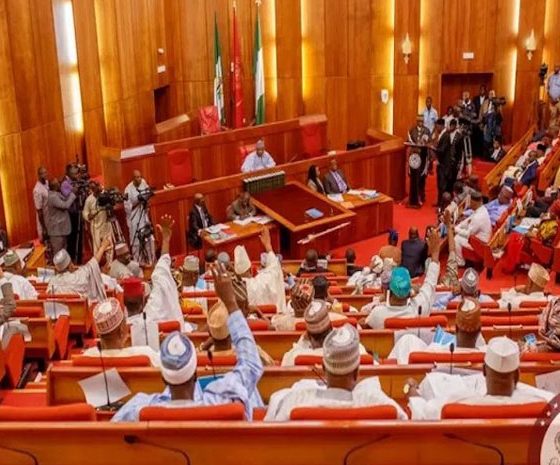
State Police: 10th Senate takes on Nigeria’s toughest security conundrum headlong
By Ken Harries
It often begins as an ordinary day. A commercial bus pulls out before dawn, its passengers expecting nothing more than traffic delays and bad roads. Traders carry the week’s earnings. Students return to school. A nursing mother cradles her child. A retired civil servant travels to visit his family. Elsewhere, anxious parents wave goodbye as a school bus disappears through the gates, expecting to see their children again that afternoon. Then, somewhere along a lonely highway or beside a quiet rural school, armed men emerge from the bush. Within minutes, ordinary life gives way to terror. Passengers are dragged into the forest. Schoolchildren are herded into waiting vehicles. Families receive the dreaded telephone call demanding ransom. By nightfall, another community has joined the growing list of Nigerians praying that their loved ones will return home alive.
That story is no longer exceptional. It has been repeated so often, in different states and under different circumstances, so much so that it has become a grim national pattern. Across Nigeria, parents hesitate before sending their children to school. Farmers weigh every trip to their fields against the possibility that they may never return. Travellers study routes not for the shortest distance but for the greatest chance of survival. In a country blessed with enormous human and natural resources, fear has become an invisible checkpoint on countless roads.
It is against this backdrop that the debate over state police has acquired fresh urgency.
For decades, Nigerians have argued over whether policing should remain the exclusive responsibility of the Federal Government or whether states should be empowered to establish their own police services. It is a conversation that has generated more heat than light, with strong emotions on both sides.
The State Police Bill, now making its way through the constitution amendment process, represents the most determined effort yet to answer that question and make community policing a constitutional reality.
More importantly, it reflects a growing national consensus that the country’s evolving security challenges require a policing structure that is closer to the people, more responsive to local realities, and better equipped to detect and prevent crime before it occurs. Whether one ultimately supports or opposes state police, there can be little doubt that the debate has moved beyond theory. It is now about finding practical solutions to one of the greatest threats confronting Nigeria’s unity, stability, and future.
It is certainly an ambitious proposal. The strongest argument in favour of state police begins with a simple reality: Nigeria has grown too large, too complex, and too diverse for a completely centralised policing structure to respond effectively to every local security challenge.
A police officer deployed hundreds of kilometres away can rarely know a community as intimately as those who live there. Local officers are more likely to understand the terrain, recognise unfamiliar faces, detect emerging threats, and build the trust that encourages residents to volunteer vital intelligence before crimes occur rather than after lives have been lost. They also have a deeper personal stake in preserving peace. Their families live in the community. Their friends are there. Their children attend its schools. Their lives are woven into its social fabric. That sense of belonging often translates into a stronger commitment to preventing crime because every threat to the community is also a threat to the people and places they call home.
Such local knowledge can make all the difference. It can be the difference between prevention and tragedy. It can enable security agencies to identify suspicious movements before they become deadly attacks, respond more swiftly to kidnappings and violent crimes, resolve communal tensions before they escalate, and gather intelligence that outsiders might never obtain. At the same time, it would allow federal security agencies to concentrate their resources on terrorism, organised crime, transnational offences, and other threats that transcend state boundaries.
There is another advantage that is often overlooked. Effective policing depends not only on uniforms, weapons, and patrol vehicles, but also on public confidence. People are far more likely to cooperate with law enforcement when they regard police officers as members of their own communities rather than distant representatives of an impersonal bureaucracy. They are more willing to report suspicious activities, identify criminal elements, and volunteer intelligence that could prevent crimes before they occur. In the fight against insecurity, timely information is often the most powerful weapon, and that information flows most readily where trust has been earned.
Yet, if the promise of state police is considerable, so too are the risks. No constitutional reform should be judged solely by its potential benefits; it must also be tested against the possibility of unintended consequences. It is here that the debate becomes more complex.
Nigeria’s political history gives critics ample reason for caution. Governors already wield significant influence within their states. Entrusting them with operational control over police formations inevitably raises difficult questions. Could state police be used to intimidate political opponents? Could elections become even more contentious if security agencies are perceived to serve incumbents rather than the law? Could legitimate dissent be treated as political disloyalty? These are not hypothetical concerns. They arise from Nigeria’s own political experience and deserve credible constitutional and institutional safeguards.
Beyond the question of political misuse lies an equally practical challenge: funding. Professional policing is expensive. It requires far more than uniforms and patrol vehicles. Officers need rigorous training, competitive remuneration, modern equipment, reliable communication systems, forensic capabilities, intelligence infrastructure, and continuous oversight. Many states already struggle to pay salaries and finance essential public services. Without a sustainable funding framework, some states could build highly professional police services while others struggle to maintain basic operational capacity. That would not strengthen national security; it would simply replace one centralised policing problem with thirty-six unequal policing systems.
There is also the issue of coordination. Criminals do not stop at state borders to admire welcome signs. They move across jurisdictions with ease. Any state policing framework must therefore establish clear rules for cooperation between state and federal agencies, intelligence sharing, joint operations, and conflict resolution. Otherwise, confusion could become as dangerous as the insecurity the reform seeks to address.
These are difficult questions, but difficult questions are precisely what serious legislatures exist to confront. That is why the Senate’s handling of the State Police Bill deserves plaudits.
Under the leadership of Senate President Godswill Akpabio, the 10th Senate has chosen engagement over avoidance. Few constitutional questions are as politically sensitive as those touching the nation’s security architecture. They evoke competing interests, regional anxieties, constitutional concerns, and deeply held convictions about the nature of the Nigerian federation. Faced with such complexity, the easier course would have been to postpone the debate or leave it to another Assembly. Instead, the Senate elected to confront the issue directly, recognising that a nation under relentless security pressure cannot indefinitely defer difficult decisions.
By encouraging public hearings, inviting diverse perspectives, and steering deliberations through the constitutional process, the Senate has transformed what was once an endless national argument into structured legislative engagement. That is how democratic institutions are supposed to function. The objective is not to eliminate disagreement. It is to channel disagreement into laws that strengthen the republic.
The State Police Bill is certainly not a magic wand. No legislation, however well crafted, can eliminate insecurity overnight. Laws create frameworks; institutions and leadership determine outcomes. The success of state police will therefore depend not merely on the passage of the Bill but on how faithfully its provisions are implemented and how effectively its safeguards are enforced. Independent oversight, merit-based and transparent recruitment, sustainable funding, clear operational protocols, professional accountability, and robust protection against political interference will determine whether state police emerge as trusted guardians of public safety or degenerate into instruments of partisan power.
Achieving those objectives is not solely the responsibility of the National Assembly. It demands a sustained commitment from every stakeholder in the security ecosystem. State governments must resist the temptation to politicise the police. Security professionals must uphold the highest standards of professionalism and integrity. Civil society must remain vigilant in demanding accountability, while citizens must embrace the civic responsibility of cooperating with law enforcement. Only through such a shared commitment can the promise of state police be translated into lasting public safety.
Still, there is value in recognising progress when it occurs. For too long, Nigeria’s security conversation has revolved around managing recurring crises instead of questioning whether the structures themselves require reform. The State Police Bill signals a willingness to examine first principles and ask whether yesterday’s solutions remain adequate for today’s realities.
That willingness matters. Nation-building is seldom about finding perfect answers. More often, it is about having the courage to ask the right questions and the wisdom to improve institutions one reform at a time.
The Senate has opened that door. What remains is to ensure that what ultimately emerges from it strengthens security, deepens accountability, and restores public confidence in law enforcement. The true test of state police will not be the passage of the Bill but whether it produces police officers who know the communities they serve, share in their hopes and anxieties, and recognise that every threat to those communities is also a threat to their own families, neighbours, and future. Only then will Nigerians have renewed confidence that the institutions established to protect them are not distant enforcers of the law, but trusted guardians of the communities whose fate and destiny they share.
- Ken Harries Esq is an Abuja based development communication strategist