



Rwanda: A lesson For Nigeria
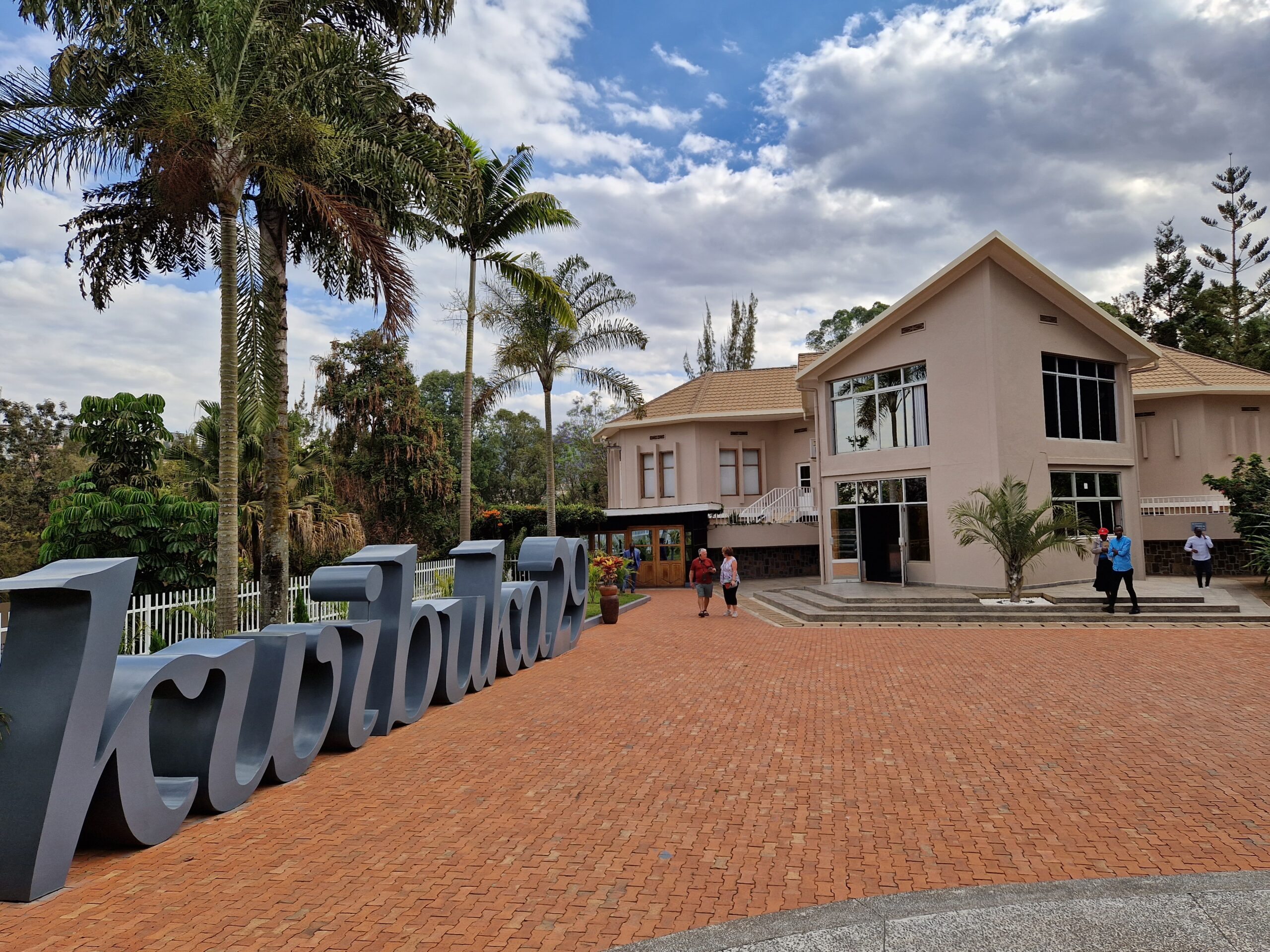
The Rwanda Memorial Museum in Kigali
By Achike Chude
Kibwuka – never again
This is the boldly written message in Kinyarwanda that comes at you as you slowly make your way to the place of tragedy and grief in Kigali, but a place that, at departure gives you a strong urge to want to be a better human being.
The entrance grounds serve both as a sacred final resting place for victims and a sanctuary for survivors to remember.
Just an hour tour of the Rwanda Genocide Museum and you come out a completely changed person – unless you are a constant visitor to the land of the dead and are therefore inured to the ghostliness and ghastliness of the netherworld with its unfathomable mysteries.
And if you are witness to the showglass display of shattered skulls, bones, and clothings of those who once lived like us but were brutally cut down in cold blood with crude implements and you remain unmoved, then you are a nut case and a danger to those around you. You are in need of serious clinical psychiatry for the potential danger you represent to society.
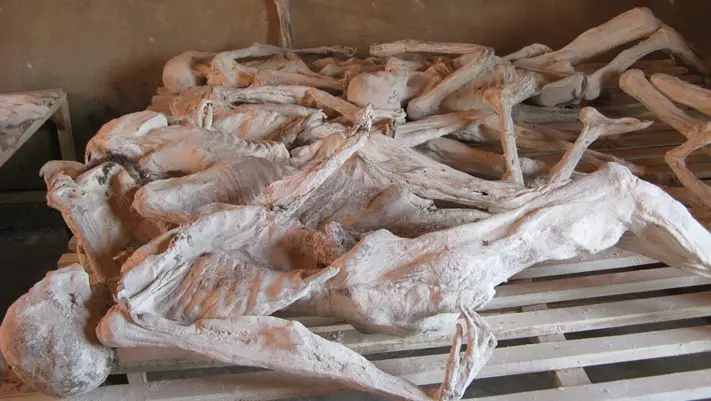
Showglass display of shattered skulls, bones
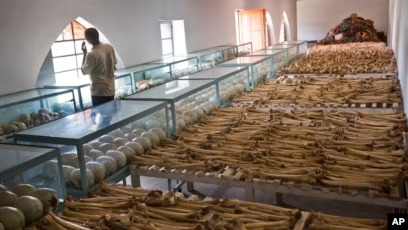
Showglass display of shattered skulls, bones
There are similar museums in other provinces of Rwanda, though none as big and appropriately architectured as the one in the capital with its vast labyrinth of silos and vaults underground housing the bodies of 250,000 of the victims in well preserved caskets. This represents a quarter of all those killed in the pogrom nationwide. If it were not for the soberness of the circumstances that led to the construction of the museum, it would not have been out of the way to marvel at the ingenuity behind the construction.
It’s an unreal world, the museum in Kigali. Or at best, it is an excursion and incursion into our inner souls. Who knows! Depending on circumstances, some beyond our control, we could have been either victims or perpetrators of the genocide in 1994. Every man or woman has a destructive spirit if cultivated and fanned. But so also does the human mind possess the capacity for refined and exulted human conduct. It is the later that tells us that even in the worst of circumstances, we possess the capacity to pick ourselves up and strive to improve our humanity.
Yes, what happened in that east African country in 1994 rebounded and rebouds on all of us by the fact of our common humanity – a humanity that is nowadays constantly being questioned by our constant descent into the beastial nature of animals above whom we have often been elevated.
It is one thing to read about or be told about the darkness that unfolded all over the hills, the valleys, and the plains of Rwanda 33 years ago, but it is another to almost relive it through the chilling, harrowed, and haunted words of survivors, some of who are today, adults but reliving the trauma of a childhood filled with demons, phantasms, and ghosts.
Thirty-three years ago in Rwanda, the augurers’ ‘finely’ prepared brew of blood, hatred, envy, pre and post-colonial conspiracies, ignorance, bigotry, malice, violence, greed, blood lust, and beastiality, all brewed for decades in the augurers’ fiendish pot finally burst forth, and in a mind-numbing paroxysm of terror and horror, turned the beautiful hills, valleys, and plains of the country into a spectacle of total ugliness, revulsion, vileness and shame of the worst kind.
In the wake of this vile phantasma one million people lay dead, infants, children, the young and the old – all in the space of three months with a turn over of ten thousand human beings killed per day. Mind you, the dead and mangled were once friends, neighbours, colleagues, fellow parishioners, playmates, wives, husbands, and relatives.
Their crime? They were ‘Tutsis’ as well as moderate Hutus, who were suspected of having soft spots for the Tutsis.
But they did not get away with their atrocities as a combination of international tribunals, traditional community courts, and national prosecutions tribunals, all worked together to ensure that apprehended culprits were made to face justice.
Today, when you visit the Rwanda Memorial Museum, you will first be shown an audio-visual presentation that begins with the beautiful hills, valleys and plains of Rwanda as they are today. Thirty-three years ago, the topography was rural and the mentality and social configuration of the people followed suit to match that of the era.
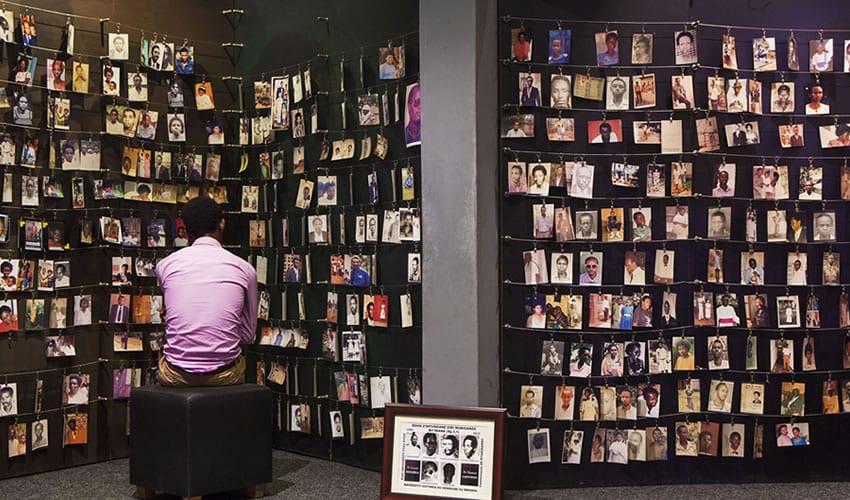
Pictures of victims on display inside the memorial grounds
Yes! The once beautiful, once rural Rwanda, made ugly by the genocide has blossomed and become even more beautiful and radiant once again. The landlocked country of fourteen million inhabitants has moved on from the traumatic vestiges of the past in what one may describe as one of the greatest wonders of the world.
They are certainly moving forward, but for the Rwandese people, moving forward rightfully cannot be achieved without looking back at where they are coming from. They are very much aware of the ugliness of the past. Those too young to remember or those born post-genocide are told of the tragedies of the past in tones that quietly scream ‘never again’.
The recovery, revival and growth of modern Rwanda is not a product of random speculative action but of deliberate, calculated, series of policies and actions starting with the restoration of the state and her institutions, then the search for meaning, the why, the how, and the what post-genocide, and then the long, winding road to recovery and reconstruction.
And it is in this (recovery and reconstruction) that the government of Rwanda has made the most remarkable achievement. But it is not in the recovery of roads and physical infrastructure alone but in the recovery and reconstruction of the minds and mentality of the Rwandese people.
To successfully pick Rwanda and her people up from the despair, hopelessness and near-nothingness of the ‘bottomless’ pit following the genocide is perhaps one of the great wonders of the world.
You will see the successes of the government’s recovery and reconstruction efforts on the faces of the people you meet on the streets of Rwanda, in their smiles, their laughter, their banter and general friendliness. ‘Are you a Nigerian?’, some of them would ask you in the market place as the shrewed ones quietly calculate how much they can get out of you if you are not versed in the act of hard bargaining as most Nigerians who are seen to be ‘rich’ are.
Rwanda is a beautiful country – at least the parts I have been to, on a training visit, mainly Kigali, the capital. The reputation of the country for cleanliness, order, and security are no exaggeration. But there is still a way to go. Employment, especially among the teeming youths remains a challenge and some critical socio-economic indices have to be improved upon to uplift the quality of life of the people.
This is my second visit to Rwanda. The first was in August this year where I was sobered up considerably by a group visit to the Genocide Museum and saw first hand the uspeakable evil the human person could be capable of. Since then my conscience has been assailed by guilt for my inability to write about the horrors at the museum as a warning to Nigerian politicians and peoples some of whose bigotry, conducts and speeches are reminiscent of the conduct of some Rwandese, both ordinary citizens and highly placed, whose rhetoric fueled the shame of 1994.
If you are a person of conscience, every visit to the Genocide Museum will leave you drained of energy, leave you listless, and questioning the essence and worth of human life. It is more understandable to see some women cry at the sight of such debasement of our humanity, but to see some men break down in tears added to the gloom, the despondency, as well as heightened the fears for tomorrow in our country because of the extremely poor political leadership currently available.
There is a small section of space in the Museum that confirms the universality of the human foibles that lead to acts of genocide. It is the section that contains equally gruesome information of the genocides in Cambodia, Srebenisca, in the Balkans, as well as the depiction of the Hitler-era genocide at Autchwitz and other locations – an indication that genocidal tendencies are not alien to all peoples.
As one contemplates today’s Rwanda and the road to recovery, one frightening thought and question assails one’s mind: what if the right side had not won the civil war? What if the other side had won? A different outcome would almost have guaranteed that today’s revival would be a mirage.
It is refreshing to know that Paul Kagame and his Rwandan Patriotic Front (RPF) won the battle for the soul of Rwanda. All of this transformation has taken place under his watch. Surely it must count for something.
Every other thing beyond that is politics.
Kibwuka!
Achike Chude is the National Secretary, Nigeria Union of Journalists.


