Rochas, Hope and politics of karma: When political power begins to slip
By Ogechi Okoro
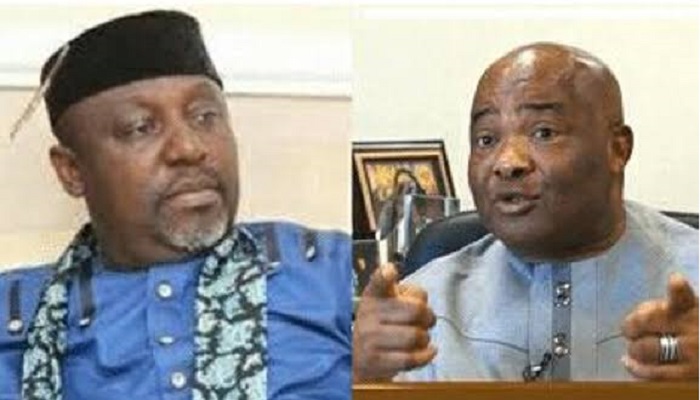
I have been reflecting on last Thursday’s court ruling involving Senator Rochas Okorocha and Governor Hope Uzodimma. Beyond the legal implications, the moment’s political symbolism is intriguing. In a country where political power often seems to rest in the hands of a few elected officials, this development reminds us that no political authority is beyond the reach of changing circumstances.
Many are wondering how Owelle Rochas pulled this one off. For some, the outcome evokes memories of the Supreme Court judgment that brought Uzodimma to power at the expense of Emeka Ihedioha. The irony is striking. A governor whose political fortunes were transformed by a controversial judicial decision now finds himself confronting a judicial outcome favouring a political rival. Is this karma, or simply the unpredictable theatre of Nigerian politics?
I spoke with someone in Owerri who described the celebration following the ruling as unprecedented. That reaction, whether representative of the entire state or not, deserves reflection. What does it say about the relationship between Uzodimma and the people he governs? Political power can be acquired through elections, alliances and even judicial interventions, but public affection cannot be commanded. When the fortunes of a political opponent become an occasion for widespread celebration, perhaps there is a deeper message that deserves attention.
For a while, Uzodimma appeared politically invincible. His perceived closeness to President Bola Tinubu gave the impression that he enjoyed considerable protection at the centre. Some even assumed that his relationship with the President would provide sufficient political cover amid his disagreements with Nyesom Wike. But recent political tensions have demonstrated that proximity to the corridors of power does not necessarily translate into control over the people who occupy them.
His disagreements with Wike are particularly interesting. Wike is not a politician who quietly retreats from political disagreements, and his influence within the political establishment is difficult to ignore. Their relationship has become another dimension of the shifting alliances in Abuja. Whether Wike has played any role in Okorocha’s latest legal fortunes remains speculation, but the fact that people are making that connection says something about how Nigerians interpret the relationship between political power and judicial outcomes.
Then there is the Akpabio dimension. The relationship between Uzodimma and Senate President Godswill Akpabio also deserves attention in the broader context of political influence and ambition. In a political environment where the Senate presidency is a significant centre of power, relationships between governors and the leadership of the National Assembly are rarely without political implications. The tensions and competing interests within these circles remind us that belonging to the same political family does not guarantee the absence of rivalry. Today’s allies can become tomorrow’s competitors, particularly when ambition and influence collide.
Perhaps Uzodimma’s greatest political challenge is not necessarily his opponents but the delicate balance of relationships he must maintain. Politics is not simply about having access to the President or occupying an influential office. It is also about knowing when to consolidate, when to negotiate, when to accommodate dissent and, importantly, when to recognise that the political atmosphere is changing.
There were suggestions that Uzodimma could emerge as the next Senate President. I considered such expectations rather ambitious. Political ambition is legitimate, but it must be accompanied by the necessary relationships, goodwill and political capital. One cannot assume that yesterday’s influence automatically guarantees tomorrow’s acceptance. Sometimes, politicians become so preoccupied with the next political destination that they lose sight of the responsibilities and relationships immediately before them.
I would also be cautious about attributing the ruling to either Wike’s influence or President Tinubu’s nonintervention. Some have suggested that Wike may have had a hand in the outcome, while others see it as evidence that Tinubu is prepared to allow the judiciary to operate independently. Neither interpretation should be accepted without evidence. What matters is that the judiciary must be allowed to perform its constitutional responsibilities without political interference. Its credibility is ultimately more important than the temporary fortunes of individual politicians.
The ruling is not necessarily the end of the legal battle, but it offers an important moment for reflection. If I were advising Uzodimma, I would urge him to consider carefully the implications of pursuing further litigation. The right to appeal is unquestionable, but political wisdom sometimes lies in knowing which battles are worth prolonging. Another round of litigation could deepen the complications and potentially take the dispute to the Supreme Court.
Perhaps this is also the moment for the governor to reflect on his political legacy and what life after office might look like. Every tenure eventually ends. The real measure of political leadership is not how many opponents one defeats while in office, but the relationships, institutions, and goodwill one leaves behind.
There is something humbling about Nigerian politics. The man who once appeared untouchable can suddenly find himself vulnerable. The politician who was once considered finished can return to the centre of the conversation. Rochas, Uzodimma, Wike and Akpabio are all operating within a political system where influence is constantly negotiated, and alliances are rarely permanent.
Perhaps the greatest lesson from last Thursday is not that Rochas has won or Hope has lost. It is that political power is never as permanent as its holders sometimes imagine.
Power is borrowed, not owned. Alliances are temporary, ambition is unpredictable, and political fortunes can change without warning. In the end, everyone must leave the stage. There is no champion forever
- Dr Ogechi Okoro, a political and social analyst, writes from Hamilton, New Zealand