



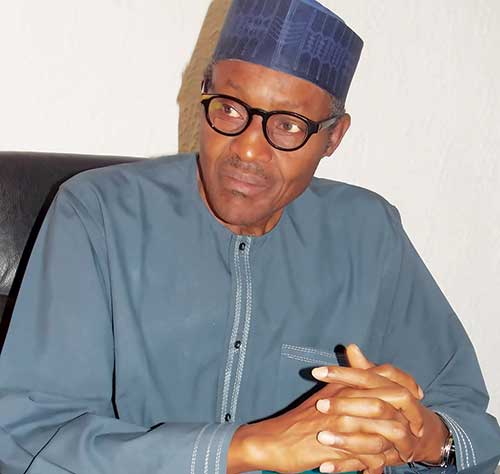
Muhammadu Buhari will be sworn in as President on May 29 to rule the country for the next four years.
Because of his incorruptible nature and perceived good intentions, Nigerians are full of expectations that he will lift the fatherland from the ashes of failures.
Correspondent Sam Nwokoro lists some of the pressing issues on Buhari’s plate in his second shot at leading Nigeria into moral dignity on the curve of economic, social, and technological development.
Statesman persona
Buhari has acquired this leadership brand: no-nonsense gentleman whose selling point is prudence and discipline not compromised by inducement or blackmail.
The fact that the international community, known for ambivalence about any African leader with a military background, gave him a rapturous welcome back to the realm of power attests to this.
He was young when he first ruled Nigeria between December 1983 and August 1985 and his policies and actions then were inspired largely by righteous indignation. The social space today is different, being democratic. Again, he is much older now at 72.
Nigerians expect him to act with the same patriotic zeal with which he fought the rotten values and ethos of the Second Republic.
Foreign partners that have endorsed his election are aware of this fact and would want him to repeat same, not minding political or tribal leanings, a bane that has retarded the country’s development for decades.
The February edition of The Economist eulogised Buhari’s virtues, and in a land where the media shape public opinion, the endorsement speaks of great expectations.
Chijioke Nwachukwu, a teacher says: “Buhari is old. He is not going to look at anybody’s face. The political party that produced him cannot be said to harbour many patriotic men.
“If the outgoing Peoples Democratic Party (PDP) was bad, the incoming All Progressives Congress (APC) is equally bad because many PDP members flocked to the APC when they lost relevance in the ruling party.
“I believe Buhari is still strong health wise, after all George Bush (Snr) left the White House at age 78 after ruling for four years. Bush did well within that one tenure, especially in fighting dictators around the world.
“Buhari can demonstrate such feat by providing Nigerians security. And for that matter, he is a military man like Bush.”
Structure of the polity
The foundation of Nigeria’s development trajectories lies in the economic and political structure.
Wrong priority in the economy has delayed development, created dependency in fiscal administration, and encouraged sleaze among public officers.
In some cases, centralised administration has hindered the harnessing of human potential for national productivity.
Buhari can muster the will to address the political structure by holding a referendum on the recommendations of the national conference or create a “Restructuring Taskforce” to do the job if referendum and legislative amendments would not fly.
The Lower Niger Delta Congress (LNDC), which comprises people from the South East and South South, recently called for the restructuring of Nigeria “to allow each region feel equal with other regions in the country and control their resources for the betterment of their people,
“The outcome of the general election was a conspiracy by the South West and the Northern regions to sustain a master/slave relationship between and among the federating units.”
LNDC spokesman, Tony Nnadi, said the 75 million residents of the Lower Niger Delta would decide whether they want to remain in the Nigerian federation and under what Constitution such relationship would be.
He disclosed that the LNDC is planning a self determination referendum because “the celebrated democracy in Nigeria has left a deeply fractured nation where the ethnic nationalities that make up the Lower Niger region are treated as conquered people who have lost their power to participate in the Nigerian state as equal owners.”
Also recently, calls came from many groups urging Buhari to run the nation along six economic zones, focusing on their competitive strength to ginger economic productivity without dependence on oil and gas.
Professor Pat Utomi of the Centre for Leadership Values lamented that “for over 30 years, every budget speech has been riddled with diversification of the economy without real action.
“What I have tried to do is to have a real practical approach: get everybody involved in producing Nigeria out of poverty: create six zones of development considering the natural endowments that are specific to each of the zones.”
NNPC
The Nigerian National Petroleum Corporation (NNPC) is shortchanging the treasury. Its overhaul should start from 1999 when the country returned to civil rule.
Stories are flying around that something is still missing in the NNPC even with the latest audit by PriceWaterHouse Coopers (PWC).
Finance Minister and Economy Co-ordinating Minister, Ngozi Okonjo-Iweala, has joined those seeking a probe of the NNPC.
There are allegations that government joint venture (JV) partners in the oil and gas sector connive with top officials of the NNPC to shortchange Nigeria in gas pricing, leaving the country with the only receipts from crude oil lifting.
The Nigerian Petroleum Development Company (NPDC), a subsidiary of the NNPC, operates in a manner that makes it practically unaccountable to anyone. Its expenditures and preferences are determined by itself alone, with little or no executive or legal sanction for wrongdoing.
Boko Haram
Boko Haram insurgency is the produce of religious indoctrination and the dichotomy between the Western route to prosperity and self-actualisation and Islamic traditions and perceptions about life.
Godfrey Onuecheta, the Chief Executive Officer (CEO) of Goldlines Brooking Firms, said: “There should be a sustainable template for empowering the whole mass of Muslim youths. Nigeria cannot go back on the private property model that has underpinned her political economy.
“There should be mass education of Muslim youths so that they don’t become easy recruits of Boko Haram.
“It is not enough to promise security. How many of them are you going to mop up? The strategy should be to restrain the ranks of Boko Haram from getting sympathy and recruits.
“When a proper method of empowering Muslim youths in the North is designed as, for example, massive injection of funds into education, vocational training and constant engagement with the government, the menace will ease and this so called Islamisation of Nigeria will not be a realistic proposition.
“Nigeria needs a lot of foreign investment because the economy requires huge foreign capital that comes with foreign investment . Nothing much is coming from oil; and non-oil sector revenue, though encouraging, is still far below because not all the sectors are doing well.
“The business environment is still challenging.”
Security
Armament does not provide security in the absence of right intelligence.
With the nightmare of Boko Haram, and the huge budget allocations security has been receiving since 1999, the security agencies should not lack modern communication and intelligence gathering tools.
Nigerians expect Buhari to restore the capability of the armed forces, especially in intelligence.
Fuel subsidy removal
Subsidising fuel consumption is at a huge cost to the nation. Infractions, some outside the control of the government, enable the Major Oil Marketers Association of Nigeria (MOMAN) to hold the jugular of the authorities.
A member of MOMAN, who did not want his name in print, said: “The solution to fuel scarcity is removal of fuel subsidy and allowing everyone who is able to import the product and sell at any price he or she considers profitable.
“It is not likely that the government will be able to mop up funds and defray the cost of our members without leaving us waiting and sweating, and banks manipulating us back and forth.
“Even then, the government’s source of revenue, crude lifting, is uncertain these days.”
He reiterated that the administration of President Goodluck Jonathan recently released N215 fuel subsidy to importers to prevent the incoming government from inheriting a fuel crisis, but this does not mean that subsidy is sustainable.
Slash public officers’ allowances
In 2014, the emoluments of National Assembly (NASS) members alone amounted to N150 billion in a budget containing a recurrent expenditure of about N1 trillion and capital expenditure of N144.42 billion.
With the expectation that most ongoing capital projects will be completed within the Medium Term Expenditure Framework (MTEF) in 2017, and others in 2019 or 2020, there is need to reduce the allowances of political office holders at all levels as well as those of civil servants.
The Movement for Nigeria’s Total Transformation (MNTT), led by veteran journalist Areoye Oyebola, believes that “one of the gravest issues and unbelievable absurdities for which Nigeria is well known is the outrageous and sickening salaries and allowances which all categories of political office holders in Nigeria earn.”
MNTT has reportedly submitted a document to Buhari advocating, among other things, a 70 per cent pay cut for public office holders.
Sustain amnesty programme
Oil producing states would prefer Buhari retains the Amnesty Programme initiated by the late President Umaru Yar’-Adua, at least for its pacifist face value, while the government enhances pipeline security and other oil and gas facilities in the Niger Delta.
People are asking, what happens to Nigeria’s space satellite meant for surveillance, especially detecting and preventing pipeline and terrorist attacks?
Refineries
How come a nation that has four refineries and abundant oil and gas scramble for refined petroleum? There is no logic in Nigeria spending N200 billion every quarter to import petrol.
In 2013, the Jonathan administration flagged off the building of six more Green refineries across the country in partnership with foreign stakeholders, promising to deliver them all by 2018 or 2020.
But with the current state of finances, it is not certain the plan will proceed unhindered.
Nonetheless, Nigerians expect Buhari to ensure that before his tenure expires, the curse of fuel importation would cease and the country would have additional refineries to refine its God-given crude oil.
Corruption
This is where the people expect Buhari to prove his word. Nigeria has not had a dedicated leadership since the return of democracy in 1999. There is graft in all institutions.
Jide Owolabi, a Lagos resident, urged Buhari to “start from 1999 down the line, those who sold oil blocks, and to whom, those doing the illegal bunkering and oil theft, and even inconclusive EFCC (Economic and Financial Crimes Commission) arraignments.
“Every now and then you hear that this person has been arrested by the EFCC, after which you don’t hear about the case anymore.
“Buhari should not mind political parties. He should ask the EFCC to give him all the case files and find out why some cases are inconclusive.”


