



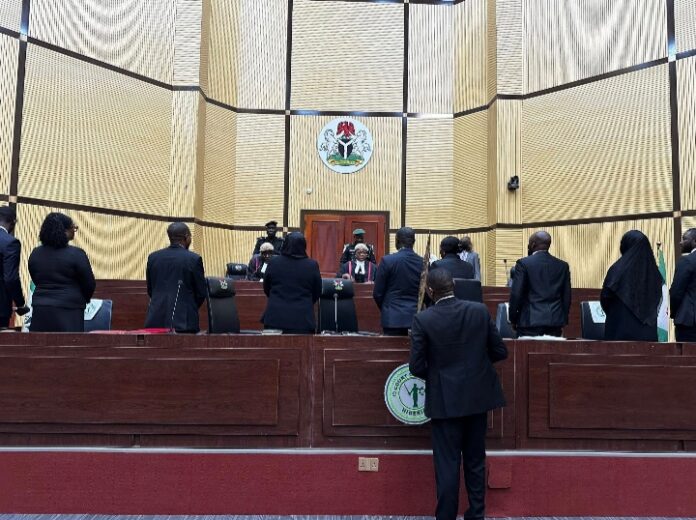
Powerless courts: Why Nigerians are turning to activists for justice
By Ishaya Ibrahim
On May 12, 2016, a Federal High Court in the Kaduna Division ordered the police to release the body of one of its own officers, Deputy Superintendent of Police Nambol Audu, to his family for burial. The police ignored the order and kept the corpse in a morgue for another two years.
Patricia Nambol, his wife, had dragged the Nigeria Police Force to court to compel it to release her husband’s body, which had lain in a Kaduna morgue for years by that point. The officer, who served as chief armourer of the Kaduna police command, was found dead in police custody three days after his arrest on October 23, 2014, on an allegation of gun-running. Police said he died by suicide, using a pistol he somehow obtained inside his cell.
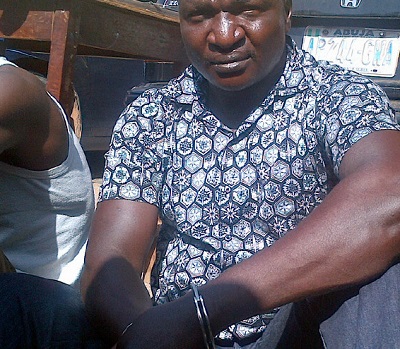
Audu’s family rejected the suicide narrative, alleging he was murdered to silence him or to cover up broader gun-running involvement.
They filed a suit (FHC/KD/CS/85/2014) at the Federal High Court, Kaduna, against the Inspector-General of Police (IGP) and the Kaduna State Commissioner of Police, seeking:
*A declaration that his right to life was violated.
*Release of his body for burial.
*N1 billion in compensation and damages.
On May 12, 2016, Justice Emeka Nwite — then of the Federal High Court, Kaduna Division, and now elevated to the Court of Appeal — ordered the police to release Audu’s body to his family. The police ignored the order and kept the body.
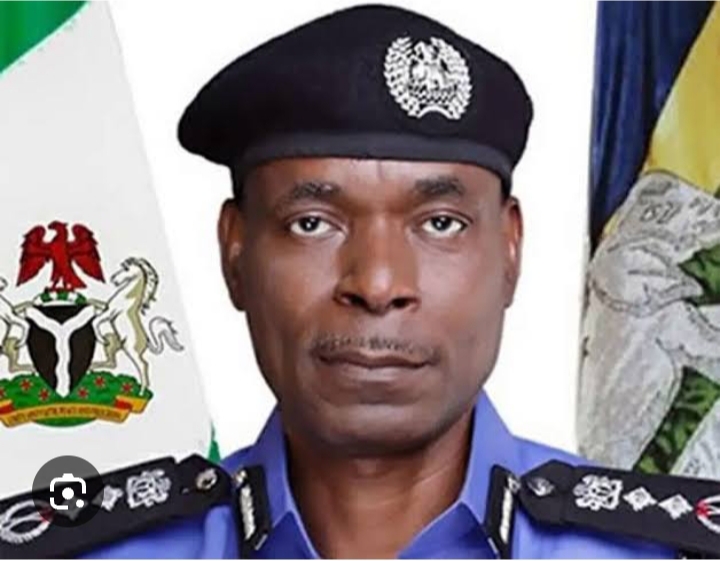
On February 12, 2018, then-Inspector General of Police Mohammed Adamu, acting through his principal staff officer, ACP AK Umar, directed the Kaduna State Police Command to release the body to Patricia Nambol Audu and to carry out an autopsy. That directive came after former military general and then-Senator for Plateau South, Jeremiah Useni — himself from the same state as the deceased officer — wrote to the IGP asking him to intervene.
The Kaduna command ignored its own IGP’s order, just as it had ignored the court.
Brekete family intervenes
Having found no relief through the judicial system, Patricia took her case to Human Rights Radio — popularly known as Brekete Family — in February 2025. By then, her husband’s body had spent more than a decade in the mortuary, racking up storage costs running into millions of naira.
The Brekete Radio conducts its programme like a courtroom, complete with a dock, a witness box, a jury stand, a clerk’s desk, and an elevated seat from which the station’s owner, Ahmed Isah — popularly known as “Ordinary President” — presides.

On air, Patricia recounted the trauma of losing her husband under circumstances she still disputes, and the decade without closure that followed. She reiterated her belief that the gun-running allegation was baseless and that his death in custody was a cover-up.
After hearing her account and reviewing the court documents and the ignored IGP directive, Isah phoned the then police spokesman, Muyiwa Adejobi, live on air. Adejobi asked that Patricia be brought to his office the next day at noon.
Within days of that meeting, the body her family had been unable to reclaim for over ten years — despite two court rulings and a direct order from the IGP — was released. She has since buried her husband.
A lawyer’s perspective
A lawyer who worked on the Nambol family’s case, speaking on condition of anonymity, marvelled at how quickly the matter was resolved once Brekete Family got involved, compared with years of stonewalling despite court orders.
“A matter we were doing for several years without headway with the police… Despite the court ordering the police to release the corpse, police kept being difficult until Brekete gave an order live on the radio. Police then agreed to release the corpse,” he told TheNiche.
He questioned the implications: “Do we want a system where activists are the ones resolving disputes? That will be a state run by a militia. We don’t want that.”
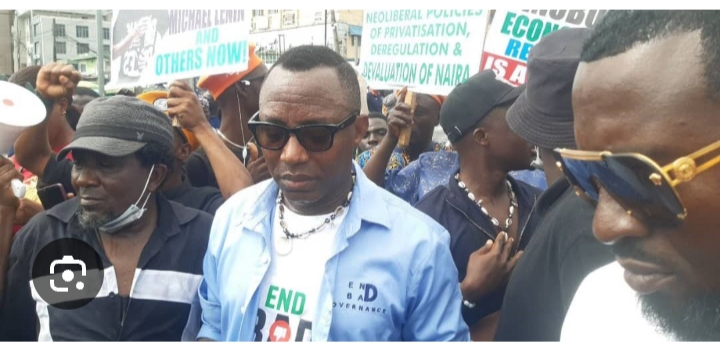
In recent years, many Nigerians have relied on activists to help them recover debts from individuals or organisations that refuse to pay, or to escape oppression at the hands of state institutions. Among the activists at the forefront of this effort are the presidential candidate of the African Action Congress (AAC), Omoyele Sowore, and social media influencer Martins Vincent Otse, popularly known as VDM.
The lawyer traced the roots of the judiciary’s decline: “These things have been going on for several years, and it was allowed to fester.”
He invoked a principle from Islamic law that evil left unchecked becomes entrenched. “We allowed this evil to become a monster.”
He pointed to history. He said complaints about judicial corruption predate independence. He cited the 1960s play The Incorruptible Judge, and infractions during military rule went unreported for years because journalists and lawyers had little access to those courts. Once exposed, practices such as judges dissolving marriages only to marry the parties involved, or court staff having relationships with litigants, revealed just how entrenched the rot had become. “The system has condoned it, and it has become a systematic thing,” he said.

A senior lawyer diagnoses the problem
Dr. Monday Onyeakachi Ubani (SAN), a senior lawyer and former chairman of the Nigerian Bar Association’s Ikeja branch, explained why many Nigerians now bypass the courts in favour of figures like VeryDarkMan, Sowore, and the Brekete Family.
“The growing public shift of confidence away from the formal judiciary to informal, populist platforms… is a loud indictment of the systemic failures within Nigeria’s judicial and justice delivery institutions,” he said.
Ubani outlined several drivers of this erosion of trust:
- Delay. Cases that should be straightforward drag on for years or decades, exhausting citizens’ patience and hope
- Corruption and influence. Allegations of bribery and political interference leave ordinary Nigerians feeling that outcomes are rigged in favour of the wealthy and powerful.
- Cost. Legal representation and even routine filings are prohibitively expensive for many citizens.
- Complexity. Court proceedings are technical and conducted in English, alienating rural and less-educated litigants.
- Weak enforcement. Even a courtroom win can feel hollow if the judgment is never enforced.
By contrast, he noted, populist influencers resolve disputes quickly, without the cost or complexity of formal litigation.
To rebuild public trust, Ubani proposed:
- Digitising and simplifying court processes, reducing adjournments, and penalising delay tactics.
- Empowering the National Judicial Council (NJC) to discipline corrupt judges and improve transparency in case allocation.
- Funding and expanding Legal Aid Councils and pro bono services for indigent citizens.
- Strengthening sheriffs and bailiffs to enforce judgments without corruption.
- Engaging the media, civil society, and grassroots communities to demystify the legal system.
He added: “People are not rejecting justice — they are rejecting a system they perceive as unjust, slow, and inaccessible. The judiciary must reform itself or risk becoming irrelevant to the common man. Informal platforms cannot replace the courts, but the judiciary must learn why people are losing confidence in them and change the system.”


