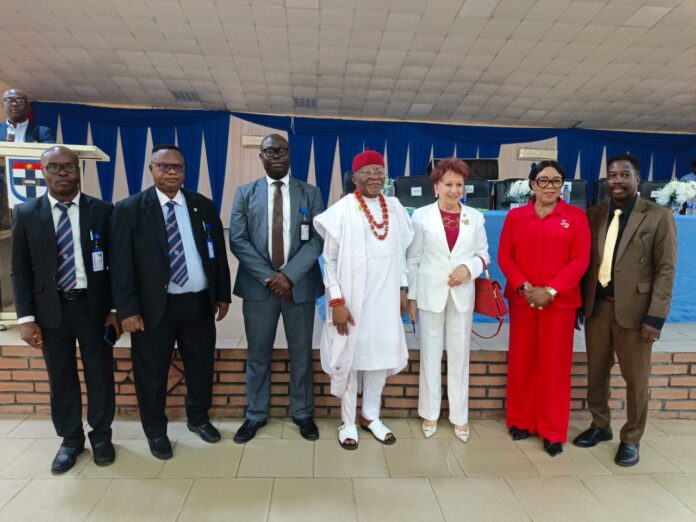
Former Head of the Department of Defence and Security Studies, Nigerian Defence Academy (NDA), Kaduna, Prof. Isaac Mbachu, has blamed poor governance, corruption, and weak accountability for the resurgence of military coups across Africa.
By Emma Ogbuehi
Former Head of the Department of Defence and Security Studies, Nigerian Defence Academy (NDA), Kaduna, Prof. Isaac Mbachu, has blamed poor governance, corruption, and weak accountability for the resurgence of military coups across Africa.
Mbachu said the growing wave of military interventions on the continent reflects deep public frustration with civilian leadership rather than merely a breakdown of democratic structures.
He spoke at the 2026 Diplomatic Dialogue Forum organised by the Department of International Relations and Diplomacy, Afe Babalola University, Ado Ekiti, where he delivered a lecture titled, “The Resurgence of Military Intervention in African Politics.”
READ ALSO:
From Ponzi scheme economics to liberation economics – the imperative of opposition rescue of Nigeria
According to him, the return of military rule in several African countries signals a collapse of trust between governments and citizens.
“The resurgence of military intervention in African politics is not simply a failure of the security sector; it is a systemic failure of the social contract between the state and its citizens,” he said.
Mbachu noted that between 2020 and 2025, Africa recorded at least 11 successful coups in countries including Mali, Guinea, Burkina Faso, Niger, Sudan, and Gabon.
He said the trend had reversed nearly two decades of democratic progress, warning that increasing civilian support for coups, particularly among young people, stems from disappointment with governance failures.
“The sure remedy to military intervention is good governance, accountability, and zero tolerance for corruption by political leaders,” he said.
The Don argued that sanctions and diplomatic isolation imposed on coup-hit nations had produced limited results, stressing that Africa must shift focus from merely conducting elections to delivering effective governance.
He also warned that ignorance of international relations and geopolitics among political leaders could worsen instability.
Mbachu added that weak institutions, inequality, economic frustration, and declining public trust in democratic systems have created fertile ground for military takeovers.
According to him, the resurgence of coups carries severe consequences, including democratic regression, political instability, weakened regional cooperation, declining investor confidence, and worsening insecurity.
Earlier, the Vice Chancellor of Afe Babalola University, Prof. Smaranda Olarinde, said the return of unconstitutional changes of government in Africa had raised fresh concerns about the future of democratic governance on the continent.
She described the forum as a platform for examining critical threats to Africa’s political stability and governance systems.