From Ponzi scheme economics to liberation economics – the imperative of opposition rescue of Nigeria
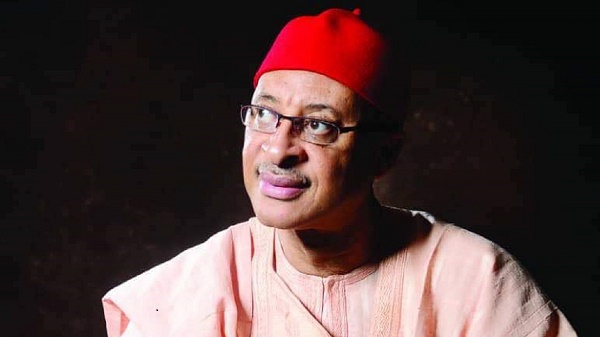
By Pat Utomi
Mr. Chairman, leaders of opposition political parties, ladies and gentlemen, allow me to begin with a preamble. I have been requested to address the subject of “Rebuilding a productive and dynamic and efficient economy for Nigeria – a way forward.” Such a discussion can sound esoteric, academic and impersonal so I want to put practical reality up front before turning to elegant presentation.
Yesterday as I pulled into a petrol station in Lagos to fill my tank for the journey to Ibadan I was reading a report, the Piggyvest Savings Report, which showed that 58% of Nigerians earn less than N100,000 a month. It struck me that two and half times the salaries of my compatriots had gone into that tank. Just then a siren blaring motorcade went by. It was at least a seven car convoy. I could not but imagine there goes the monthly income of 20 people. As I reflected on the cost of living it struck me that our current economic reality is a moral outrage. Many people manage to eat because relatives abroad send home a few dollars. Yet some people glow about what they call Tinubunomics and ask people who are dying to wait in hope for wonders while they are drinking Champagne.
Profligate spending in government, immoral borrowing and massive looting of the treasury goes on as business as usual while the people groan.
This is a tale of two cities. Apologies to Charles Dickens. Yet some people pretend to be neutral about the current state of things.
I remembered Dante’s inferno. The hottest part of hell is reserved for those who in the face of a moral crisis take refuge in neutrality. I do not want to end up in hell and certainly not that part of hell.
That people do not chant Enyi ole, Ebi mpa wa, every time big men pass by amazes me. I am also petrified as I hear World Bank statistics that nearly 130 million of us live in multidimensional poverty that we do not have more people of moral ambition out there leading protests.
I have chosen, therefore, to title my remarks: From Ponzi scheme economics to liberation economics – the imperative of opposition rescue of Nigeria.
Let me preface my remarks at this important summit with gratitude to the organizers for the privilege of return to this city of my nurture. Back in those days when the geography books educated us on the fact that Ibadan was the largest city in West Africa, I played my way from childhood to a determined young adulthood here on old Ife Road as a student at Loyola College.
In those days Nigeria was in a civil war. It prosecuted that war without borrowing. Today we have insurgences and we are so deep in debt that even a ripple can drown us.
It was military rule at the time I grew up here but we had Agbekoya farmers uprising and students protested regularly at the University of Ibadan.
When one, Kunle Adepeju, was killed by police bullets, as I was finishing high school here in 1971, the protests went on for years and I began University life at Nsukka in 1973 leading those protests there. Today students cannot protest anymore because they say every time they come out to express themselves in a ‘democracy,’ law enforcement slaughter and massacre them.
This has consequences for how the world evaluates freedom of expression and where they make investments and those they trade with. But those who pretend to be democrats are pleased to act like blood thirsty tyrants just to hold on to power.
When I went to school here I traveled with ease by train to the city of my birth, Kaduna. There the traffic surge at the end of a shift, be they bicycles or motorcycles, in one of the textile mills, showed the vibrancy of one of the more transforming economic experiences of that era in the world.
I recall that colonial Nigeria, focusing on its purpose of extracting raw materials for industry in Europe, had ignored manufacturing in Nigeria.
When self-Government arrived by 1957 and Nigerians became premiers and ministers there was a competition between the regions in the rush to industrialization.
Chief Obafemi Awolowo, as Premier of Western Region kicked off the rush to set up industrial estates in Ikeja, to which his counterpart in the East, Dr. Michael Okpara, responded with Aba and Trans Amadi in Port Harcourt, and the Sardauna in the North with Kakuri Industrial Park in Kaduna. There he matched the natural evolution of Bompai in Kano, focusing on the Region’s factor endowment in Cotton.
At Independence in 1960, manufacturing had moved from nearly zero as a percentage of GDP in 1956 to 20% of GDP.
Irene Sun, a China born McKinsey consultant tells us one of those factories in Kaduna broke even in one month and had presold its production in its first six months to Manchester merchants in the UK. Talk about export led manufacturing industrialization.
Today those in charge ask us to trust them that after three years of suffering the result is something we should hope for. Looks like we may be dead when hope shows up in the horizon.
When I begin the main discussion, after this prologue, I will show that hope being lost in renewed hope is understandable. The people perceive hopelessness which they themselves are signaling by sacking the head of the economic team. By way of irony, it was here in Ibadan, at a Nigerian Tribune event at Premier Hotel that my good friend Wale Edun who was then Lagos State Commissioner for Finance came to complain to me about my pressuring President Olusegun Obasanjo to establish a savings of Oil Windfall which he said was taking away the money of the states and I reminded him he was an Investment Banker and should understand Mutual Funds. Part of our current mess is not understanding saving windfalls and investing for future growth.
We have been down this path of stabilization reforms they call renewed hope and that its end is utter hopelessness. I remember SAP everyday.
My Loyola years left me certain about a few things. One of them is that character matters. Our rivals here in Ibadan, Government College Ibadan clearly taught the same thing. A mentor of mine, Dr. Christopher Kolade, and his classmates I got to admire and to become friendly with, like Prof. Ladipo Akinkugbe, clearly lived that out.
My Loyola mates chanted their Oriki to remind themselves of whose sons they were. They knew what it was to be called Omo Oluwabi. Today shame is dead. Our economy is crippled by state capture. This is why the opposition must have a character checklist for people who seek office, entrench checks and balances and erect institutions that constitute boundaries for acceptable conduct.
The problem of the Economy is that those who manage it today lack character, compared with those who did so between 1957 and the early 1960s. That is why the earlier group transformed the economy in three years of self-government and those managing it today tell us after three years to have hope.
How can you ask people to bear pains for a season and you use their limited resources to buy Presidential Jets where befitting ones existed; and a Yatch, and go on a binge of luxury automobiles acquisition. Add to this ridiculous budget for food in the Villa and the unconstitutional abuses of the budget process.
My parents realized the value of character, and decided on Catholic education as the path; so I started school in St Thomas Primary in Kano, and to Our Lady of Fatima in Gusau, and got secondary school bound towards St John’s Kaduna, the leading Catholic school in the North when political crisis led me instead to the leading Catholic school in the East, CKC, Onitsha. The civil war caused me to move west from CKC to Loyola, the leading Catholic school in the West. When I grew up, a man’s word was his bond. If you say you will quit if you do not solve the power problem, you simply kept your word, even if a force from hell could be seen as the obstacle.
We neglect education and character education, at our peril.
One government secondary school in Owerri went as far as to incorporate it into its motto: when wealth is lost, nothing is lost, when health is lost, something is lost, when character is lost, all is lost.
Our economy is where it is because character has been lost. To save ourselves we need to place the management of the economy in the hands of people who have character and can feel the pain of others. Human solidarity is not only a moral imperative it is the basis of inclusion and economic expansion.
Before I leave the subject of gratitude to Ibadan, let me speak to one more important thing I learnt here. In my class, in Loyola, or one or two classes below were children of ministers. I remember the Enahoros, those of leading business families, the Runsewes and Sadipes in my class, children of Judges, like the Ademolas, Gboyega Ademola, being a close friend; of children of washermen, and farmers. None was the child of a lesser god. We were all just kids chasing dreams.
Today it is not the same anymore. And the economic choices of current leaders, many of who come from among the poorest of the poor, trample the dignity of the poor, and remove the ladders of social mobility. This is the tragedy of now.
Let me now turn to the heart of my lecture: How economic prospects in Nigeria dipped and what we must do about it.
How does anyone explain that a country with a youth bulge and can harvest a demographic dividend; is endowed with fertile agricultural lands, solid minerals, oil, ocean facing cities and a long coast line with blue economy prospects manage to be called the poverty capital of the world?
This is the ultimate paradox and the solution is in understanding the place of the prosperity paradox in the theories of development from which we derive policy choices; the strength of our institutions; and our values.
I do not have the time here for a very comprehensive analysis but it will be enough to say that the ‘curse of oil’ marked majorly by Dutch disease, and abandoning of the principle of subsidiarity, or decentralization, which led to the rise of manufacturing in the late 1950s, in addition to the arrival of a prebendal culture of sharing the so called national cake, and corruption wrath havoc on potential.
We are where we are today because advice on saving the oil windfall was not followed. Instead of revenues going into a Distributable Pool Fund (FAAC account), a Stabilization Fund and a Future fund, we went profligate with spending and fell into a debt trap. SAP became inevitable but its promise proved a Ponzi scheme that favoured players in financial services and those favoured in privatization exercises.
In 2023 we repeated the mistakes of SAP and were told to wait in hope. Now people have run out of patience and have stopped hoping. How shall we liberate these people?
Quo Vadis. Where do we go from here?
We have to move from stabilization to high economic growth; consumption by a narrow elite which is fueled by economic rent, to production for export and local consumption by a broad mass consumer market; from retrenchment to jobs, and from exclusion to inclusion. So how will we deliver on this?
The thrust of policy is to build, with continuity from the new foundation, future proofing a world class quality of life for the average citizen through investments, institutions and culture that sustain the expansion of the economy and massive creation of quality jobs and entrepreneurship opportunities flowing from the demographic dividend of our youth bulge. This surge will derive from factor endowments well spread across Nigeria, if prosecuted by a disciplined non-thieving elite.
Here I want to point us to the thought leadership of the late Clayton Christensen on what has been called the prosperity paradox which is a key factor in my critique of why Washington Consensus ideas in SAP failed in my forthcoming book but I do not want to get academic here.
This thrust of policy will derive from intentional public investment in education and industry clusters supported by infrastructure linkages that facilitate aggregation for a significant share in global value chains rooted in select factor endowments from the six geopolitical zones to assure balanced prosperity.
The fundamental departure of the policy framework of these proposals from extant reality is that current orientation is from the bias of a narcissistic politically privileged class prioritizing their comforts over the greater public good.
The failure to prioritize solving the electricity and ICT connectivity problems over opportunity for politicians and their friends lining their pockets, has been the Achilles heels of the extant order. As South Africans set up the Zondo commission to probe state capture, our own legislators are decriminalizing certificate forgery and not questioning criteria for contract awards.
The easiest example is the building of Airports that are seldom used. An Airport that sees the dispatch of less than a dozen flights a day is troubling suboptimization and abuse of public resources; yet many with less than an hour’s drive from the nearby Airport have less than three commercial flights a day. Yet we see one state or the other embarking on such poorly reasoned public choice. Some are even considering a second Airport.
Following a commitment to the principle of subsidiarity which will make the local government and the other sub national, the state government, core drivers of industrialization, based on the value chains of the factor endowments of that local development area, we need to erect production clusters and innovation hubs. These value chains will influence curriculum of schools from the primary and secondary schools to assure productivity that is globally competitive.
The truth is we have to be ready to ask and answer a few basic questions to decide whether we want Nigeria to continue down the road to serfdom and human misery or to enable people chant our liberation is near at hand.
So what did Deng Xiao Ping do that changed China’s course from worse than us to so much better than us today?
What did the ‘Berkeley mafia’ group of economists advice Suharto to do that enabled Indonesia diversify its economic base when oil revenues surged? If we answer these questions, overcome the mystery of capital, and govern with discipline, build institutions that embed entrepreneurship in development planning, and integrity, a new Nigeria of posterity will emerge.
We know from the many speeches given in 1978 by Deng how China saw its future in education and knowledge. What we see today is a return on that wisdom. You cannot be capital of out of school children and hope to have a competitive economy. Advice to Suharto not only prevented an exchange rate regime that worked against diversification of the base of the economy and the distortion of Labour markets by the dominance of the non-tradable goods sector of the economy.
Just like Mahatma Ghandi identified the 7 deadly Social sins, we need to nail down deadly economic development ills:
1. Failing to place the people at the centre of economic and development policy choices
2. Thinking zero sum where an abundance mindset can be the modus vivendi
3. Using policy choices to support consumption of a few rather than facilitating production
4. Pursuing state capture that favour parasitic contractors
5. Failing to provide investment in education that propel innovation, grassroots entrepreneurship to the detriment of an aristocracy of talent that makes merit king
6. Pursuit of Dirigite orientation that spreads a culture of corruption, poor accountability rather than value creation that expands job opportunities
7. Neglecting to build strong Institutions and an entrepreneurial civil service
Our relevance as political parties depends not only on socializing our members, especially those who are running for office to avoid these sins. It also depends on our training aspirants to understand the economics of sustained growth and progress and how current affairs affect economic policy options.
Our idea of an entrepreneurial people’s capitalism driven by value creation that adds new jobs to the economy und up the ideology of the coalition of political parties working together on rescuing Nigeria. Our clear goal is making markets work in a system of checks and balances between the public sector, the private sector and the none-governmental social enterprise regime.
Let me close by saying that I am persuaded that with such thinking the people will come with us, and that with faithful implementation the people will stay with us and Nigeria will rise up again.
- Speech delivered by Prof Pat Utomi to opposition political leaders in Ibadan on Saturday, April 25, 2026