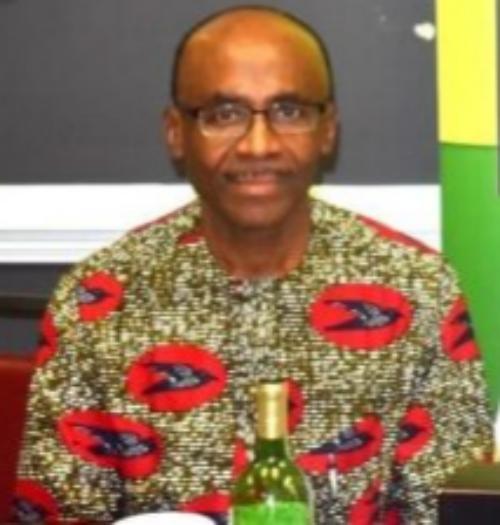
Overview of Mbaise strategic development priorities: Mbaise People’s Congress is championing the Mbaise University project in Ife. Whatever your persuasion regarding this project, please understand that the train has since left the station. Better to get on board and help get it to the right destination… let’s all be part of the development we seek. Everyone has something to offer – time, ideas, money, talent, experience, publicity skills, executive skills, etc. If you’re in a position of public trust, be honest, transparent, and accountable. And remember that you are expected to serve the public interest with integrity. This is a requirement of good leadership and good governance. Let’s never forget the power of example – the ability to inspire or influence other people through our actions, not just our words.
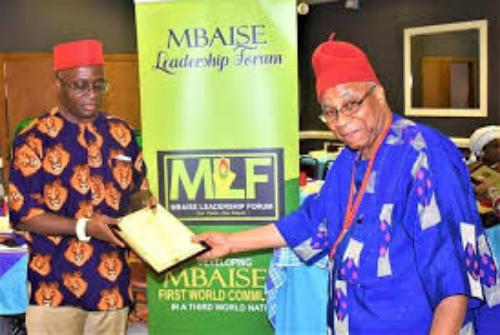
Dr. Sylvester Ugoh (R), former chairman of the Mbaise Global Foundation Board of Trustees (BoT) being presented an award by Ezeji Alozie Aguwa, President of the Mbaise USA
By Chris Ohanele
Preamble
I believe that every Mbaise adult knows our development priorities. We may articulate them differently, but surely, we know what they are. But for the avoidance of doubt, let me clarify upfront. Our strategic development priorities are those high-impact development sectors necessary to achieve our vision. And our vision is to develop Mbaise into a first world community in a third world country. First world community? Yes, and that simply means having good quality public infrastructure, economic opportunities, and an elevated standard of living.
In 2019 at the Mbaise Leadership Form (MLF) strategy summit that kicked off the Mbaise USA convention that year in Arlington, Virginia, I presented a summary of the Mbaise strategic master plan which outlines many of the priorities. The master plan was published by MLF and formally presented to Ezuruezu Mbaise in December 2019.
That presentation also included an Mbaise Wish List meant for the attention of the new governor, Hon. Emeka Ihedioha, and channeled through the president-general, Ezuruezu Mbaise, Barrister Cyril Anyanwu. We all know how events unfolded the following year, in 2020, resulting in a change of governor.
Individual progress and community challenges
All over Mbaise there is ample evidence of individual progress mostly in the form of modern residential homes and cars and private water supply facilities, and solar-powered homes, etc. You will also see the progress in banking and telecommunications, which has made it easy to move money around without requiring a “Ghana Must Go”, and to communicate instantly with anyone around the world. That is progress that positively impacted the community, made possible by collaboration of government and the private sector. But we are still confronted by a host of other developmental challenges. We must focus on addressing them, especially the collective challenges.
Whether in a remote village or while driving along any of our ill-maintained roads, we inevitably experience mixed emotions as we look around. While we acknowledge the signs of individual progress that are present before our eyes, at the same time, we are appalled by the sights and sounds of lingering underdevelopment of the community. This stark contrast – signs of progress coexisting alongside systemic poverty and dilapidated infrastructure – is not peculiar to Mbaise, though.
From personal experience garnered in other parts of Nigeria that I’ve lived – Oyo, Niger, Edo, Lagos, Delta, and Rivers states – and through credible accounts by people from multiple ethnicities, I can confidently say, and most people would agree, that Igbo villages are among the most livable in Nigeria. Obviously, Mbaise has much to show in this regard.
Take any cross section. From Ekwerazu to Nguru to Uvuru and perhaps back to Chokoneze to Lorji to Ife or from Enyiogugu to Ahiara to Achi Ngali unto Onicha and Obizi, an observant person will be impressed by the modern houses along the way, many of them single-storey residential buildings, occupied and unoccupied. But between and around them are the humble dwellings of the less privileged majority who are doing their best to eke out a living and barely escape the indignity of poverty and deprivation.
Development priorities
Economic development
Referring to poor majority, they spend their workday mostly on the farm or in the hustle and bustle of the market. You see them heading out early in the day, many on foot trekking long distances, sometimes in defiance of the weather. Some get on board one of those rickety buses, invariably overloaded with goods and wares. Okada (motorcycle) riders are also out early and doing brisk business, the sound of their motorbikes adding to the day’s noise. These are all simple, hardworking folks trying to earn an honest living. But their ceaseless striving is met with the harsh reality of a depressed national economy and slow economic development. In general, they are cash-starved and can ill afford many basic goods and services which have become ever more expensive.
Public power supply
At the end of the day, they lay their heads for a well-deserved rest but the peace and quiet of the night is interrupted by the noise of personal power generators, sometimes coming as a buzz from the compound of a more privileged neighbour. Whether privileged or not, everyone is constantly reminded that public power supply is epileptic and highly unreliable. If you need power, you must have your own generator. And blessed are those who can still afford to power theirs despite the exorbitant fuel cost.
But for those who cannot afford it and do not own one, their nights are, at least, quieter, albeit darker. In the absence of reliable public power supply solar power is now a welcome alternative and increasing in popularity.
The lack of stable power has for years significantly contributed to stifle economic activity and economic development. And low economic growth and high inflation are impediments to the expansion of economic opportunities.
READ ALSO: Set your sights higher than mere survival, Mbaise USA, MLF counsel Ndigbo
Skills acquisition and employment
Skills acquisition is a priority also. The high preference for university degrees has resulted in too many young people shunning vocational training and apprenticeships. Consider that the job market is unfavourable to young university graduates and those who would rather set up their own small-scale businesses have little access to credit. Thus, society is faced with high, youth unemployment.
There can be no excuse for crime. But surely low economic development, high youth unemployment and a host of other factors have left in their wake a large mass of embittered destitution. Frustrated, unemployed and resentful young people with little access to economic opportunities are bad for any community. Sadly, many of them have taken to crime and into the shadow economy further compounding existing security challenges.
Security
Any conversation between Mbaise people at home or abroad would be incomplete without talking about the incessant insecurity of lives and property at home. Surely, Mbaise is not immune to the systemic social breakdown in Nigeria. Terrorism and banditry may be largely confined to far places in the north of the country but armed robbery, kidnapping, identity theft, internet fraud and financial crimes, assassinations, and ritual killings are no longer crimes that happen only in other places. There are many accounts of such crimes in and around our once peaceful Mbaise communities.
This is serious stuff that we must continue to address seriously and responsibly. But we must refrain from exaggeration and fear mongering. And we must stop deluding ourselves that the insecurity in Mbaise and Imo State is primarily caused by people from the north. Home-grown security challenges and home-grown perpetrators must be taken seriously too.
Education
Public primary and secondary schools are in a state of dilapidation owing to decades of neglect. Many school buildings do not have roofs, and many do not have doors or windows. When it rains, it pours on pupils. When the wind comes it blows away not only their books but also their faith in the system. There are not enough teachers, not to mention the qualifications of some of them. And the few in service are poorly paid and demoralized. Should we still be wondering why they’re not much bothered by the general indiscipline that descended on schools many years ago. Why should we be surprised that the quality of graduates has declined? We can all agree that the problem is not inherent intelligence.
The problem is the decline of the education system, especially in the areas of school infrastructure, management, staffing, and funding.
Sanitation, water supply, and environment
We have a sanitation problem and not much is being said about it. Whether on the roads or in the markets, motor parks, or abattoirs there is ample evidence of the lack of adequate public health systems to dispose of waste, be it plastics, garbage or other forms. Poor sanitation ruins the environment with consequences for almost every facet of society including human health and the economy.
A key component of sanitation is clean water supply, private and public. Regrettably, clean water supply is unavailable to most of our people. Private boreholes have therefore become essential infrastructure in the homes of more privileged people that can afford it. Gratefully, some of them have extended water supply lines to nearby schools and to the public.
We should be asking ourselves some pertinent questions. For instance, how is it that in this 21st century there are no public toilet facilities in our markets? How many churches in Mbaise have toilets supplied with clean water? What about waiting at the motor park at Eke Ahiara or Eke Nguru or Nkwogwu, for instance, and needing to use the toilet? It has to be said that the dignity of our people is inseparable from the quality of development that is available to them.
Healthcare
We have serious public healthcare challenges including insufficient hospitals, clinics, doctors and other healthcare professionals; ill equipped and ill maintained facilities; inadequate emergency response services; low health insurance coverage; low preventive care; fake and expired drugs as well as medical costs.
The lack of clean, potable water and overall poor sanitation have had a telling effect on the health and hygiene of the community. If health is the overall state of well-being – physical, mental, social, – hygiene encompasses the practices and habits necessary to maintain good health and prevent disease. The absence of clean, potable water militates against healthy practices, making it more difficult to prevent the transmission of diseases like typhoid, cholera and dysentery.
In Nigeria, one does not need to be a medical doctor to make that most common of diagnoses – malaria and typhoid. When was the last time you saw someone step out of the doctor’s office who was not told that the sickness is malaria and typhoid?
My brothers and sisters, the foregoing paragraphs contain a synopsis of most of our development priorities – Economic Development; Skills Acquisition and Employment; Power Supply; Security; Education; Sanitation and Clean Water Supply; Healthcare; the Environment; etc.
They are outlined in the Mbaise Strategic Development Master Plan. Note that these priorities are interconnected with and significantly impacted bythe quality of governance. And good governance we do not have. This brings me to our political priorities, which I will discuss in the next few paragraphs under leadership.
The overarching priority – Leadership
Identifying our development priorities is one thing, addressing them is another matter. Many people would suggest that we need to apply all available resources, means, and possible leverages to get the job done.
That means we need to be organized, and we need to have a plan. We need to support Ezuruezu as the apex socio-cultural organization. We have multiple Mbaise organizations at home and abroad working for Mbaise development. There should be some degree of coordination and collaboration between them for greater synergy. We have three local governments, and we need to engage them and persuade them to do more.
I’m sure they have their challenges and they may not feel free to speak out openly or loudly. But we must engage them. Too many of us spend so much time on the affairs of faraway states in Nigeria when we can’t even sit down with our own local government officials? How do we propose to impact anything outside Imo state but cannot influence what goes on in Owerri or at the local governments in Mbaise?
We must continue to build bridges to other parts of Imo State to improve our chances of getting our people elected as governor or to other positions in Abuja. We must engage our elected representatives at all levels, respectfully and clearly, and hold them accountable for their service or lack thereof. For these and many other action, we need leaders and, more crucially, we need leadership.
We should never stop asking questions. For instance, are we satisfied that the current crop of political leaders are delivering good results? Are they accessible enough? Do we ask them hard questions? Are they even willing to entertain our questions? Are they transparent about funds allocations meant for their constituents? What have they been doing with them?
These are not judgmental questions. I believe that people would appreciate being informed on matters that concern them. Going forward, what kind of leaders do we need? And how can we convince them to get on board and serve the public interest? What quality of leadership should we expect from them? If these are pertinent questions, we should be posing them and we should be expecting honest answers and insights from the people who should know.
It is my considered view that, for sustainable development, we must solve the perennial, seemingly intractable challenge of Leadership. This is the overarching challenge not just for Mbaise but for Imo state and for Nigeria.
By leadership I do not mean politicians or other people who merely occupy positions but are incapable of providing the leadership we truly need. We can all agree that some of them are good, but most are not. When I say leadership, I am not just referring to people with titles, whether in politics or the corporate world or in the community. I’m certainly not thinking about loud-mouthed, corrupt people, some of them current or former executives and Honourables, who desperately want power to gain access to public resources rather than serve the public good. And it is not about the length of their convoy or the volume of their dress. No!
My mind is on the quality of leadership. The quality expected from educated, enlightened people with integrity; people who are willing and able to selflessly serve the public interest and stand by their conviction. I’m talking about people who can manage public resources judiciously and be accountable. That is the kind of people we need and they exist among us. I call them the right people. Through their example they will inspire us to work together towards our shared purpose of development and progress. This is not wishful thinking. It is a realistic proposition.
Everyone does not need to be at this top level at the same time. And we will not arrive at this destination overnight. We just need to have a critical mass of them to make the difference we need. And others will come on board. Remember this: The road from Myopia to Utopia passes through Ethiopia. No less important, and in parallel, is how can we discourage the unfit, corrupt people that currently infest the public space, especially politics? Have they not done enough damage already?
Need to be well-organized
A word on the need to be well organized. Organizing people and managing resources are critical components of effective leadership. And good organization is indispensable to effective collective action.
Notice that the key difference between us and the so-called advanced countries, be they in the west or east, lies in the quality of organization. It’s not intelligence. It’s not that we lack educated people. Obviously, we don’t. The big difference is in organizational ability. While they’re relatively well organized, we are generally disorganized, often individualistic.
The right quality of leadership will create the necessary framework that ensures good organization. Individual action is good but collective action is best to develop the community. To be well organized requires us to collaborate and build greater synergy.
That means we must build trust and build relationships. When we are well organized, we become more effective in aligning our priorities as well as sharing ideas and goals and common purpose. And we become more effective in mobilizing our people to work in synergy towards achieving that common purpose. To do all that requires mutual respect and ability to manage our individual ego.
What we must do and what we are doing
I believe that everyone has a role to play – various organizations, and individuals. But we should be clear that nothing we do can relieve government of its responsibility to manage public resources well and provide good governance. Therefore, we must redouble efforts to bring to the attention of government our legitimate needs that are within government’s purview. For instance, building roads, maintaining existing ones, funding education, providing security, ensuring a fair, strong justice system, etc. Meanwhile, we must continue our self-help efforts for which Ndigbo are well known.
In this regard I’d like to briefly mention what MLF, and others have been doing to help ourselves. I have neither the time nor the complete data to discuss this exhaustively. But I’ll say a few examples.
Mbaise associations
For years Mbaise USA has organized medical missions to Mbaise, sometimes in collaboration with other organizations. It is also pursuing the Medville project for which it has been allocated a vast area at Ife.
Mbaise People’s Congress is championing the Mbaise University project in Ife. Whatever your persuasion regarding this project, please understand that the train has since left the station. Better to get on board and help get it to the right destination.
Mbaise Top seed is leading the effort to revive our cultural dances and holds annual competitions in Mbaise. I attended the last one in December 2025, and it was beautiful. I recommend that you attend the next one this December.
It is also important to acknowledge that various communities have been renovating primary schools and putting smiles on the faces of pupils. We have seen recent examples in Ezuhu Nguru Nweke as well as Oboama and Onicha Ezinihitte.
Old boys and girls and communities have also renovated secondary schools or are currently doing so. Some communities like Ezialakaohu in Nguru and some individuals have built health centres and staffed them and are paying the workers. Some individuals have hired elementary school teachers and paying them. Some others are providing solar power to light up village streets. We must commend these efforts and appreciate the people who are making sacrifices to develop Mbaise. Let us agree that any development project in Mbaise is good for Mbaise. And let us understand that we are better off working together, in collaboration towards our common purpose of Mbaise development.
Now to Mbaise Leadership Forum and Mbaise Global Foundation. In their different ways they have been doing quite a bit as well. And I’d like to make some remarks about them at this point.
What MLF has been doing
Mbaise Leadership Forum (MLF) was set up in 2016 by Mbaise USA as an operationally independent think tank. An important component of its work is advocacy – trying to influence people and governments to address challenges and facilitate the development of the community.
Master Plan
A deliberate, structured plan is essential for building a strong community. Vibrant networks do not occur by accident; they require a baseline design to transform isolated individuals into a unified group. Whether establishing an online network or developing a community like Mbaise, a strategic framework is essential to chart the future and provide a road map towards our vision. This is what MLF is about.
In 2019 MLF published a strategic development master plan with a 50-year outlook. The plan was formally presented to Ezuruezu in December 2019 at the civic centre, Aboh and received by then president general, Barrister Cyril Anyanwu.
The master plan is essentially a compendium based on the recommendations of various committees comprising members of MLF and expert presentations by eminent Mbaise sons and daughters as well as two former ministers in 2017 and 2018. The good work done by my predecessor as moderator, Prof. Eddy Oparaoji, and the Admin team and dozens of committee members, is acknowledged and appreciated.
As a road map, the master plan must be subject to occasional course correction and should be updated from time to time to incorporate new ideas and projects and new approaches. During my tenure as the Moderator, we in the Admin team decided that we should organize a public event in Mbaise to formally launch the plan. That action is still pending, and I expect the new Moderator, Prof. Pauly Chigbu, to take it up in coordination with MGF.
Education
Like other well-meaning entities, Mbaise Leadership Forum (MLF) is appalled by the decline in the education system evident in the dilapidation of school infrastructure, inadequate funding and staffing, indiscipline, exam malpractices, etc. In 2021 MLF started the Adopt-A-School initiative to encourage old boys and girls as well as communities to organize themselves to renovate secondary schools in Mbaise. While we cannot take full credit, MLF is proud that its advocacy has significantly contributed to progress recorded in some schools during these past few years – e.g. Mbaise Secondary School, Pater Noster, Amumara Girls, Nguru Secondary School, Oji Nwambe, etc.
We must not forget that some schools have been closed for years. Probably the most prominent is Girl’s Secondary School, Ogbor Nguru. Every ongoing effort should continue to ensure that this and other affected schools are reopened and made ready for occupation and for studies.
Markets Report
In 2020 MLF set up a Markets committee chaired by Mazi Alban Acholonu. Among other things the committee was asked (i) to propose at least two development projects such as borehole water scheme, solar power supply, or business centre within or in the vicinity of selected markets in the three LGAs, and (ii) to propose some markets as economic development hubs, e.g. a hub for building materials, a hub for leather and textiles, and a hub for electronics products.
The committee did a very good job and produced a good, actionable report in September 2020 which was well received and which I forwarded to the chairman, economic development committee, Dr. Frank Ihekwoaba. The new Moderator and I have discussed this recently and he will review the report and decide, in consultation, how best to move forward with the recommendations.
Setting up Mbaise Global Foundation (MGF)
To implement the master plan, MLF and Mbaise USA, in 2020, on the recommendation of Prof. Phillip Amadi, and in consultation with Ezuruezu Mbaise, jointly set up Mbaise Global Foundation (MGF) as a nonprofit entity to source and manage the required funds. This is pursuant to the previously stated imperative of organizing ourselves well to work collaboratively towards achieving our common purpose. Former president Mbaise USA, Chief S.O.S. Echendu; former vice-president Mbaise USA, Ezeji Alozie Aguwa (who is now the incumbent); former president general Ezuruezu Mbaise, Barrister Cyril Anyanwu; the incumbent president-general Ezuruezu, Sir Joe Anosikeh; and Prof. Amadi, are all members of MLF. Their contributions to setting up MGF are acknowledged and highly appreciated.
We had the foundation registered with corporate affairs commission in Abuja and opened an account with Fidelity Bank. For these we relied on two other members of MLF, respectively – the legal adviser of MGF, Barrister Emeka Ibe and the Treasurer, Chief Anogwi Anyanwu. They put in significant amounts of their time and money to achieve the desired results. We are grateful for their contributions. Barrister Emeka Ibe is now the incumbent executive director of MGF.
We also acknowledge and appreciate Prince Dyke Anyanwu, the vibrant, indomitable director, media/publicity, for his relentless efforts to inform the public about MGF activities.
Membership of MGF is open to Mbaise organizations that share its purpose and are willing to collaborate with others. Currently, there are ten members including MLF, Mbaise USA, and Mbaise Europe but more work needs to be done to strengthen the collaboration and make sure that the spirit and the letter of the terms of association signed in 2024 come together.
What MGF has been doing
The first test of this collaboration happened soon after its inception in 2020, during the covid-19 pandemic. MLF teamed up with Mbaise USA and Mbaise Europe to respond to the covid-19 emergency. We raised money through freewill donations to create awareness of the pandemic, encourage preventive measures, and provide palliatives for our people in Mbaise. That collaboration was acclaimed as highly successful.
MGF has a Board of Trustees (BoT) comprised of Mbaise sons and daughters. The incumbent chairman is Barrister Louis Alozie who succeeded the honorable Dr. Sylvester Ugoh in 2025. MGF also has a team of executive officers who manage the day-to-day affairs of the nascent foundation. The incumbent executive director is Barrister Emeka Ibe.
As part of MGF’s governance structure, the BoT approved several committees (or advisory councils) to address various development sectors including security, education, healthcare, economic development and finance, innovation and technology, as well as media and publicity. Some of them worked well and produced results. Regrettably, others have not but we still hope they will get to work.
We also set up a committee for another important aspect of our development that is not addressed in the master plan – Women Development. I’d now like to say a few words about that. Later I’ll also comment on economic development, security, road infrastructure, as well as innovation and technology.
Women Development
Increasing prosperity and reducing poverty must be the goal of sustainable economic development, one that permits the participation of the largest possible number of the population. Looking after our female folks goes a long way towards achieving that goal.
In a rural community like Mbaise where customs and traditions are strong, we cannot take for granted that the interests of our female compatriots are adequately accounted for to enable their equal participation. Despite much progress and in recognition of certain cultural realities, we must continue to address important matters affecting our women and girls. We must develop strategies to remove any remaining prejudices and impediments and take actions that enable full expression of their talents and abilities.
Consequently, during my time as executive director of MGF, my colleagues and I set up a women development advisory council, to address these matters. The members of the committee are educated and motivated Mbaise women in Nigeria and abroad. The maiden chairperson was Dr. Linda Ngozi Enwere-Imoh assisted by four co-chairpersons and supported by a network of coordinators in all 93 autonomous communities.
The council specifically focused on the education of the girl child, female health and hygiene, sexual abuse and exploitation, skills acquisition like fashion design, confectionery training, etc. empowering them by handing the starter packs and finding ways to improve their access to credit. The council organized lectures and workshops and held Annual women’s global day events rotated among the three LGAs that included fashion shows and attracted hundreds of women and girls.
Dozens of young women were awarded academic scholarships and granted loans to start small businesses. Selected indigent women were given wrappers and cash donations. All told, the council laid a solid foundation for future progress not just for women but by extension the wider Mbaise community. We expect the new chairperson, Dr. Alice Ukaegbu, and her expanded group of co-chairpersons, to maintain momentum. Let us give her and her advisory council our full support.
Economic Development
Every priority has significant impact on the economic development of the community. So, we set up the economic development committee, chaired by Dr. Frank Ihekwoaba, and they have been working quietly to develop a business plan for the proposed microfinance bank. In addition to the chairman, some members of the committee like Prof. Bongo Adi, Sir Stanley Amuchie, Prince Dyke Anyanwu, and Mr. Nnaemeka Nwachukwu have made significant contribution in one way or another and we are grateful to them. The committee will now turn their attention to also producing a business plan for the proposed security company. We urge them to keep pushing and not relent.
Security
Security enables a peaceful, stable environment for economic development which in turn enables jobs and other resources to fund, equip, and reinforce security frameworks. To enable economic activities, we must continue to improve security in Mbaise.
To this end, in 2020 following consultations with Ezuruezu leaders including Air Commodore Luke Ochulor (Rtd.) who was the trustee responsible for security, MGF set up Chekwamba as the security arm of the foundation. Brig. Gen. Joe Osuji (Rtd.) was appointed as the chairman and supported by a co-chairman for each of the three LGAs.
In April 2021 Chekwamba organized a security strategy meeting at Chris V1 hotel, Ahiara, attended by many Nde Eze and others. MGF also held a virtual town hall meeting attended by about 200 Mbaise people in many countries. These efforts contributed significantly to raise awareness of the increasing security challenges in Mbaise and make more people take ownership.
Following the EndSars protests of October 2020, MGF set out to rebuild the police stations that were destroyed in the wake of those protests. The Aboh police station was rebuilt but destroyed a second time, confirming the concern some people had expressed earlier. However, the station at Itu was rebuilt and commissioned and stands as testament to the resilience and determination demonstrated by Ndi Ezinihitte. They set up Ezinihitte Stakeholders Forum and contributed generously to fund the renovation project. We are also aware that one or two Mbaise sons also built police stations which they donated to the community. They deserve our deep appreciation.
Some people have recently complained about what they call Chekwamba’s lack of visibility in Mbaise. If they interpret that as lack of activity or effectiveness, they are wrong. Surely, Chekwamba can do more as there is always room for improvement. We can all do better. But I want to be clear about this: Chekwamba has since evolved into an advocacy group, in response to the political environment in Mbaise and Imo state.
Adaptation is essential for survival and Chekwamba had to adapt to the realities of the environment in which it exists. We are all Chekwamba as long as we are advocating for Mbaise security in whatever capacity.
At inception some people had suggested, and many had expected, Chekwamba to set up a centralized armed, uniformed vigilante group. That idea was considered and rejected. That was the right decision and still is.
An armed Mbaise in the name of and under the auspices of Chekwamba would have attracted negative attention and unnecessary drama. Probably, it would have been viewed with consternation in certain quarters in Imo State that had the motive and the power to hurt Mbaise people. So, we decided not to arm Chekwamba but instead work quietly with key stakeholders in Mbaise and beyond to secure Mbaise. That is what we did.
Any objective Mbaise person will agree that Mbaise is more peaceful and more secure today than it was, say, in 2020 and 2021. That is not coincidence. That is an outcome produced through thoughtful reflection and prudent engagement with key stakeholders.
Many of us were not privy to various engagements over these past few years between some Mbaise sons and the security services in Mbaise and Imo state to mitigate threats to safety and security. It took public relations skills, making the right contacts and building relationships with key stakeholders. It cost some people a lot of their personal funds to help protect us.
I am aware of many individuals who have significantly contributed to make Mbaise a safer place. They include, but are not limited to, Sir Joe Anosikeh, President-General, Ezuruezu Mbaise and his leadership team; Mr. Frank Nneji, OON; Barrister Emma Njoku, businessman and Philanthropist; Sir Stanley Amuchie; Chief Chris Enwereuzor; Chief S.O.S. Echendu; Barrister (Mrs.) Ogechi Njoku-Ehirim, former SOLAD Aboh-Mbaise LGA; Brig. Gen. Joe Osuji (Rtd.), Chairman of Chekwamba; and his co-chairs, AIG Charles Ugomuoh, Air Cmdr. Peter Gbujie (Rtd.), and Barrister Louis Alozie, SAN; as well as Ezeji Alozie Aguwa and Mr. Wisdom Anyanwu. I’m sure there are others who have contributed in one way or another to improve security in Mbaise. And we should be grateful.
Needless talking about my role as executive director of MGF including my conversations with Sir Joe Anosikeh, Brig. Gen. Joe Osuji (Rtd.), Mr. Frank Nneji, Chief Larry Chikwe, Chief Chris Enwereuzor, Sir Tony Awusaku, and others on this subject.
I would just like to leave you with the impression that much of the good work has been done quietly, and should continue that way, for the sake of peace and security in Mbaise. I have learnt from experienced security professionals that, unless it is absolutely necessary, security conversations should not be in the public domain. Security matters and engagements must be handled prudently, often quietly and under the radar, for best outcome. We do not need unnecessary drama or attention seeking.
Road Infrastructure
Road infrastructure is directly related to the economic development of the community by reducing transaction costs, connecting markets, and it enhances productivity through optimizing supply chains through reliable and timely delivery of goods and services.
We must make every effort to bring to the attention of government authorities the need to maintain existing roads that traverse Mbaise, as a minimum. The 2019 wish list that I referenced earlier mentioned specific roads that would help open up Mbaise a bit more and help facilitate its economic development. Meanwhile, we must appreciate philanthropic Mbaise sons that have used their personal funds to improve our roads.
I do not have a full list of these philanthropists, but my mind easily goes to Late Barr. Lucius Nwosu, a native of Udo, and Barr. Emma Njoku, a native of Eziala Nguru-Nweke.
In 2022 Barrister Emma Njoku temporarily repaired, to wide acclaim, some sections of the Ahiara – Okpala Road to ensure that it was usable during that year’s rainy season. That effort to keep Mbaise – Okpala – Aba axis active helped to sustain economic activity. But we need government intervention to fully fix the road. Then in 2023 he paved the Eziala road from Eke Nguru to Umungoma kindred complete with asphalt and gutters at the cost of over N700 million. That was a benefit not just for Eziala but for all Mbaise. We are grateful for his generosity.
Innovation and Technology (INTECH)
Innovation and Technology are important components of the engine of economic development. They drive economic development by allowing people and communities to increase output using fewer resources like labour and capital, and at lower production costs.
MGF set up the Innovation and Technology Advisory Council for this purpose. The committee, chaired by Mr. Ike Nwaobasi, proposed the GrowMEE initiative, a platform to connect Mbaise entrepreneurs and potential entrepreneurs, retired and current leaders of industry and corporations, from everywhere in the world, to empower them with helpful resources. GrowMEE stands for Grow Mbaise Entrepreneurs from Everywhere. The platform will have a link to the MGF website which is currently being tested.
GrowMEE has several elements including organizing and coordinating training, mentorship and possible funding for entrepreneurs involved in business activities in Mbaise.
Conclusion
Finally, let’s all be part of the development we seek. Everyone has something to offer – time, ideas, money, talent, experience, publicity skills, executive skills, etc. If you’re in a position of public trust, be honest, transparent, and accountable. And remember that you are expected to serve the public interest with integrity. This is a requirement of good leadership and good governance. Let’s never forget the power of example – the ability to inspire or influence other people through our actions, not just our words.
- Keynote address by Mr. Chris Ohanele during the Mbaise Leadership Forum Global Summit at the 2026 Mbaise USA convention in Baltimore, MD on July 23, 2026