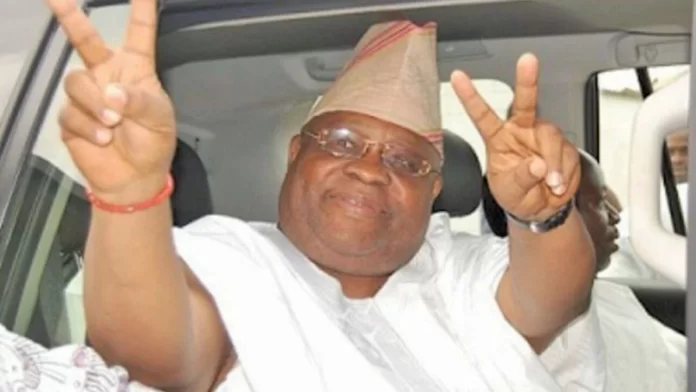
Ademola Adeleke did not win because the odds were in his favour. He won because, when the odds were counted, more voters still wanted him than his opponents.
By Azuh Arinze
When Governor Ademola Nurudeen Jackson Adeleke stepped into the 2026 Osun governorship contest, it was clear that winning a second term would be considerably harder than winning his first.
This time, he was no longer the underdog challenging an incumbent. He was the incumbent defending his record. He had also abandoned the Peoples Democratic Party, the platform on which he won in 2022, to contest under the not-too-visible Accord Party. Across the aisle was the All Progressives Congress, backed by a formidable national political structure and led in the race by Bola Oyebamiji, popularly known as AMBO.
Yet, when the votes were finally counted, Adeleke did not merely scrape through. He won 511,067 votes, defeating Oyebamiji, who polled 444,815 votes, a winning margin of 66,252 votes. Adeleke also won 19 of Osun’s 30 local government areas, while the APC candidate won 11.
So, what happened?
Here are 12 reasons Adeleke won again despite the odds.
He turned incumbency into an advantage
Incumbency can be a burden when a government has little to show. In Adeleke’s case, however, his administration had a visible record to campaign with.
His government highlighted road construction, rehabilitation of schools and health centres, workers’ welfare, education and other infrastructure projects as evidence of delivery. The governor specifically cited the reconstruction of enough health centres, rehabilitation of so many schools and improvements in the state’s education and healthcare sectors.
READ ALSO:
Adeleke fingers Oyetola in Osun account freezing, absolves Tinubu
Whatever the criticisms of his administration, therefore, Adeleke ensured that voters had something tangible to assess.
The power of visible projects
Politics is often about perception, but perception becomes considerably stronger when voters can point to physical projects.
Adeleke’s aggressive infrastructure programme gave his campaign a simple message: look around you.
From roads to bridges and public facilities, the administration made physical development a major part of its political identity. Even reports critical of the governor acknowledged that infrastructure was one of the areas where he enjoyed considerable support. For many voters, expectedly, a completed road can be a more persuasive campaign speech than a political rally.
He mastered grassroots politics
Perhaps Adeleke’s greatest political asset is not his office but his connection with the grassroots. His campaign consistently took the governor to communities, wards and local government areas rather than relying solely on political heavyweights in Osogbo or Abuja. The result was remarkable: Adeleke won 19 of the state’s 30 LGAs.
That spread, matters. He did not depend on one senatorial district or one ethnic constituency. He built a coalition broad enough to survive the strength of the APC machinery.
The Adeleke political dynasty remains powerful
The Adeleke name carries considerable political weight in Osun.
The late Senator Isiaka Adeleke, the governor’s elder brother, widely known as Serubawon, was the state’s first elected governor and represented Osun West in the Senate. His political network and personal following have remained important to Ademola Adeleke’s political career. The governor, therefore, entered the 2026 election with something that cannot easily be manufactured during a campaign: an established political family structure and years of relationships across the state.
His personal popularity transcended party politics
Perhaps the biggest surprise of the election was that Adeleke changed political platforms and still won. He won in 2022 on the PDP platform. In 2026, he contested under Accord, after leaving the PDP. Yet the voters who mattered most were not necessarily voting for a party logo; many were voting for Adeleke himself. That is a significant political achievement.
His ability to carry his personal support base from one party to another demonstrated that his electoral coalition had become more personality-driven than party-dependent.
His unconventional style became an electoral asset
For years, critics dismissed Adeleke’s dancing, colourful personality and unconventional public image as unserious. The governor, however, turned what could have been a weakness into a brand. “Imole” became more than a slogan. Adeleke cultivated an image of accessibility, informality and connection with ordinary people.
The same politician who was once mocked for his dancing eventually made that dancing part of a political identity that many voters found relatable and irresistible. In Nigerian politics, being relatable can be enormously powerful.
The opposition underestimated the Adeleke phenomenon
One of the recurring mistakes of political campaigns is confusing institutional strength with electoral affection. The APC entered the race with powerful structures, influential politicians and national backing. At different points, its campaign projected confidence that its political machinery would overwhelm Adeleke. Even the Economic and Financial Crimes Commission stepped in at some point until they were called to order by the President.
But Osun voters ultimately demonstrated that elections are not won by the number of political heavyweights standing behind a candidate. They are won by votes. Adeleke’s grassroots network proved more resilient than many of his opponents expected.
He successfully made the election a referendum on his record
Adeleke understood an important political principle: an incumbent should make the election about what he has done, not simply about what his opponents say he has failed to do. Throughout the campaign, he repeatedly presented his first-term achievements as the reason voters should give him another four years. His administration pointed to improvements in education rankings, primary healthcare, infrastructure and public-sector welfare.
The APC, meanwhile, spent considerable energy attacking his performance and dancing skills. In the end, Adeleke’s strategy prevailed: he made the election a choice between his record and the opposition’s promises.
The APC’s national strength did not automatically translate into Osun votes
This election offered another reminder that federal political power has limits at the state level. The APC had national visibility and formidable political figures behind it. But Osun has its own political history, personalities and local calculations.
The electorate did not simply vote along national party lines. Adeleke’s victory demonstrated that a popular incumbent with a strong local organisation can defeat a nationally dominant party when voters believe the state election is fundamentally about the candidate and his record.
He understood that elections are won one polling unit at a time
Ultimately, the most important reason Adeleke won was that his campaign converted popularity into votes. The final numbers tell the story. He secured 511,067 votes, against Oyebamiji’s 444,815, while the ADC’s Najeem Salaam came a distant third with 17,180 votes. Adeleke also won 19 LGAs to APC’s 11.
That was not an accidental victory. It reflected organisation, mobilisation, candidate appeal and the ability to protect a lead across the state.
The Davido factor
David Adeleke, aka OBO, aka Davido, stood solidly by his uncle. His presence, tweets and so on really made a huge difference. It also brought to the fore the unity and bond that exist in that family unlike what we are witnessing currently in the PSquare family.
Grace of God
Simply put, the Lord loves Governor Ademola Adeleke. He was there for him every step of the way. He showed him so much mercy when it mattered most and repeatedly put confusion in the midst of his political enemies.
The Bigger Lesson
The 2026 Osun election is bigger than Ademola Adeleke.
It is also a reminder that Nigerian elections are increasingly becoming contests between political structure and personal popularity, machinery and grassroots sentiment, party identity and candidate identity. Adeleke had plenty working against him. He had left the party that brought him to power. He faced a rejuvenated APC. He confronted powerful political interests and an election environment described in the weeks before the poll as unusually turbulent.
Yet, when Osun voters had the final say, they gave him another four years. The dancing governor has, therefore, achieved something considerably more significant than winning an election. He has transformed himself from an unlikely political phenomenon into a formidable electoral force.
And perhaps that is the real story of Osun 2026: Ademola Adeleke did not win because the odds were in his favour. He won because, when the odds were counted, more voters still wanted him than his opponents. Osun voters, my dear brothers and sisters, have spoken – and so shall it be until 2030.
– Azuh Arinze is the Publisher/Editor-in-Chief of YES INTERNATIONAL! Magazine and author of important books like The CEO’s Bible 1&2, Anything and Everything Journalism, Success Is Not Served A La Carte, My Story of Many Colours, etc