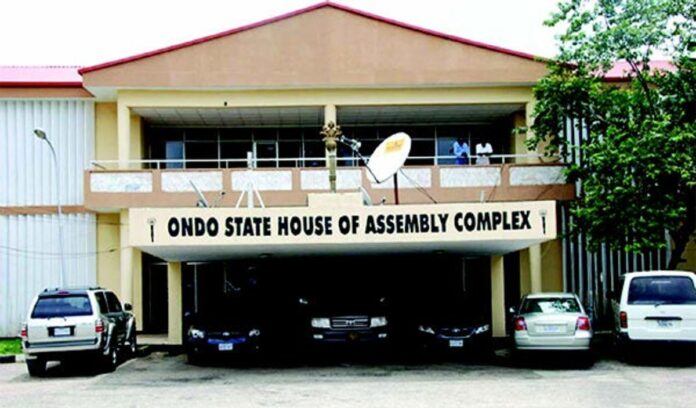
Ondo APC primaries produce 20% female Assembly candidates, one House of Reps flagbearer
By Julius Alabi. Akure
Ondo State government has recorded a significant milestone in gender inclusion, as the All Progressives Congress (APC) produces five female candidates for the 26-seat State House of Assembly in the ongoing primaries.
The State Commissioner for Information and Orientation, Idowu Ajanaku, disclosed this during an appearance on Candid Chat, a programme on Silverbird Television, where he highlighted what he described as a historic breakthrough in women’s political participation in the state.
According to Ajanaku, the development marks the first time such a number of women have emerged as candidates under a major political party for the state legislature, signalling a shift toward more inclusive representation.
He further noted that the trend extends beyond the state assembly, revealing that, for the first time in Ondo’s history, a female APC candidate will contest for a seat in the House of Representatives to represent the Akure South/Akure North Federal Constituency.
Ajanaku attributed the progress to deliberate efforts within the party and the current administration of Governor Aiyedatiwa to break longstanding gender barriers and encourage women’s participation in governance.
The commissioner described the emergence of the female candidates as a positive indicator of evolving political dynamics in the state, expressing optimism that it would inspire greater involvement of women in future electoral processes.
He however described Ondo State as one of the safest states in Nigeria, while acknowledging lingering security challenges and outlining the government’s ambitious economic development plans.
Ajanaku said the state had recorded no major security breach since the 2022 Owo church massacre, crediting the Amotekun corps and a community-based intelligence network for the improvement.
The commissioner identified insider betrayal as a growing concern, recounting how a returnee from the United States was kidnapped after a friend leaked his travel details and whereabouts to criminal networks.
“What we have now is that we are involving all traditional rulers and community leaders in the security architecture of the state,” he said, adding that drone surveillance had been deployed across Ondo’s forests — the largest in the South-West — to monitor criminal activity.
Ajanaku also revealed that security operatives recently foiled a bomb plot in the state capital, Akure, apprehending six suspects who had planned to attack the Government House, government offices, and the state secretariat. He credited local intelligence for the breakthrough.
On border security, he said the state had lined up security agencies along its boundaries with Edo and Kwara states to intercept criminal elements entering the state.
While defending the Amotekun corps, Ajanaku conceded that the agency’s effectiveness was hampered by legal restrictions preventing its operatives from carrying heavy weapons such as AK-47 rifles.
He was optimistic that the National Assembly will pass a state police bill before the end of President Bola Tinubu’s current term, saying Ondo was ready to fund its own force.
“We are about setting up a security trust fund in Ondo State so that the private sector will also be involved in shaping the course of security in the state,” he said.
Responding to questions about internal party tensions and court cases within the ruling APC ahead of legislative primaries, Ajanaku dismissed suggestions that political friction had slowed governance.
He described Governor Lucky Aiyedatiwa as “one of the coolest politicians in town,” noting that the governor had subjected himself to a competitive primary against 15 to 16 opponents rather than imposing himself on the party.
He drew a parallel with former Lagos Governor Akinwunmi Ambode, who faced criticism early in his tenure but was widely appreciated by the time he left office. “The governor is not distracted. We are focused,” Ajanaku insisted.
He pointed to the recent commissioning of Ondo’s first major overhead bridge named after elder statesman Pa Fasoranti and commissioned by Vice President Kashim Shettima as evidence of continued governance activity.
On economic development, Ajanaku highlighted Governor Aiyedatiwa’s private sector background as a key asset, arguing it distinguished him from predecessors and better positioned him to drive industrialisation.
He cited a £40 million investment by British firm JohnVent in cocoa and agricultural projects, and the planned revival of a ceramic factory in Ifon, Ose Local Government Area, as early signs of progress.
The commissioner also announced two flagship projects with specific timelines: a modular refinery in Olokola expected to produce 500,000 litres of petrol daily, set to be operational by June next year, and a deep seaport projected to reach 70–80% completion by 2028.