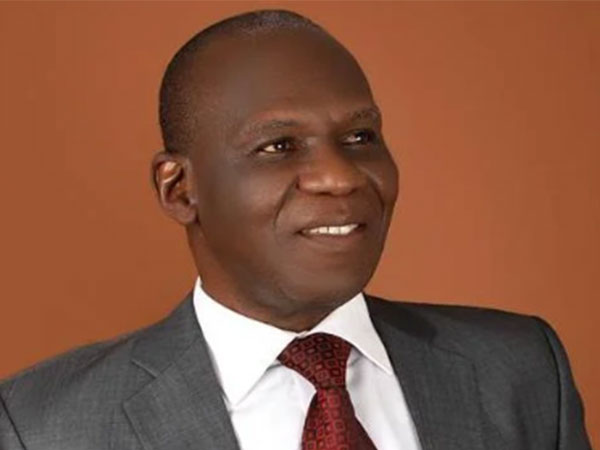
The day Onitsha claimed Peter Obi: The world may know Peter Obi as a former governor, a national political figure and the presidential candidate of the NDC. Onitsha knows another dimension of him: the boy who grew up in its streets, the student who passed through its classrooms and the man who still calls it home. On November 20, 2026, Onitsha did more than welcome Peter Obi. It claimed him as its own.
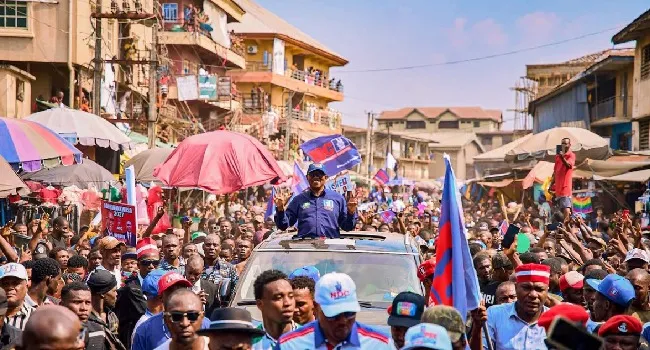
Peter Obi in Onitsha
By Tony Onyima
Onitsha does not easily abandon business for anybody. In a city where time is money and commerce rarely takes a breather, Friday, November 20, 2026, was an extraordinary exception. From Head Bridge to the sprawling markets and adjoining streets, the commercial capital of Anambra State momentarily surrendered its familiar rhythm to welcome one of its most celebrated sons, His Excellency, Mr Peter Obi.
Long before dawn, young men had kept vigil at Head Bridge to secure vantage positions for his arrival. Traders delayed opening their shops. Keke riders abandoned their regular routes. Schoolchildren in colourful uniforms lined the streets, singing and waving. At the same time, mothers lifted their children above their shoulders for a glimpse of the man whose return had stirred the city into an uncommon frenzy. Then he arrived. And Onitsha claimed him.
His convoy barely moved through the sea of humanity. Blue flags fluttered overhead, placards rose into the morning sky, and thousands of voices competed to announce his return. Young people climbed vehicles and crowded balconies, phones held high. Traders poured out of their shops, dancing to campaign songs. From market squares to residential streets, Onitsha erupted in celebration.
The organising committee, led by Hon. (Prof.) Oby Lilian Orogbu, member representing Awka North and South Federal Constituency, had conceived the event as a homecoming. Obi, in his characteristic modesty, objected to the description, arguing that it suggested he had been away for a long time. After all, he still lives in Onitsha. The invitation card had to be redesigned.
But residents needed no permission to call it a homecoming. And there are homecomings, and there are homecomings. Some are carefully choreographed, complete with red carpets, ceremonial receptions and rented guests. Others are written in the language of the streets, expressed through spontaneous affection, unrestrained excitement and the unmistakable warmth of a people receiving one of their own.
For Onitsha, this was the latter. From Head Bridge, the convoy made its way into the city, but progress was painfully slow. The human tide almost swallowed the black SUV carrying Obi. Chants mingled with the blaring campaign anthem, NDC Ka Nma. Schoolchildren sang and clapped, mothers lifted their little ones for a better view, and traders abandoned their counters to join the celebration.
Men stood on vehicle roofs. Young people occupied balconies and overhead bridges, their mobile phones raised to capture the spectacle. Others surged towards the convoy, eager for a handshake, a greeting or simply the privilege of witnessing the moment.
From the popular Ogbo Ogwu Market to the building materials market, traders poured onto the streets. The familiar commercial urgency of Onitsha was momentarily suspended. A city accustomed to measuring its heartbeat in transactions, deliveries and negotiations had exchanged its trading tables for campaign songs and its commercial calculations for an emotional celebration.
The convoy snaked through the streets as Obi waved and acknowledged the cheering residents. The spontaneity of the reception was perhaps its most striking feature. “This one no be paid crowd. This is real love,” one enthusiastic young man declared.
Whether viewed through the prism of politics or popular sentiment, the scale of the reception was difficult to ignore. Onitsha was not merely watching a political convoy pass; it was participating in a celebration that had become a civic reunion.
Yet, away from the deafening excitement of the streets, perhaps the day’s most poignant moment unfolded at Christ the King College (CKC), Onitsha, the Catholic secondary school that helped shape Obi’s formative years.
Established in 1933, CKC occupies a special place in the intellectual and cultural history of Onitsha. Its motto, Bonitas Disciplina Scientia — Goodness, Discipline and Knowledge — reflects the values that have guided generations of its students.
For Obi, returning to its grounds was a journey into personal history. The gate through which he once entered as a young schoolboy opened again to receive a man whose public journey had taken him far beyond the familiar corridors of his youth. He revisited the school grounds, including Anyogu Hostels 1 and 2, before joining an excited gathering of students and members of the school community.
Something deeply moving about the encounter. Time had transformed the schoolboy into a former governor and presidential candidate, but the pathways, buildings and memories remained. In returning to CKC, Obi offered Nigerians a glimpse of the formative environment behind the public figure — a refreshing reminder that national leaders, too, have childhoods, teachers, friendships and places that shaped their journeys.
A Catholic priest in a white cassock addressed the gathering as students in matching blue shirts applauded and sang. Outside, supporters celebrated his connection to the institution, proudly identifying him as one of their own.
It was more than a courtesy visit. It was a symbolic return to the beginning — an affirmation of origin, identity and belonging. For a man whose public life has become a subject of national conversation, the visit briefly brought him back to the schoolboy who once walked those grounds.
Of course, the massive turnout came with its inconveniences. Traffic was severely disrupted, keke tricycles were trapped in the congestion, and an ambulance siren could be heard in one of the circulating videos as it struggled to navigate the crowded streets. The excitement was not without logistical challenges. But beneath the noise, confusion and gridlock was an unmistakable human story: a community expressing its affection for a man it considers one of its own.
There was another dimension to the visit. Obi had travelled through Kano and Abuja, proceeded to the United States via Lagos and flown directly from America to Anambra for the occasion. The journey underscored the geographical reach of his engagements and the increasingly international character of his public profile.
Yet, after all the miles, his emotional destination was home.
The contrast was striking. A man whose political engagements take him across cities and continents returned to a familiar environment where he needed no elaborate introduction. Here, he was not merely a presidential candidate seeking votes. He was the former schoolboy, the familiar son, and the man whose personal story is intertwined with the city’s history. Perhaps that explains why the reception carried an emotional intensity that no conventional political rally could manufacture.
At the Archbishop C. J. Patterson Building of All Saints Cathedral, the Main Bowl was filled with women, youths, traders and party faithful. Songs and dancing animated the gathering as the formal programme unfolded. The celebration had moved from the streets into the hall, but its emotional charge remained undiminished. Here, the political message of the visit came into sharper focus.
Addressing the gathering, Obi urged Nigerians to “sacrifice one day for Nigeria to be good again”, insisting that the 2027 election offered an opportunity to change the country’s direction. He called on voters to turn out, cast their ballots and remain at their polling units until the votes were counted, recorded and announced.
“Go with your stool and food, cast your vote. Sit down, wait, monitor and guard your vote. Follow it till it is counted, recorded and announced,” he charged, declaring Election Day “a public holiday for vote defence”.
Obi also painted a picture of the Nigeria he and his running mate, Dr Rabiu Musa Kwankwaso, hope to build. “We want a country where if you are sick, you go to hospital and not church,” he said, promising functional primary healthcare centres in every ward and 50,000 primary school blocks. He pledged to prioritise education, healthcare and other critical sectors.
On electricity, he lamented that Nigeria currently generates, transmits and distributes only about 4,000 megawatts, promising that his administration would work towards generating 10,000 megawatts.
“Everything we say here, please take note of it because we will do it. We will not give you excuses because we know that the country is already bad, and we will not tell you we didn’t know it was this bad,” he assured the audience. He also aimed at the Tinubu administration’s borrowing record, arguing that the country needed a fundamental change in leadership and governance.
“Nigerians have suffered enough, so all of you are contestants in this election through us. So go out there on that day, take it as a day of sacrifice for Nigeria,” he appealed. In a pointed reference to President Bola Tinubu, Obi added: “We want a president that has energy. Tinubu is tired, so we have come to beg him to go and rest.”
The message was clear: the election, in Obi’s estimation, was not merely about replacing one government with another, but about restoring public confidence, rebuilding essential services and giving Nigerians a country in which they could live with dignity.
Senator Victor Umeh, representing Anambra Central Senatorial District, appealed to Nigerians, particularly the vulnerable, to support Obi and other NDC candidates across the country to actualise the party’s promise of a New Nigeria.
Summing up the significance of the town hall meeting, Hon. Ifeanyichukwu Ibezi, Ph.D. (Ochiagha Idemili), Anambra State Coordinator of the NDC National Campaign Council, declared that “Onitsha has delivered an important message to Awka and Abuja. And Nigerians and the entire world have taken note.
On his part, Rt. Hon. Ikem Uzozie (Ikeoha), the NDC State Chairman, said that the huge success of the Onitsha town meeting “showed the energy and goodwill our party, NDC, enjoys. This is the kind of politics His Excellency, Mr Peter Obi and NDC stand for: going to the people, listening to them, and accounting for our plans in the open. Nigerians are tired of leaders who appear only at election time. NDC and our candidates will sweep the polls next year”, he said.
Attendance figures, speeches, endorsements, and the strength of campaign structures often determine the success of political gatherings. But occasionally, an event communicates something statistics cannot capture. Onitsha’s reception of Peter Obi was one such occasion. It revealed the power of memory, identity and belonging in shaping the relationship between a public figure and his community.
The world may know Peter Obi as a former governor, a national political figure and the presidential candidate of the NDC. Onitsha knows another dimension of him: the boy who grew up in its streets, the student who passed through its classrooms and the man who still calls it home.
On November 20, 2026, Onitsha did more than welcome Peter Obi. It claimed him as its own.
- Dr Tony Onyima, veteran journalist and former Anambra State Commissioner for Information, writes Idemili