By Chijioke Churuba
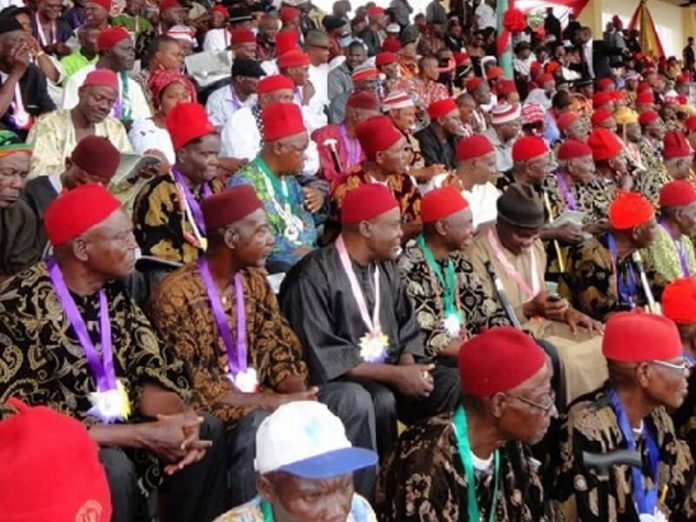
The Igbo people, for several reasons, are scattered in many parts of the world. Yet, they are emotionally and strongly attached to their ancestral homeland in Nigeria!
In several cities across the world, they organise themselves through their various town unions to protect their interests, and to socially and economically empower one another, as well as contribute to the development of their local communities back home.
For those in trade, commerce and vocational businesses etc., they use the ‘apprenticeship business incubation strategy’ to train and mentor their kinsmen and most importantly consolidate their grip in those businesses.
In several of their communities, they resolve local disputes and customary issues through their local assemblies (republican in nature) – otherwise called the Ama-Ala or Umunna to maintain peace, harmony and build fairly cohesive communities.
Over the years, they have strongly resisted non-liberating influences and idiosyncrasies and have embraced education and entrepreneurship as a combined strategy to fairly fight against ignorance, superstition and poverty.
Two key Igbo states – Anambra and Imo – are some of the front-line educationally advantaged states in Nigeria, with modest living standards.
Several of their sons and daughters have made and are currently making indelible marks in literature, sports, entertainment, the creative arts, commerce, business, medicine, development economics, banking, international diplomacy and at various top leadership positions across the world.
Despite the glass ceilings and limitations placed against them by certain historical and political circumstances, they have flipped the economic odds to their favour and tend to be at their best in open, competitive and often challenging situations.
However, in spite of their well-known brilliance, industry and uncanny ability to create wealth, they have not done so well in the murky waters of the Nigerian politics.
Often, they have been politically outmaneuvered by others who wrongly view their intensity, independent-mindedness and defiant outspokenness with suspicion.
In many instances, their interests have been sabotaged under the guise of protecting national interests!
Also, their well-known enterprising potentials have not really translated into visible economic successes across their ancestral homeland.
Of recent, their frustrations birthed a renaissance – with a heightened level of consciousness.
A consciousness that has led a significant number of young men and women of Igbo extraction (across the world) unequivocally demanding for fair-play, equity, and better economic/political opportunities or the freedom to create their own opportunities. They have also placed the restructuring of the existing socio-political and economic structure of Nigeria on the table.
These agitations have rattled and exposed the inherent contradictions of the fragile Nigerian State, its foundational vulnerabilities, structural weaknesses and fault-lines.
Although civil agitations are standard democratic tools for the re-balancing of power and political negotiations, in Nigeria, political power is usually negotiated through underhand tactics, crude politics, deception, propaganda and sometimes political intimidation. But, politics, it should be noted, is usually not benevolent and obviously not in Nigeria.
So, it is time for the Igbo people to wake up and as much as possible, think across the dots to see how they can practically and steadily forge ahead as a people without yielding themselves to paralyzing emotions, group exuberance or victimhood.
It is time to solidify their common identity. Thankfully, they have a near homogeneous belief system, and a liberating cultural and economic worldview which could be consolidated to forge an enduring common identity.
Also, regardless of the current political constraints, they need to urgently look inwards to find creative ways to attract the required expertise, resources, investments and capital so as to quickly fix their health care, consolidate on education and develop their region technologically and economically to frontally tackle joblessness and poverty in many parts of the region.
They should insist on good governance, and to this end, demand the judicious use of their public resources and begin to hold the regional leaders to account.
It is also imperative that they create the enabling conditions in their homeland to attract their people scattered all over the world and even those whose ancestry could be traced to them, to think home, invest home, and patronise home.
They need a local content master plan to promote and jealously preserve their local technologies, innovations and manufacturing industry and for foreign investors and partners to safely invest in Igbo land.
Importantly, they need to enthrone a leadership recruitment culture that identifies and encourages the best of their people to lead the rest of them.
Furthermore, they need to build bridges and preserve strategic alliances with other tribes, ethnic nationalities and partners, so as to acquire the necessary political capital and goodwill for political negotiations and to achieve their desired political goals.
Without losing sight of the various conversations (about the future of Nigeria), it is also critical for them to chart a workable strategy that would as a matter of urgency preserve/protect the lives and property of their people, catalyse their leaders to deliver on the fundamentals, as they look forward to the promise.
In Igbo land, it is usually said ‘Isi gu zo bu isi’ – meaning that a standing and preserved head is paramount in life.
Churuba, a former banker, is the Managing Consultant at Sprog Consulting Limited.