



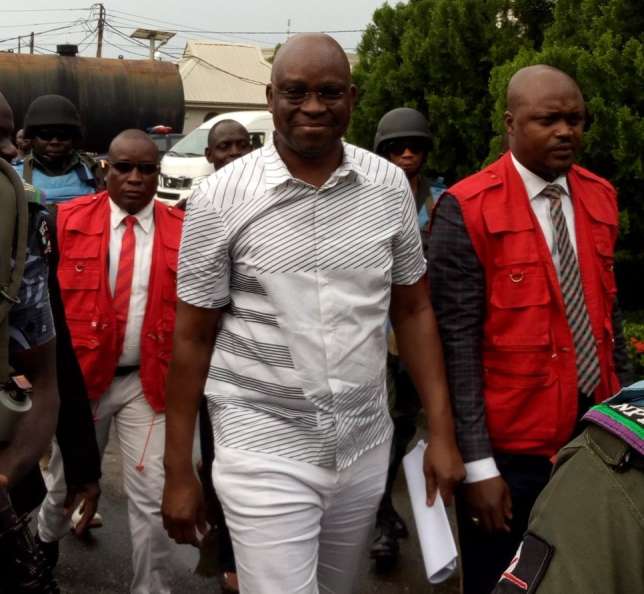
By Onyewuchi Ojinnaka
The failure of the Economic and Financial Crimes Commission (EFCC) to bring its witness in court on Monday July 6 for continuation of trial of a former governor of Ekiti State, Ayodele Fayose, and a firm, Spotless Investment Limited, stalled the trial.
When the matter before Justice Chukwujekwu Aneke of a Federal High Court sitting in Ikoyi, Lagos State, Nigeria was called, the prosecution counsel Rotimi Jacobs (SAN), who was in court, informed the trial judge that a relative of the witness had been admitted into a COVID-19 isolation centre, adding that the development had apparently affected appearance of the witness in court.
Consequently, RotimI Jacobs asked for an adjournment which was not opposed by the defence counsel Mr Olalekan Ojo (SAN) In granting the request, Justice Aneke fixed trial dates October 5, 6, 19, 20, 2020, for continuation of trial.
Former Ekiti State governor Ayodele Fayose is standing trial over N6.9billion money laundering charges. He was charged to court by the Economic and Financial Crimes Commission (EFCC) for the alleged offence.
Recall that Fayose was first arraigned on October 22, 2018, before Justice Mojisola Olatoregun, alongside his company, Spotless Investment Ltd, on 11 counts bordering on fraud and money laundering offences.
He had pleaded not guilty to the charges and was granted bail on October 24, 2018, in the sum of N50 million with sureties in like sum.
The defendant was subsequently, re-arraigned before Justice Chukwujekwu Aneke, on July 2, 2019, after the case was withdrawn from Justice Olatoregun, following EFCC’s petition.
He had also pleaded not guilty to the charges and was allowed to continue on the earlier bail granted, while the case was adjourned for trial.
The commission has since opened its case before Justice Aneke, and is still leading witnesses in evidence.
When the case was mentioned on Monday, the prosecutor, Mr Rotimi Jacobs (SAN), informed the Court that the prosecution witness who ought to testify in court was unavoidably absent .
On this premise, the prosecution prayed the court for an adjournment.
Defence counsel, Mr Olalekan Ojo (SAN) did not oppose the request for adjournment.
Consequently, Justice Aneke adjourned the case until October 5 for continuation of trial.
During trial before Olatoregun. the prosecution had called witnesses, from several commercial banks, as well as a former Minister of State for Defence, Senator Musiliu Obanikoro.
According to the charge, on June 17, 2014, Fayose and one Abiodun Agbele were said to have taken possession of the sum of N1.2 billion, for purposes of funding his gubernatorial election campaign in Ekiti, which sum they reasonably ought to have known formed part of crime proceeds.
Fayose was alleged to have received a cash payment of the sum of five million dollars, (about N1.8 billion) from the then Minister of State for Defence, Sen. Musiliu Obanikoro, without going through any financial institution.
He was also alleged to have retained the sum of N300 million in his account and took control of the aggregate sums of about N622 million which sum he reasonably ought to have known formed part of crime proceeds.
Fayose was alleged to have procured De Privateer Ltd and Still Earth Ltd, to retain the aggregate sums of N851 million which they reasonably ought to have known formed part of crime proceeds.
Besides, the defendant was alleged to have used the aggregate sums of about N1.6 billion to acquire properties in Lagos and Abuja, which sums he reasonably ought to have known formed part of crime proceeds.
He was also alleged to have used the sum of N200 million, to acquire a property in Abuja, in the name of his elder sister Moji Oladeji, which sum he ought to know also forms crime proceeds.
The offences contravenes the provisions of Sections 15(1), 15 (2), 15 (3), 16(2)(b), 16 (d), and 18 (c) of the Money Laundering Prohibition Act 2011.


