



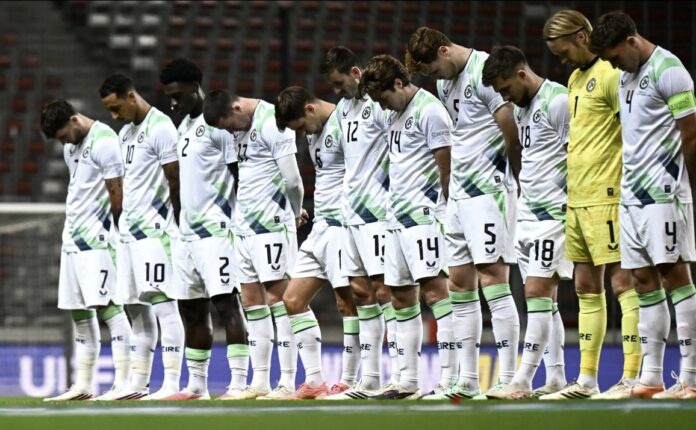
The Irish players also bowed their heads when the Israeli national anthem was being rendered in a pre-match gesture before kickoff.
By Kehinde Okeowo
Republic of Ireland players on Sunday refused to shake hands with their Israeli counterparts during Sunday’s UEFA Nations League match played in Hungary.
The Irish team also bowed their heads during Israel’s national anthem and declined to exchange pre-match pleasantries before kickoff.
The development came amid controversy surrounding the fixture and the ongoing Israel–Gaza war.
Prior to their action, the Irish players held a lengthy meeting at their hotel in Debrecen on Saturday before voting by a significant majority to play the fixture.
Goalkeeper Gavin Bazunu, who has Nigerian heritage, subsequently withdrew from the squad, stating he believed it would be wrong for him to participate in the match and the return fixture scheduled for 4 October in Bačka Topola, Serbia.
Ireland went on to win the match 3–0 thanks to first-half goals from Troy Parrott, Adam Idah, and Jack Moylan.
Justifying the decision, Republic of Ireland manager Heimir Hallgrímsson said the players’ actions drew international attention to the conflict.
“I hope that will not be in the next game because they have shown support for the protest, they have raised awareness worldwide, not only in Ireland, on the subject,” Hallgrímsson told RTÉ.
On Bazunu’s decision to withdraw from the ties, the Ireland manager said it was not questioned by his teammates; however, he admitted that its timing presented difficulties for the team.
“Nobody was questioning his decision. It was only the timing that was difficult for us to kind of react to it,” he said.
The Irish players also wore black armbands during the match. Football Association of Ireland chief executive David Courell said the gesture was intended to recognise lives lost in the Gaza conflict.
The fixtures between Ireland and Israel have faced calls for a boycott since the Nations League draw in February. The Football Association of Ireland had previously backed a motion calling for UEFA to suspend Israel from its competitions.
More than 160 Irish athletes also signed an open letter urging the national team not to play the matches.
The FAI later decided to proceed with the fixtures, with delegates citing concerns that a boycott could cause significant and lasting harm to the association.
The two fixtures are being played at neutral venues, with Ireland’s home match moved from Dublin to Bačka Topola.


