


Investigation shows 109 Senators earn N2.354b per month, Professors less than N500,000
By Jeph Ajobaju, Chief Copy Editor
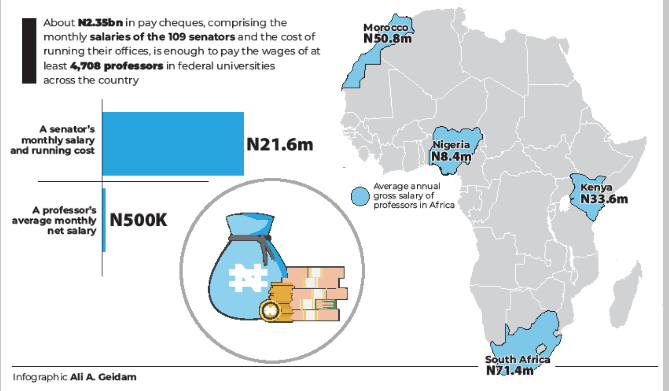
Nigeria’s 109 Senators earn N2.354 billion per month, in salaries and office running costs, more than enough to pay 4,708 university Professors across the country, many of whom are forced into side hustles away from academic pursuits to survive.
Social media was recently awash with reports of Nasir Hassan-Wagini, a Professor at Umaru Musa Yar’adua University, Katsina, who was shown in a video taken at a market in Batsari selling vegetables he produced and several other lecturers doing “side hustles”.
Investigation by Daily Trust shows that depending on the years of professorship, they receive an average N500,000 net pay per month each, against N21.6 million each collected by Senators.
Senator Sumaila Kawu (Kano South) told the BBC Hausa Service on 14 August 2024 that he received N21.6 million in salary and running costs every month, more than the salary of about 43 senior Professors.
“The amount of salary received per month is less than N1 million. If there are cuts, it comes back to about N600,000. In the Senate, each Senator is given N21 million every month as the cost of running his office,” he disclosed.
Kawu made the disclosure a day after the Revenue Mobilisation, Allocation and Fiscal Commission (RMAFC) claimed that each Senator receives N1.06 million in salary and allowances per month.
The massive disparity in the remuneration of Senators who officially sit for only six months a year and lecturers who teach and conduct research all year is condemned across the board by stakeholders and activists as chronicled below by Daily Trust.
Niyi Sunmonu (Congress of University Academics (CONUA) National President)
“All Academics were on the same salary scale from 2009 until 2024 when the Federal Government implemented a 35 per cent pay raise for Professors and 25 per cent for non-Professors.
“Currently, the gross salary of a Professor is about N700,000. After tax and other deductions, it comes down to around N500,000.
“It is difficult for Professors to replace their faulty vehicles as their salaries cannot afford them a N10 million/N15 million loan with a repayment plan of 24/30 months at cooperative societies on the campus.
“In the 1960s, after the Prime Minister and Supreme Court Judges, Professors were the third-highest paid public servants in Nigeria, who, like politicians, received running costs as they were expected to have a driver, a house help and at least an office clerk.
“So, in those years of yore that the academics were motivated by the take-home, there was motivation, which was then reflected in the quality of graduates.
“These days that salaries have remained virtually stagnant for over 16 years, you see academics and Professors who could not come to the office five times a week because the salary is not even enough to sustain their transportation to and fro.
“Some of them come around maybe once a week to attend to their classes, and you see it written all over them that these are not happy people.
“Unlike when I was an undergraduate, Professors don’t come around to motivate and mentor students anymore. The remuneration is so poor that no one is motivated.
“The government should improve academics’ salaries and restore motivation.
“The current renegotiation the government is talking about is a little too late, but it is better late than never.
“Where we are today is top-heavy and bottom-low. The university that we see in this country today is a shadow of its old self.
“In the next five or 10 years, if something drastic is not done and all these Professors retire, most universities in Nigeria will be buried.”
Balarabe Abdullahi (Professor at Ahmadu Bello University (ABU), Zaria)
“My salary is not enough to enroll my child in a standard school in Abuja.
“Only a few young people now aspire to become lecturers and if the authorities fail to urgently reform the system, the nation risks an intellectual drought.
“More people go into politics because it offers dignity, a higher income and stability that academia cannot provide.
“Our salaries are ‘chicken change’ (meagre). Professors, who are meant to be the custodians of knowledge and the drivers of national progress, are now living in near-poverty.
“I have colleagues who have confided in me, weeping, because they have gone three days without being able to cook a proper meal for their families.
“Imagine a Professor at a Nigerian university resorting to selling groceries to make ends meet. It sounds absurd until you realise it is the daily reality for many of us.
“We have children. We have dependents. And yet, no Professor in Nigeria earns enough to comfortably get through the month without hustling.
“That is why many of us are constantly on the move, desperately chasing extra income through visiting lecturing jobs.
“Even with a small family, we are often forced to settle for staff schools because we simply cannot afford the fees of decent private schools.
“If I were to show you my pay slip, you might be moved to tears. This is why Nigerian lecturers are migrating in droves to countries where their intellect and expertise are valued and rewarded.
“Many of us who choose to stay do so out of a sense of duty, cultural attachment, and hope for a better future for our country. But even that hope is wearing thin.”
Samuel Agu (Professor and Dean, Faculty of Humanities, Abia State University)
“I and some of my colleagues are exploring other means to augment our meagre pay.
“You have to do adjunctship in different universities or have some businesses to sustain yourself and your family and other social and communal obligations.
“I have been a Professor for over eight years now. My salary used to be around N460,000. The state government introduced some taxes and it came down to about N390,000. With the so-called minimum wage, it is now around N490,000.
“That is the total package. I don’t get any extra allowance.”
Chukwudi Ibe (Professor and former Dean of School of Management, Federal University of Technology, Owerri)
“Our remuneration is not taking us home. It stops us midway. Inflation has especially whittled it down. It’s pathetic.
“These are the light of society, but Nigeria does not see us as such. Our salary is within the range of N500,000 and we don’t get any allowances.”
Workload taking toll on lecturers’ health
Lecturers said the departure of many of their colleagues for greener pastures abroad is making them battle with a heavy workload that takes a toll on their mental health.
The Academic Staff Union of Universities (ASUU) stressed that this is compounded by the economic hardship in the country, with several lecturers falling ill and even dying.
ASUU lamented that it lost 46 members in its Abuja Zone in February 2024 owing to economic hardship worsened by poor remuneration and unfavourable working conditions.
Abuja Zone comprises the University of Abuja; Federal University of Technology, Minna; Federal University, Lafia; Nasarawa State University, Nasarawa; and Ibrahim Babangida University, Lapai.
Salahu Muhammed (ASUU Abuja Zonal Coordinator)
“More Nigerian academics are leaving the country in droves in search of greener pastures, thereby overworking the patriotic ones that remain in the system whose level of patriotism is dwindling on a daily basis due to poor remuneration and working conditions.
“It is also worthy of note that the union has lost several members in this decade due to herculean working conditions, psychological and emotional stress, and diseases related to these conditions.
“For instance, universities in the Abuja zone have lost 46 members.
“In fact, just two days back, the union lost an eminent Professor of fisheries, Johnson Oyero, of the Federal University of Technology, Minna due to the inability to afford quality medical facilities.”
Death of Abubakar Roko, (Professor at the Department of Computer Science at Usman Danfodiyo University, Sokoto [UDUS])
Recently, crowdfunding N13 million was launched for the medical bill of Abubakar Roko, a Professor at UDUS who died after donations, including N5 million from Kano Governor Abba Kabir Yusuf.
In a Facebook post, a Nigerian scholar in Germany, Mushin Ibrahim, blamed the situation on a dysfunctional system that gives less priority to academics and the education sector at large.
“It has become monotonous to lament about the plight of Nigerian academics on social media. We had this same conversation a few weeks ago, shortly after the tragic story of Professor Abubakar Roko surfaced. May Allah forgive his shortcomings and look after his family, amin,” he wrote.
“Now, no one doubts the existence of the problem. Some people may argue that Professors should do this or that to earn more than their salaries. But why can’t they get a decent payment? Isn’t that what every worker deserves?
“Politicians are awash with money. Their welfare, as well as that of their aides and others close to them, is non-negotiable. They not only earn substantial salaries but also receive allowances and other benefits during their tenure and even afterwards.”
Hassan Soweto (Education Rights Campaign National Coordinator)
“It is illogical that politicians earn more than academics, particularly Professors, a lopsided arrangement that sends a wrong signal to upcoming young scholars.
“The poor remuneration of university Professors and academics across Nigeria is the first reality that any university undergraduate or prospective scholar encounters.
“When a person enters the university and sees that the living standard of his lecturers, whom he is meant to look up to, is so poor, it immediately produces a psychological reaction. It gives a very clear idea of how that person is likely going to end up if he chooses academia.
“Unlike what used to be the case in the [immediate] post-colonial era, the current poor wage of university Professors actually tells a different story.
“That is why it is not surprising that among the new generation now – a subculture that has become quite prominent – education is seen as just a means of satisfying the wishes of parents, while success is seen as something that is only possible through hustle, whether legitimate or otherwise.
“It is completely illogical that a Senator earns more than a Professor. In fact, for a society that wishes to excel and thrive, its politicians should not even earn more than a teacher, let alone a university Professor, because politics is not a job.
“It ought not to be in the first instance. Politics ought to be something that people do to offer their service selflessly to their community, to their constituency, or to the nation.
“For Nigeria to recalibrate its national development objective, this anomaly should be corrected, it is the only way the dignity of education can be restored.
“That is when young people can be proud of going to school, recognising that education is the only pathway to success.
“But right now, that is not the case, and that is because other engagements like politics, which is not supposed to be a profession, appear to be more profitable.”
What obtains in other African countries
Nigeria is one of the five biggest economies, otherwise known as the “Big Five,” in Africa alongside South Africa, Egypt, Morocco, and Kenya.
Academics get very decent pay in these and other African countries, except Nigeria.
South Africa
According to SalaryExpert, average annual gross salary for a university Professor in South Africa is R818,907 (N71.4 million) apart from average bonus R28,089 (N2.4 million).
Entry-level Professor (1-3 years of experience) earns an average R578,940 (N50.5 million) yearly, senior-level Professor (8+ years of experience) average R1,025,119 (N89.4 million).
Morocco
Average annual gross salary of a Professor is MAD 300,290 (N50.8 million) besides average bonus MAD 10,300 (N17.4 million).
Entry-level Professor average MAD 211,288 (N35.7 million) yearly, senior-level Professor MAD 374,125 (N63.3 million).
Kenya
Average gross monthly salary of a Professor 241,875 KES (N2.8 million). The lowest 125,866 KES (N1.4 million), the highest 370,866 KES (N4.3 million).
Niger Republic
World Salaries, a database of international average salaries, shows that a lecturer earns 5,771,600 XOF (N15,747,986) per year.
The lowest 2,773,700 XOF (N7,568,124); the highest 9,060,600 XOF (N24,722,122).
It is, however, not stated whether the salary is gross or net.
Cameroon
A Professor earns an average 8,590,400 XAF (N23,602,723) per year. The lowest 4,129,300 XAF (N11,345,539), the highest 13,441,600 XAF (N36,931,733).
The Gambia
A lecturer earns average 265,000 GMD (N5,602,622) per year, ranging from the lowest 143,200 GMD (N3,027,530) to the highest 399,900 GMD (N8,454,674).
ASUU vows honeymoon with government over
ASUU President Chris Piwuna, a Professor, decried the failure of Abuja to honour most parts of the 2009 agreement it reached with the union.
The agreement seeks university autonomy, adequate funding, payment of earned allowance, which was just recently paid, and improved staff welfare, among others.
“But since the agreement was signed, what was supposed to have been implemented progressively upon expected constant renegotiation has been left to gather dust,” Piwuna told DevReporting, an online newspaper.
“What we have in terms of remuneration, instead of reviewed salaries, is a wage award. Even with the wage awards of 25-35 per cent, our members are owed more than 12 months now.
“And when they talk about the new minimum wage, what we receive is a N40,000 increment.
“Following the 25/35 per cent increment, Graduate Assistants in public universities who used to earn between N90,000 and N95,000 now receive between N135,000 and N160,000, while a Professor receives less than N500,000.
“So, I can tell you that our members are getting agitated; they are getting restless. If you look at our chat groups and all the universities, that is what our members are talking about, because it is becoming very unbearable for them to go to work, feed, pay school fees, and take care of their families.
“So, it has reached the point where we think that the honeymoon with the government is over. I repeat, the honeymoon with the government is over. This renegotiation is over.”
Yakubu Ochefu (Professor and former Secretary General of the Committee of Vice-Chancellors of Nigerian Universities [CVCNU])
“There should be a national conference for holistic discussions on the nation’s higher education with a view to finding lasting solutions to critical problems bedevilling the sector.
“We need to look at it from a holistic perspective, talking about the salary from entry points and the general funding environment of the tertiary institutions, which is grossly inadequate.
“When you compare somebody who is coming in as a Graduate Assistant or an Assistant Lecturer with somebody who is joining the CBN [Central Bank of Nigeria] and all other top government parastatals, you begin to see the gaps.”
Read also:

