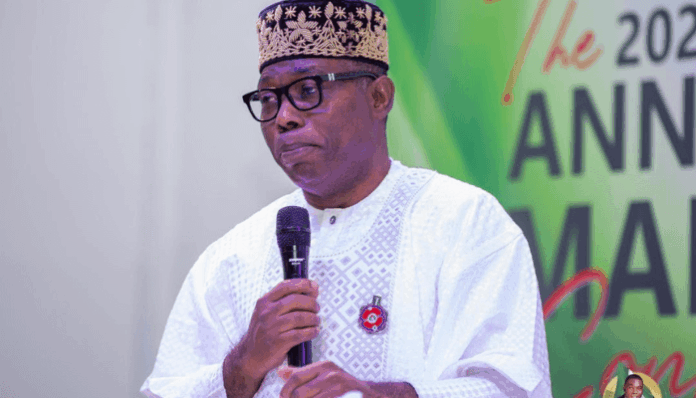
As political activities gather momentum ahead of 2027, frontline politician Adewole Adebayo has identified insecurity and deepening poverty as the decisive factors that will shape electoral choices, arguing that Nigerians are now more preoccupied with survival than political rhetoric.
In this interview, with HENRY NNAEMEKA, Adebayo said growing public frustration over what many perceive as inadequate government response to their plight is fuelling widespread disillusionment, with citizens increasingly feeling abandoned amid rising insecurity and worsening living conditions.
You visited Jos recently. What were you hoping to find out in Plateau State?
I went to Plateau to understand the plight of communities like Angwan Rukuba, where residents have suffered a severe humanitarian crisis. Entire families were wiped out in sudden attacks, people killed, others injured, and communities traumatised. It was devastating.
Beyond witnessing the damage, I wanted to restore hope. Many residents feel abandoned and unprotected by the government. Some are beginning to question the humanity of others and whether anyone still cares. I felt it was important to stand with them and reassure them that the country itself has not failed, even if leadership has.
I also engaged first responders and security personnel to understand their challenges, why responses were delayed, what gaps exist, and how they are working with local communities. I met community leaders and families of victims, and since leaving, more people have reached out with similar concerns.
What I found is troubling: beyond widely reported attacks, there are numerous low-profile killings across the country that go largely unnoticed. Many victims no longer speak up because they believe no one will respond.
Was the visit part of building political momentum ahead of 2027?
At that moment, politics was secondary; it was about the survival of the country. I was concerned that, in the face of such tragedy, leadership failed to directly engage victims. Visiting affected communities and speaking with families should be a priority.
I wanted to demonstrate that leadership can be compassionate and present. I also met faith leaders and saw a worrying decline in social cohesion.
The visit gave me deeper insight into leadership, how to gather intelligence, work with communities, and support security agencies. From my interactions, I am convinced that our law enforcement agencies are capable but constrained by poor leadership and inadequate support. We must use these lessons to build a more effective community protection system.
Are you running for president in 2027?
Yes, I intend to run under the SDP. But public service goes beyond politics. One can be a politician and still act with empathy and humanity.
My visit was not about optics; it was about solidarity. I will continue to engage affected communities beyond public attention. That said, we are in a political season, and the issues of poverty and insecurity remain central. Both have worsened, and we must offer practical solutions that people can trust.
The opposition appears divided, especially with the crisis in the ADC. What is your view?
The situation in the ADC appears to be a leadership dispute now before the courts. INEC has taken a position based on its interpretation of a court order, while some party members disagree.
In such cases, the most effective path is legal clarification. While parties have the right to protest, the courts remain the appropriate avenue for resolution. Until then, no side can claim final authority.
Is Nigeria at risk of having a weak opposition ahead of 2027?
The concerns are valid. You can address the overbearing nature of the government and the fact that it is using its incumbency to gain advantage over other contestants in an electoral situation. You can see how they misuse their majority to pass unpopular, unfair, and restrictive electoral acts.
You can also be concerned about political parties taking care of their internal systems. People join political parties knowing they are in opposition, so they should try as much as possible to minimise errors, reduce internal wrangling, and remain united.
Every party has one or two elements that act like saboteurs, but with wisdom and proper management, these issues can be controlled. If you don’t have internal crises, it is easier to stand and challenge effectively.
What Nigeria is at risk of is one-man rule. If anyone in the APC thinks that Bola Ahmed Tinubu is trying to build a dominant one-party state, that is not the agenda. The real danger is a concentration of power in one individual.
The first victim of such a system would be the APC itself, because as they get used to not having internal democracy and being dictated to by their leader — who is the president — they will lose institutional strength. They will not be like parties such as the ANC, where internal processes are strong and members are stronger than those in government.
So, the APC itself becomes the first casualty. It is not going to be a one-party state, but rather a one-man rule, and the APC will struggle to function properly under such a system.
Looking at the 2023 elections, none of the presidential candidates secured a dominant share of the vote. Out of about 89 million registered voters, the largest bloc did not vote at all. This shows that our politics has become that of a self-interested elite, leaving the electorate behind.
No country can continue holding presidential elections with such low turnout and remain satisfied. It shows that the issues dominating media narratives and political agendas are not addressing the real concerns of the people. That is why people are effectively boycotting the process.
Nigerians should not abandon democracy to politicians or the ruling party. Democracy remains the best means to ensure that issues like security, social welfare, infrastructure, employment, rule of law, and accountability are addressed.
Citizens must remain active — watching those in power, holding them accountable, rewarding good performance, and voting out failure. If the electorate withdraws and focuses only on personal survival, then the system deteriorates further.
We need a reset. More people must join politics with better character, and those who cannot change will eventually be pushed out.
Why is the judiciary often the final arbiter in party disputes?
It reflects deeper problems in leadership recruitment. In the past, politics was driven by individuals with clear ideological commitments. Over time, especially after military rule, politics became transactional.
Today, many politicians operate without principles, moving between parties based on convenience. This has weakened party discipline and increased reliance on the courts.
What we have now is less a political class and more a collection of actors driven by access to power. To change this, we must rebuild the system and encourage individuals with integrity and vision to participate.
If the system does not change, the same actors will continue to migrate to whichever party controls power.
Can state police address growing insecurity?
Structural reforms alone will not solve the problem. The current system can work if driven by sincere and capable leadership. The same applies to state police.
The real issue is leadership. Without accountability and commitment at all levels—federal, state, and local—no system will deliver results.
If you change the structure without changing leadership, nothing will improve.