



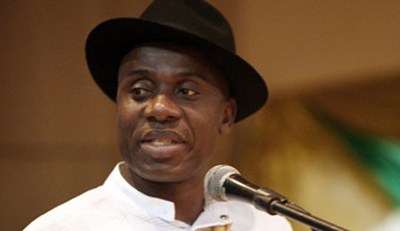
Personal traits of APC, governorship candidate, Peterside, and his PDP counterpart, Wike, as well as group and sectional considerations, come to play in Rivers governorship election, Assistant Editor (South South), JOE EZUMA, writes.
With the conclusion of primaries of the All Progressives Congress (APC) and the Peoples Democratic Party (PDP) in Rivers State, the state seems set for the complex battle that may witness geo-political, ethnic, and socio-cultural forces at play.
While Dakuku Peterside, who represents Opobo/Nkoro/Andoni Federal constituency in the House of Representatives clinched the APC governorship ticket at the party’s affirmative primary on Wednesday, December 5, former Supervising Minister of Education, Nyesom Wike emerged PDP gubernatorial flag-bearer, following his victory at the party’s primary on Monday, December 8, 2014.
Before the emergence of the two candidates, observers of political activities in the state in the past four months had waited with berthed breadth the conclusion of the primaries. This was against the backdrop of intrigues, subtle threats, as well as sheer mutual recriminations and other activities by ethnic and interest groups before the exercises.
But with the primaries over, the main consideration now is who wins the governorship in 2015 and by what factors? Interestingly, Wike and Peterside are going to the battle field with many attributes that can swing victory on their sides as well as many debilitating factors, mostly outside their individual control that can work against them.
The man, Peterside
Peterside first came into political limelight as Wike during the Dr. Peter Odili administration as Special Adviser (S.A.) Youths. He later became a commissioner for works in Governor Chibuike Amaechi’s cabinet where he had exemplary service performance, according to his close associates, before going to the House of Representatives where he is the chairman of the House Committee on Petroleum (down-stream).
Relatively younger than his opponent and known to be humble and large hearted according to those close to him, he had been seen as meek and can imbue his flock with confidence. More importantly, he is seen as one who can be persuaded to sustain Amaechi’s development politics in the state.
Rivers APC Chairman, Dr. Davies Ibiamu Ikanya, perhaps, had this in mind when he boasted that with the emergence of Peterside as his party’s flag-bearer, PDP would be in trouble in 2015 election. Ikanya who saw Peterside’s choice as a divine mandate, described him as a man whose love for the emancipation and development of Rivers is infectious, noting that his performance profile as Works Commissioner, remains enticing.
Besides, the choice of Peterside from the riverine zone of the state, although from its fringe, was seen as a clever strategy by the governor, to calm down, and get the support of, the riverine ethnic clusters which had been marginalized from the state power equation since 1999.
With his emergence, APC may feast on the prevailing sentiments in the area where 13 of 19 governorship aspirants from the riverine zone, who felt maltreated at the PDP primaries are still waging war against the party. It is expected that if the PDP does not handle the disaffection carefully, it may lead to mass exodus from the part to either APC, Labour Party (LP) or APGA that appears to be in search of membership for relevance in the state. Where this happens, Peterside will be the beneficiary.
Amaechi factor at play
The APC candidate is also expected to reap from the Amaechi factor that will obviously be very significant in the election. Amaechi has transformed the state in terms of infrastructure, Health, Education, Road. A major stride in his developmental agenda is the commencement of Greater Port Harcourt City which at completion, will not only lead to decongesting Port Harcourt metropolis but will also remove the tag of a mono-city state from Rivers. It is widely believed by residents and outsiders that the state had not witnessed the level of infrastructural development it witnessed under Amaechi since the administration of Alfred Diete-Spiff, immediate post-war military administrator of the state.
Amaechi had at the conclusion of the APC primary in Port Harcourt, while commending the 26 House of Assembly members who stood by him to stave off his impeachment at the height of the Rivers political crisis, extended them automatic tickets to return to the House next year. This singular action, it is estimated, will offer Peterside ready structures in the legislators’ constituencies and facilitate his reach to the grassroots
But how far these leverages would help the APC flag bearer is still largely debatable in Rivers political circles, especially with the scanty riverine voting power and the alienation of the Ogoni which although from the same Rivers South East with him, felt shortchanged by their son, Senator Magnus Abe, being dropped from the governorship race.
Ogoni is the only major ethnic group that had not ruled the state since its creation in 1967. The group boasts of 400,000 votes as against the riverine cluster that can barely raise 200,000 votes. If the Ogoni allow the bitterness arising from the loss of governorship to linger, then their votes may not be available for Peterside. Another drawback for him is that he is widely seen as green horn and less visible politician compared to Wike, his opponent. Even his interactions with the press is often not embracing.
Enter Wike
Wike, former Supervising Minister for Education, two time Chairman of the Obio/Akpor Local Government and former Chief of Staff to Amaechi and Campaign Director -General for his re-election in 2011, has been long time player in the state political turf unlike his opponent. A political mobilizer and good dispenser of resources who understands the gimmicks of Nigerian political engagements, he has acquired the image of a grassroots politician in the state in the past four years.
The way he prosecuted President Goodluck Jonathan’s proxy war with Amaechi and survived the groundswell of opposition from crowd of governorship aspirants and some elder statesmen from the riverine sector of the state to emerge the PDP flag bearer, had elevated him to the status of an enigma in the eyes of watchers of political developments in the state.
Wike’s ethnic group, the Ikwerre, emerged from political minority to new power bloc with the excision of Bayelsa State, a largely riverine state from the old Rivers state in 1996 as well as further balkanisation of the remaining riverine section of Rivers by the Senatorial divisions during the Peter Odili era.
This development instantly turned the riverine zone to new minority with depleted voting power. Wike may also get the backing of the 11 local governments with which the Ikwerre forms what some politicians in the state call the Igbo cluster.
Ogoni question
Even with the two candidates looking good to go, there are fears that the highly disenchanted Ogoni could turn out the battle field for APC and PDP in the election. The ethnic group felt alienated when, against their long quest to taste power at the highest level in the state, and against their optimism, Abe was denied the governorship ticket by the APC. They got further angered when the PDP which they had looked forward to, for succour, rather gave its ticket to Wike, an Ikwerre. What thus, is left for Ogoni is to support any of the political parties that offers them better political offices and the one that has the chance of winning the 2015 election for that matter.
Aside the Ogoni question, Wike has to contend with the internal discontent within his party and the possible gang-up by riverine politicians and people whose appeals to democratic morality that could have made the Ikwerre to drop from their interest after producing two governors in quick succession fell on PDP deaf ears.


, JOE EZUMA, writes.)