



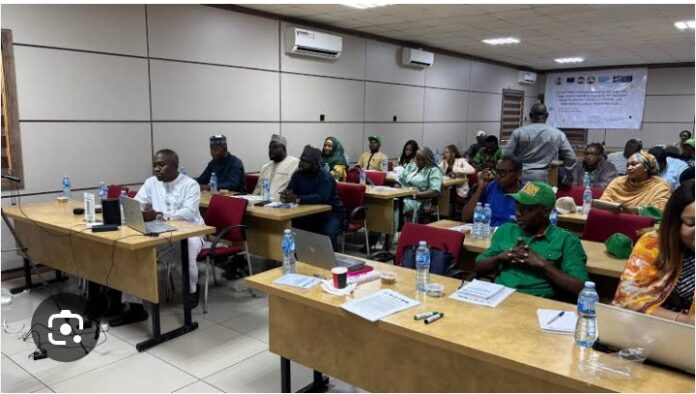
ILO/ACTRAV training workshop: Building capacity for inclusive social protection
By: Aishatu Yakubu Shalangwa ,NLC/NUJ
I still remember the exact moment Zuma Rock came into view. After an hour on the Abuja-Kaduna Expressway, the massive monolith emerged through the haze; unyielding, ancient, and impossibly grand. It felt like a sign. I was heading into something substantial, something that would leave its mark on me just as deeply as that rock has marked the landscape for centuries.
I was one of 36 participants selected for the ILO capacity building programme, and honestly? I didn’t fully grasp what I was walking into.
The resort itself caught me off guard. I had expected a standard training venue; sterile conference rooms, bland meals, and the kind of institutional atmosphere that makes you watch the clock. Instead, I found myself in a space that felt more like a vacation.
The gardens were immaculate,the swimming pool sparkled under the afternoon sun and the terrace overlooking the golf course offered a view that made even the training feel lighter. But it was the animals; the antelopes grazing peacefully, the rabbits darting between bushes, the pigeons flying and the guinea fowls that reminded me that we were in a place outside the usual chaos of Abuja.
The conference facilities were surprisingly well-equipped. Every session ran smoothly, thanks to attentive officials who anticipated our needs before we even voiced them. But what truly set the tone was the natural calm that seemed to permeate every corner of the resort. You couldn’t help but think clearly here.
June 22nd marked the start of something far more intense than I had anticipated. The ILO capacity building programme, delivered under the EU-funded Supporting Sustainable Social Protection Systems in Nigeria (SUSI) project, wasn’t just another workshop.
We were introduced to the ILO Mandate and Social Protection Architecture. And I’ll be honest: the first few sessions were overwhelming. The technical language, the policy frameworks, the sheer scale of what we were being asked to absorb; it felt like drinking from a fire hose.
But that’s where the magic of the programme revealed itself .As to whether or not Nigeria has ratified the Social Security Convention as well as the Other Conventions , that was a challenging question from our facilitator, a breakthrough moment during a group exercise, and a personal realisation gradually shifted my perspective.
For me, the turning point came during a group exercise on Day 2 ,we were divided into teams. The exercise forced us to confront the real-world constraints we face, by writing a few action plans and recommendations.
I found myself arguing passionately for a solution I had never considered before. And at that moment, I realised the training wasn’t just teaching me technical skills, but reshaping how I think about my work.
As some comrades shared during a session: “The training has helped me move from problem-solving for my team to coaching and empowering them.” That resonated deeply with me. I could feel the same shift happening within myself.
A programme is only as good as its participants, and I was fortunate to be surrounded by some of the most dedicated professionals I’ve ever met.
There was a Comrade from Abia, whose firsthand accounts of implementation challenges opened my eyes to realities I had only read about in reports. There was another facilitator Iviolata, whose quiet wisdom during tea breaks often provided more insight than the formal lectures.
We came from different backgrounds; NLC,TUC and FIWOM but we shared a common purpose. And something about being at Zuma Rock, away from our daily distractions, made those connections deeper. We weren’t just networking. We were building a community of practice that would outlast the programme.
Evenings at the resort became treasured spaces for reflection. A swim after dinner, a walk through the gardens, or simply sitting on the terrace watching the sunset behind Zuma Rock, were possibilities to be grabbed. These moments allowed the day’s lessons to settle. I found myself processing ideas more clearly in those quiet hours than I ever could in a boardroom.
Tuesday 23rd ,marked the end of the formal programme but I knew the real work was just beginning.
I left Zuma Rock Resort with a deeper understanding of the transform framework and how to apply it in the Nigerian Labour Congress context,as well as the Nigeria Union of Journalists.
I was reinvigorated with a renewed sense of purpose that social protection isn’t just policy, it’s human rights ; it’s about real people living real lives of vulnerability.
The benefits of this workshop included;
A network of allies across government and civil society who share my commitment to building inclusive systems.
A mindset shift,I no longer see challenges as obstacles but as opportunities for creative problem-solving. Practical tools I can immediately apply to my work, from leadership strategies to monitoring and evaluation frameworks.
On my final evening at Zuma Rock Resort, after a stroll,I stood on the terrace one last time. The rock stood silent in the distance, just as it had on my first day. But I was not the same person who had arrived days earlier.
The programme had challenged me intellectually, humbled me emotionally, and inspired me professionally. It had reminded me that building a social protection system is not about abstract theories, it’s about ensuring that every Nigerian, regardless of their circumstances, has a safety net to fall back on.
Honestly ,Zuma Rock Resort had been the perfect vessel for that transformation. Its serenity allowed me to focus. Its beauty reminded me of what we are fighting to protect. Its comforts gave me the space to dream bigger than I had before.
If you ever have the opportunity to attend an ILO capacity building programme, especially at Zuma Rock Resort, seize it. Not just for the training, though that alone is invaluable,but for the experience of stepping away from the noise and remembering why you do this work in the first place.
We returned to our stations with new knowledge, new connections, and a renewed commitment to social justice. But I suspect many of us, like me, also carried away something more personal: a quiet conviction that we are capable of more than we once believed.
And perhaps that is the greatest lesson of all.
Aishatu Yakubu Shalangwa
Nigeria Labour Congress,
Nigeria Union of Journalists


