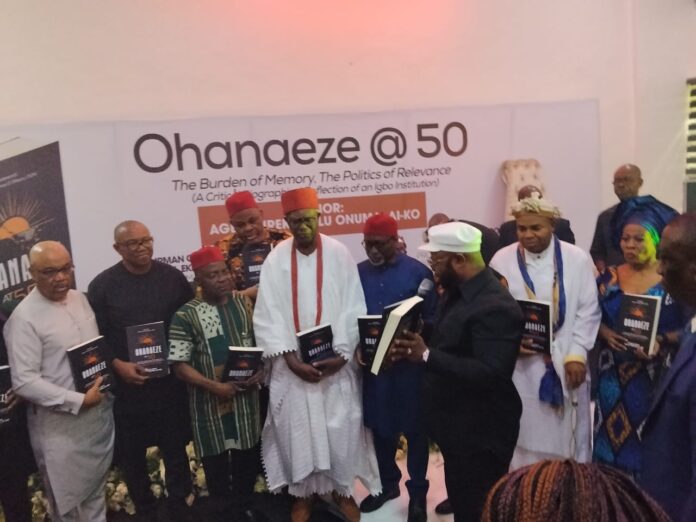
Gov. Otti, others warn: Ohanaeze must renew itself to stay relevant
By Ishaya Ibrahim
Governor Alex Otti of Abia State and the Obi of Onitsha, His Royal Majesty Nnaemeka Achebe, have called for institutional renewal, unity and stronger collective action among the Igbo, stressing the need for Ohanaeze Ndigbo to remain relevant to present and future generations.
They spoke at the public presentation and launch of Ohanaeze at 50: The Burden of Memory, The Politics of Relevance — A Critical Biographical Reflection of an Igbo Institution, authored by Agbeze Kalu Onuma.
Otti, who described the book as “much more than a book about Ohanaeze,” said it offered an opportunity to examine the organisation’s history, leadership and future.
According to him, the book addresses issues of “memory, identity, leadership, responsibility, and the future of a people,” while challenging Ohanaeze to reflect honestly on what it has become and what it must do to remain relevant.
He said an institution could not rely indefinitely on the strength of its history, stressing that while heritage provides legitimacy, relevance must be continually earned.
Otti urged the younger generation to build on Igbo heritage through institutions that embrace technology, innovation, the diaspora and economic development.
Using the Iroko tree as a metaphor, he said its deep roots represented history and heritage, while its branches and leaves represented its ability to remain a living and growing institution.
The governor commended the author for undertaking the work and described the book as a call to action on institutional renewal.
Achebe, in his remarks, said the book was important because it documented 50 years of organised Igbo political life and raised difficult questions about the direction of the people.
He recalled an interview he granted the author in 2010, during which he expressed concern about growing fragmentation among the Igbo and the absence of a strong collective centre.
Achebe said he had also warned at the time that Ohanaeze risked becoming an elitist organisation disconnected from the grassroots.
He maintained that Ohanaeze should remain a sociocultural organisation above partisan politics and serve as “the conscience of the Igbo nation.”
According to him, the organisation should help define and champion an Igbo agenda that transcends political party affiliations.
Achebe also lamented what he described as a gap between discussions and concrete action, saying successive conferences, committees and recommendations had not always translated into implementation.
He argued that the Igbo possessed significant strengths in education, entrepreneurship and enterprise, but needed stronger institutions to translate those attributes into collective development.
The Chairman of the Occasion, Elder U.K. Eke, said the author’s 15-year archival research reflected a commitment to preserving Igbo institutional memory.
He said Kalu Onuma’s experience within Ohanaeze gave him an insider’s perspective, adding that the book sought to rescue the organisation’s history from distortion and loss.
Eke urged that the 600-page book should not remain only in private and university libraries, but should become part of broader conversations on institutional renewal, economic development and the future of the Igbo.
Professor Okey Anueyiagu, reviewer of Ohanaeze at 50, described the book as a landmark and fearless examination of the history, achievements and failures of Ohanaeze Ndigbo over five decades. He commended author Agbeze Ireke Kalu Onuma for producing an independent account grounded in verifiable facts and for confronting uncomfortable truths about the organisation rather than writing a praise-seeking anniversary book.
Anueyiagu said the book’s treatment of the Nigerian-Biafran war and its aftermath was particularly significant, arguing that the experience remains central to understanding the political consciousness and historical trajectory of the Igbo people. While praising Onuma’s careful handling of the sensitive subject, he faulted what he described as the author’s excessive caution in confronting some aspects of the wartime experience, stressing that difficult chapters of history must be confronted honestly rather than suppressed.
The reviewer said the book’s greatest value lies in its willingness to subject Ohanaeze itself to critical examination, documenting both its successes and failures. He urged the organisation to learn from its history and return to what he described as its fundamental responsibilities, preserving Igbo culture and language, promoting education, supporting young people and ensuring that Igbo history is properly documented and transmitted to future generations.
Anueyiagu therefore challenged Ohanaeze to leave partisan politics and concentrate on cultural and educational development, warning that its relevance depends on reconnecting with younger Igbo people. He recalled the earlier generation of Igbo organisations that built schools and provided scholarships rather than becoming instruments of partisan politics, and urged Ohanaeze to embrace that legacy by defending Igbo identity, language, history and culture while encouraging young people to take pride in their heritage.
The event was attended by several dignitaries including presidential candidate of the Nigeria Democratic Congress, Peter Obi