




Some 1,000 men are alleged to have carried out dozens of sexual crimes on New Year’s Eve in the city of Cologne. That these crimes occured in the city’s most famous square has left local authorities reeling.
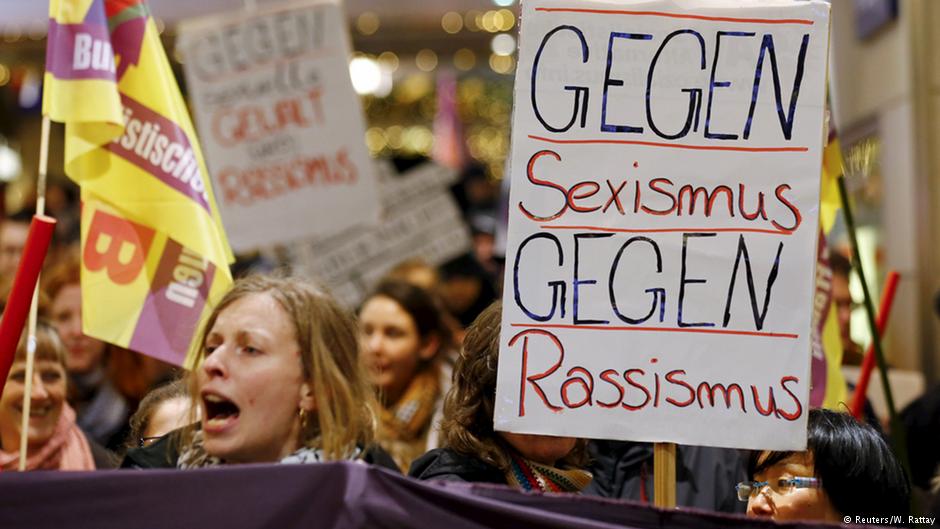
Police in the western German city of Cologne responded to Monday’s outrage over a string of sexual crimes over New Year’s Eve. According to police, the series of assaults in one of the city’s busiest thoroughfares represented a “completely new dimension of crime.”
Some 90 criminal complaints, including one allegation of rape, have been brought to the Cologne police department after women said they were molested by a crowd of men who had gathered in the city’s famous square between its central train station and towering Gothic cathedral.
Authorities expect more victims to come forward in the next few days.
City police Chief Wolfgang Albers said the crowd was composed of up to 1,000 heavily intoxicated men who gave the appearance of being “Arab or North African” in background.
The police chief told German news agency dpa that the incidents represented “an intolerable situation” for Cologne. His department has already assembled a task force to deal with the matter.
Mayor calls crisis summit
Cologne Mayor Henriette Reker, who made international headlines in October when she was stabbed on the campaign trail, has called a crisis meeting, which will include local and federal police, for Tuesday to address the crimes.
Reker told the local press she found the men’s actions “monstrous.”
“We cannot tolerate this development of lawlessness,” Reker told the “Kölner Stadt-Anzeiger” newspaper.
Speaking with local newspaper “Express,” Ralf Jäger, the state interior minister for North Rhine-Westphalia, promised swift action.
“We will not accept that groups of North African men gather expressly for the purpose of debasing women by sexually assaulting them,” the paper quoted Jäger as saying.
‘Politically uncomfortable’ consequences
The leader of the North Rhine-Westphalia branch of Germany’s main police union, Arnold Plickert, called the crimes “a massive attack on basic rights” and said justice must be seen through even if it has “politically uncomfortable” consequences.
Plickert warned, however, against exploiting the incident to stir up anti-refugee sentiment.
“Any refugees who have a problem integrating into our open society and respecting the rights of other people” must be dealt with using the “full force of the law,” he said, though adding that the public should not forget that “the great majority of the people who have come to us have done so because their lives are no longer safe in their homelands.”
Twitter storm as Cologne mayor suggests women stay at ‘arm’s length’ from strangers

Following dozens of sexual assaults on New Year’s Eve, Cologne Mayor Henriette Reker has faced a backlash of criticisms after suggesting that women stay at “arm’s length” from strangers.
With North Rhine-Westphalia’s huge Carnival season just four weeks away, the city’s mayor Henriette Reker said on Tuesday that the initial focus would be on preventive measures to ensure that the upcoming festivities don’t see a repeat of Cologne’s recent New Year celebrations.
In the early hours of January 1, around 90 women were allegedly robbed, threatened, or sexually molested at the New Year’s celebrations outside Cologne’s cathedral by young, mostly drunk men – many of whom were described as being of “Arab or North African origin.” One rape was also reported to police.
‘Code of conduct’
With this in mind, Reker proposed a “code of conduct” for young women and girls, “so that such things do not happen to them.” An updated version of the current code will soon be available online, the mayor said.
Among the guidelines was the suggestion to maintain an arm’s length distance from strangers, something which was met with a huge backlash of sarcastic criticism on Twitter, mocking Reker and the code of conduct.
By late evening on Tuesday, #einearmlänge – which translates as “an arm’s length” – was one of Germany’s top-trending hashtags.
One Twitter user @Nurit77Sara wrote: “I demand that a women’s bus is available from tomorrow. Otherwise I won’t be able to carry out #einearmlänge.”
Another, Birgit Haase, tweeted: “I have short arms. Will that be a problem for me then in the worst case scenario?”
Other recommendations for women and girls attending large public events included staying within their own group. In case of emergency, they are also recommended to ask bystanders for help, and as witnesses, they should intervene or inform police.
Reker added that there should also be a code of conduct for Carnival revelers “from other cultures … so as not to confuse what is cheerful behavior in Cologne and what has nothing to do with openness – particularly sexual openness.”
In addition to the online response, around 200 to 300 people gathered in front of Cologne Cathedral on Tuesday evening, according to police estimates, and demanded more respect for women. One demonstrator held a sign which asked: “Mrs Merkel, where are you? What do you say? This makes us scared!”
Germany is questioning refugee influx
The German government has strongly condemned the crimes, and expressed its shock over the apparently organized sexual assaults, with Chancellor Angela Merkel calling for a thorough investigation of the “repugnant” attacks.
Germany’s Interior Minister Thomas de Maiziere, also criticized North Rhine-Westphalia’s police for how they handled the sexual assaults and demanded to know how on New Year’s Day, they were able to say that celebrations had been “peaceful.”
“The police cannot work like this,” de Maiziere said on Tuesday, adding that he awaited a “clear, hard answer” from authorities.
Justice Minister Heiko Maas said the assaults represented “a new dimension of crime that we will have to get to grips with.”
Asked by a journalist whether refugees were behind the rampage, Maas said police were still working to identify the attackers.
Green Party politician Claudia Roth warned the German public against blaming refugees for the “intolerable” crimes. But reaction to the incident was swift on social media, with many users both in and outside Germany linking the events to the country’s unprecedented refugee influx.
Police investigate Cologne New Year’s Eve suspects
Officials are investigating three suspects following reports of robberies and sexual assault on New Year’s Eve. Germany’s ministers have meanwhile spoken in favour of tougher laws against foreign offenders.
Officers said they had begun looking into five initial suspects, the police spokesman said on Wednesday. The men were apprehended on charges of pickpocketing and the arrests were not made in connection with incidents of sexual assault at the Cologne central station on New Year’s Eve, the spokesman added.
Officials said 106 complaints had been registered so far. Around 75 percent of these complaints were related to sexual assault, the officers said. “Many women told us that they were also touched [by the attackers],” a police spokeswoman told reporters in Cologne.
Weisser Ring, an organization helping victims of harassment called on women who experienced assault on New Year’s Eve to register a complaint with the police. “It is like football: if we don’t step up, we’v e already lost,” the organization’s representative Rudi Glas told journalists.
Tougher laws for offenders
Security officials came under severe criticism after reports that groups of young men had robbed and sexually harassed women in Cologne’s central station on New Year’s Eve. The men were reported to be of Arabic or North African origin. Police did not comment on whether the culprits were refugees, but media and political debates linked the problem to Berlin’s willingness to let immigrants into the country.
German Interior Minister Thomas de Maiziere called upon all people living in Germany to recognize the equal rights women enjoy and threatened foreign offenders with deportation. “Anyone who commits serious crimes must reckon with getting deported out of Germany, regardless of his status,” de Maiziere said. He also hinted at changing laws to prevent criminals from getting asylum in Germany.
Family Minister Manuela Schwesig also emphasized that anyone committing a crime against women would lose his right to stay in Germany.
Steps towards a secure democracy
Speaking to DW, Syrian asylum seeker Izzat Masaud expressed regret at the incident, saying all refugees were not inclined to sexually assault women. “What I have to say is that those who carry out such attacks do not represent us as Arabs or as Muslims. A lot of refugees are Muslims and our religion and education forbid something like this,” Masaud said.
The Central Council of Muslims in Germany also condemned the incident, saying that the police force needed more members from immigrant communities. “In this manner, we can set an example in the direction of a fortified democracy,” the council’s President Aiman Mayzek said.
INTERVIEW
No conviction likely in Cologne NYE incidents
It’s not very likely that any of the men who harassed dozens of women in Cologne on New Year’s Eve will be convicted, says Cologne-based criminal lawyer Nikolaos Gazeas.
Identifying the men who may have participated in the sexual assaults, harassment and thefts in Cologne on New Year’s Eve is proving to be a problem. If you don’t know who they are, the chances of arresting them are almost nil, right?
That’s true. The chances of convicting even one of the perpetrators are slight.
All the same, what is needed in order to take penal action in these cases of massive sexual assault, even including theft in many cases?
You don’t need a lot to initiate preliminary proceedings: a so-called initial suspicion is enough, which means that there must be enough real evidence pointing at a crime. For instance, the prosecutor’s office and the police would probably make the assumption if it’s clear that one of the people in question was at the crime scene that night. But what is needed to find someone guilty and convict them is a totally different matter. You have to prove a perpetrator’s personal guilt. That’s problematic in the case of crimes committed from within groups, and it’s particularly problematic in the case of New Year’s Eve because everything was so chaotic at Cologne’s main train station.
What’s the procedure if someone is charged after all?
One would have to prove that this person committed a concrete act, for instance robbing and/or sexually assaulting, say, Mrs Miller. If the defendant doesn’t confess, you need other evidence to convict the person. That would be video footage and, above all, witnesses, in particular the woman in question, but perhaps also other people who saw what happened. The witnesses would have to testify that it was precisely this defendant – and not someone else. One must also consider that not only the perpetrators were apparently very drunk on New Year’s Eve, and thus quite uninhibited but that some of the victims and potential witnesses had had a drink, too. So the chances of people clearly remembering a certain person are reduced. If there’s any doubt as to whether the defendant was the perpetrator at all, a judge won’t and can’t pronounce the defendant guilty. If, once the gathering of evidence is closed, the judge is of the opinion that it’s impossible to say with enough certainty that the defendant is the perpetrator, the principle “in dubio pro reo” applies in our constitutional state. The defendant must be acquitted.
Is that fair to the victims?
As sobering as this might be in light of the awful events on New Year’s Eve, and as disappointing for the victims: it is and remains to be right to acquit a defendant in case of doubt, no matter what the charges were. Even in cases like these, we should not breach this iron-clad fundamental principle of a constitutional state. In such cases in particular, the constitutional state must assert itself and not give in to the temptation of straying from its own principles.
The alleged perpetrators appear to have a migrant background, whether they are recognized refugees, asylum-seekers, tolerated foreigners or people who’ve lived in this country for a while, some perhaps even with a German passport. What role does a person’s status play in case of a prosecution or conviction?
Their status has no direct bearing on either the prosecution or conviction. Everyone is equal before the law, and is treated the same. A status concerning residency or immigration laws would be relevant once a person hasn’t only been identified, but also effectively convicted. In that case, a conviction could possibly have consequences linked to immigration laws. In case of grave crimes, a person can be deported.
Which groups can be deported?
The question remains whether refugees were among the perpetrators at all, we can’t make any such claims without significant evidence. But from a legal point of view, Germany wouldn’t be able to simply deport refugees who have been granted asylum, but were involved in the Cologne events and who would face inhuman treatment, including persecution, in their native country if they were deported. That would come into conflict with our basic law and international law.
Do you see any reason to amend legislation in the wake of the incidents in Cologne?
No. German criminal law offers sufficient protection against such acts. The crimes we’re looking at here involve considerable prison sentences, both for theft and the sexual harassment. Concerning the sex crimes, however, there’s the problem that groping a breast, a butt or underneath a skirt isn’t immediately punishable as a sex crime. Here, the law requires sex crimes of great relevance. Every case needs to be screened individually to determine when that point has been reached. There have ben widely differing rulings on such cases. In some of the cases in Cologne, which apparently saw massive assaults, I would think the level of relevance has been exceeded, which would result in significant prison sentences. The perpetrators would face significant punishment if they were caught and there was evidence for what they did. Unfortunately, however, chances are slim. In this respect, and to avoid being disappointed, one shouldn’t expect too much from the judiciary in this case.
Dr. Nikolaos Gazeas is a criminal lawyer based in Cologne and a research associate at Cologne University.
OPINION: Go ahead, blame the victims
Following dozens of sexual assaults in Cologne, women are now advised to keep their distance. That amounts to holding them responsible, says DW’s Dana Regev, and is the wrong approach.
German and international media are fuming over attacks on around 90 women in the center of Cologne in the early hours of January 1.
They were allegedly robbed, molested and sexually harassed during New Year’s celebrations by a group of over 1,000 men who were described as being of “Arab or North African origins.”
Public outcry was quick to follow, with people taking to the streets as well as to social media, demanding that more be done to protect women and to make the streets of Germany safe again.
Although there is no indication that the perpetrators were linked to the recent influx of refugees from Syria, Iraq and Afghanistan, the incident has inevitably sparked a massive public debate over the refugee crisis the country is facing, with people criticizing Chancellor Angela Merkel’s policy, asking if Germany is now “colorful enough for her” or claiming that the attack is the result of a too permissive approach toward immigrants.
But the most astonishing comment of all came from no other than Cologne’s Mayor herself, Henriette Reker, who urged women to keep an “arm’s length” away from strangers, so that “such things do not happen to them.”
No, this is not a translation error; yes, it is 2016.
In fact, such a statement is not far off from telling rape victims they shouldn’t wear short skirts. It’s victim blaming in the most demeaning form. The implication is that the women in Cologne are themselves somehow responsible for provoking the assaults. As if it isn’t enough that many women – even in open societies like Germany – carry a constant fear of being attacked. Now they are being lectured on how they should watch out for themselves in future, rather than placing the blame squarely where it belongs – on the assailants.
‘Code of conduct?’
Reker’s “code of conduct,” which will be available online soon, includes not only the “arm’s length” recommendation but also urges women to stay together in groups and even more disparagingly warns them against acting too “cheerful” as this might be mistaken for sexual openness.
Some might claim that Reker’s remarks are not meant to blame women for their own assault, but were only meant to encourage caution. But the advice that women should basically stay away from men, avoid being alone in public places, and above all not to look too happy is simply patronizing and based on misconception. Even if it is intended as well-meant advice, the implication that the solution to the problem somehow lies on the victim’s shoulders is nothing but a disgrace.
Maybe Reker’s advice is relevant for some, more or less in the same way people keep their doors locked when they’re out of their homes, park their cars in safe places or try to avoid dark alleys.
Any claim suggesting that sexual assaults have anything to do with the victim’s behavior, dress or imprudence has been refuted over and over again in hundreds of studies. Rape and sexual assaults happen in every country, independent of the religious or ethnic makeup of the society.
In societies where women cover their faces and entire bodies, sexual harassment and rape are a daily occurrence. There is no proof that women who dress in a prim way or adopt a modest behavior suffer less harassment than others.
Rape, sexual assaults and harassments are crimes. Preventing such crime requires more than just a call for women to keep away from men. Primarily, it requires education, deterrence and strict law enforcement – for all sexes.
What is surely not the solution, is urging women to change their habits under the guise of taking care of them – only to then blame them for not following the instructions.
In 2016, it is about time to teach rapists not to rape, rather than victims to hide.
-DW.COM


