



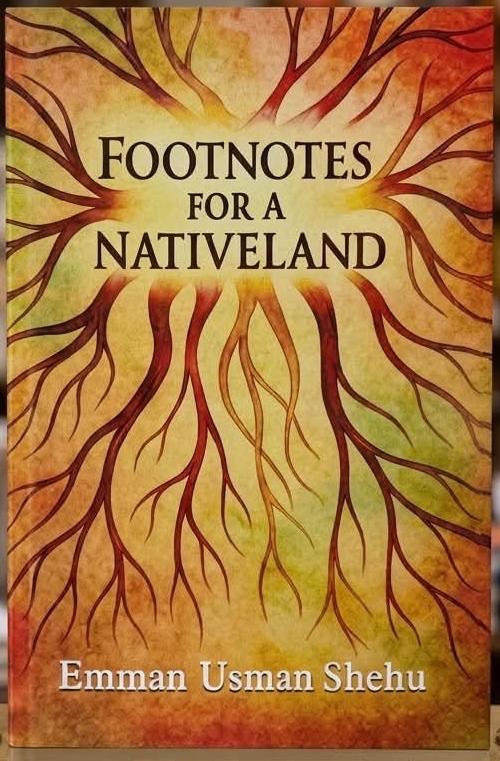
Footnotes For A Nativeland: A Review
By Angela Agoawike
Emman Usman Shehu, PhD, has had a distinguished career as journalist and author. From NTA Sokoto to the Daily Times and Daily Independent, he is currently, he is the Director of the International Institute of Journalism, IIJ, Abuja. As an author, his latest outing is FOOTNOTES FOR A NATIVELAND. Published by Topaz Books in February 2026, it is a 120-page collection of short poems that describe the aspirations, dreams, challenges, and state of the nation. Here’s my short take on the book.
EVERY DAY, young men and women in major cities across the country wake up at the crow of the cock, or sound of alarms from their cheap smartphones. With their backpacks slung over their shoulders, they stand by the roadside waiting to be hired for the day’s work.
Eventually, a vehicle stops, negotiations take place, and the young men are loaded and deposited at construction sites where they provide cheap labour for the many houses and structures that dot the landscape. At the end of the day, tired and exhausted, they trudge home for a few hours of rest before the next day’s drudgery begins.
Meanwhile, at other ends of the cities, those who have illegally cornered the nation’s wealth are busy dusting off their agbadas and ironing their pseudo-designer suits in readiness for housewarming of their insanely huge ‘mansions’ and commissioning of structures that increase the depth of their already bulging bank accounts.
At this point, no one remembers the young men whose hands built the structures, or the young women who, with pots on their heads, babies strapped on their backs, fed the young men at the construction sites, as they fade out, retreat to the back, to become mere ‘footnotes’ in the sharing of a looted commonwealth.
Like the men and women at the construction sites, so is the woman in ‘Kiss the Truth’, one of the sixty-two short satire-infused poems that make up Emman Usman Shehu’s Anthology – Footnotes for a Nativeland.
For all of these folks, their inheritance is indeed a ‘Bouquet of Broken Promises’ by an elite that keeps them on the outside, from where they look in, watching helplessly as their patrimony is stripped in what is best described as ‘Harvests of denial’ of the things that ought to be done to give everyone a fighting chance at decent living.
Footnotes for a Nativeland is an eschatological dissection of the threat greed and corruption pose to the survival of a country; when ‘shadows on the compound wall’ signal the arrival of the marauders, dampening the zeal of a people who, like the itinerant city construction labourers, dare to seek their ‘daily bread’ under the sun’s unyielding whip and mute indifferent sky.
The beauty of this Anthology as put together by Shehu, lies in the ability of the author to make the 62 short poems inviting and easy to read. For anyone who has come in contact with the author, easy to relate to, could also be an apt description of him as he delivers an accurate reflection of the state of the nation with nostalgia subsumed in infectious mirth.
‘Cracks in the Baobab’s skin’ is particularly interesting as it paints a picture of a country, gradually giving way from its former near-perfect state, even if romantically viewed, to one with cracks that run straight through it, and as the great Chinua Achebe would have said, the centre can no longer hold as things keep falling apart. As this happens, the question most of its children ask is whether ‘the drummer’s hesitant beat’ is enough to ignite a spark in the night’s stern hush.
From a ‘whisper to the river God’, to the ‘song of the open palm’, from ‘breaking the clay’, as the nation weaves through the ‘hawker’s shadow, through the ‘fisherman’s empty net’, as the ‘maid’s silent scream’ gets lost in the open seas, the hope is that one day, ‘the sun chews their bone’ as the nation’s children are rid of the ‘ghosts of the hammer’.
Till then, however, as ‘the wound refuse to close’, all the emotions, the ups and downs, highs and lows are but ‘one voice in the shadow’ waiting to see if ‘Mokwa heals” enough to allow its children, sing in a new tongue away from the ‘language of our nativeland’, which according to Shehu, is ‘forgetting the meaning of compassion, and yielding to the domineering tenor of harshness”.
And that is where I have a view antithetical to Shehu’s. The beauty of poetry is that it sets the mind free to adopt an interpretation that suits individual conviction or view. It is, that freedom that allows me to interpret the ‘language of our Nativeland as one that is, instead, filled with compassion, consideration for one another, and love of neighbour, but exploited by those that prefer for the people, a legacy of a ‘land that drinks its blood’, thereby making the people who toil daily for a living, nothing but footnotes in a nation which story of an arrested development is still unfolding.
I recommend Footnotes For A Nativeland for everyone, especially communication students, to enable them pass on critical messages without getting in harm’s way.


