



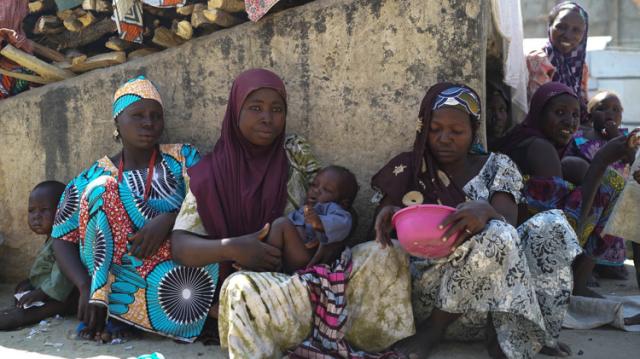
Maiduguri, the capital of Borno State, has been the epicentre of key events and changes in northeast Nigeria during the last decade.
The city witnessed the birth of Boko Haram, subsequent years of violence, as well as the arrival of more than 300,000 internally displaced persons (IDPs) fleeing their villages that were being attacked.
Informal and formal IDP camps have sprung up around the city, repurposing old government grounds, abandoned lots and real estate to give shelter to those fleeing.
At more than 100 sites across the greater city, vulnerable Nigerians, majority of whom are women and children, struggle to find ways to rebuild their lives.
Many are farmers, as nearly 80 percent of Nigeria’s northern population works in the agriculture industry.
With an increase in Boko Haram attacks and the displacement of nearly two million Nigerians, agricultural production has plummeted and staple food prices have sky-rocketed.
Northeast Nigeria now faces one of the world’s worst food security crises, with around 3.8 million people who will face critical food insecurity and around 7.7 million in need of life saving humanitarian assistance this year.
![A group of women in the NYSC IDP camp which houses around 6,000 Nigerians. Some IDPs make handicrafts, like the traditional Nigerian caps, in order to earn money and feed their children. Others are pounding millet, a task which typically requires several hours of labour. [Joi Lee/Al Jazeera]](https://www.aljazeera.com/mritems/Images/2018/6/13/d2d532aad27a49419e5d9cad5781af68_8.jpg)
!['Living in the camp is terrifying. They do supply food, but to be honest, it's not enough. Because we don't have food, we need to do some menial jobs like pounding other people's millets. One bag takes a group of nine women a couple of hours. We share the $1.10 among us.' Yagana supports two children with a limited support system in the NYSC IDP camp. [Joi Lee/Al Jazeera]](https://www.aljazeera.com/mritems/Images/2018/6/13/2de74fc452024454a9f815d141057e0f_8.jpg)
![Bakassi IDP camp was opened in January 2015 as a formal IDP camp in Maiduguri. It now houses more than over 35,699 people. Greater Maiduguri hosts the largest IDP population in Nigeria with over 309,000 Nigerians. [Joi Lee/Al Jazeera]](https://www.aljazeera.com/mritems/Images/2018/6/13/5aedb99e423946bf9f904e8e137a2214_8.jpg)
![Habiba, 55, is a displaced farmer from Gwoza, a local government area (LGA) of Borno State, Nigeria. After Boko Haram attacked her village, she fled to Maiduguri where she has been living in Bakassi IDP camp for four years with her husband and eight children. Almost 80 percent of northern Nigeria's population is farmers, which has been largely impacted by the Boko Haram insurgency over the last decade. [Joi Lee/Al Jazeera]](https://www.aljazeera.com/mritems/Images/2018/6/13/310e94f8e5ff4d14b8ecfaa242888d51_8.jpg)
![Falimatu, 40, cooks dinner for her five children in Kawar Maila camp, an informal camp in Maiduguri built by a local Nigerian to shelter IDPs fleeing the Boko Haram insurgency. [Joi Lee/Al Jazeera]](https://www.aljazeera.com/mritems/Images/2018/6/13/811ce05949d64ef8b849a0a98a758654_8.jpg)
![An estimated 400,000 children will be severely malnourished in 14 local government areas in Borno State this year. In total, more than 4.3 million children (under the age of 18) are in need of humanitarian assistance. [Joi Lee/Al Jazeera]](https://www.aljazeera.com/mritems/Images/2018/6/13/5cddb903686a4458bb64d0f68c5e41d2_8.jpg)
![A farmer before she was displaced, Habiba was given a small piece of land for farming within her IDP camp. 'When we get food, we all eat. When there is no food, we just wait and be patient.' Every year, she saves a small amount from her profits and plans to use that money to buy her own land and move outside of the IDP camp. [Joi Lee/Al Jazeera]](https://www.aljazeera.com/mritems/Images/2018/6/13/0912e3d2654b4e778dd6da17d8a24e09_8.jpg)
![Habiba has been married for 40 years. To help support the family in Maiduguri, Habiba's husband works as a mechanic. [Joi Lee/Al Jazeera]](https://www.aljazeera.com/mritems/Images/2018/6/13/a12fce75046940ad80c6133af89d5fe5_8.jpg)
!['I'm breastfeeding but I have no milk because of the lack of nutrients and food,' said Yagana, a young mother who fled a Boko Haram attack on her village in Damboa, an LGA of Borno State. Amidst the chaos, she lost contact with her husband and her family, and now lives in the NYSC IDP camp. [Joi Lee/Al Jazeera]](https://www.aljazeera.com/mritems/Images/2018/6/13/db9b3e78e54542c89da1728500bf8bd3_8.jpg)
![Making handicrafts, like the Nigerian cap, is a common coping strategy for many IDPs to make some money. Falimatu relies on cap making, NGO assistance and begging as ways to support her family. [Joi Lee/Al Jazeera]](https://www.aljazeera.com/mritems/Images/2018/6/13/585e527be22f45918a6d640d04f15bcb_8.jpg)
![A young girl inside Buzu Quarters camp, an informal host community in Maiduguri with shelters built by a local Nigerian to house IDPs. [Joi Lee/Al Jazeera]](https://www.aljazeera.com/mritems/Images/2018/6/13/2c8a0c3c001040dd86933c48946bb4e0_8.jpg)
!['If my village returns to normal, and the government agrees to let us go back, then I would return. When I think about going back home, I am happy,' said Yagana. [Joi Lee/Al Jazeera]](https://www.aljazeera.com/mritems/Images/2018/6/13/0e86ec5cd633450585f079d7dd13ded4_8.jpg)
![Women and children make up almost 80 percent of the IDP population in northeast Nigeria. Most of this population is concentrated in Borno, Adamawa and Yobe states. [Joi Lee/Al Jazeera]](https://www.aljazeera.com/mritems/Images/2018/6/13/25eabee658fa4ffd900fb7d9e40d4809_8.jpg)
.AL JAZEERA


