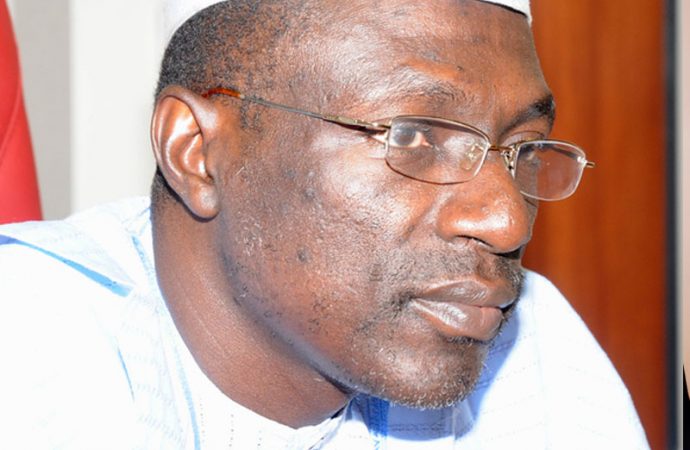
By Ishaya Ibrahim
Barring last minute changes, former Kaduna State governor, Ahmed Makarfi, will formally declare for the Peoples Democratic Party (PDP) presidential ticket at the end of April, sources at his Abuja campaign office told TheNiche.
By the Independent National Electoral Commission (INEC) timetable, all political parties’ flag-bearers will be decided between August and October this year.
Makarfi joins other big guns to jostle for PDP’s ticket, including former Jigawa State governor, Sule Lamido and former vice president Atiku Abubakar.
Age advantage
Makarfi is the youngest of the trio. At 61, he is a generation away from Lamido, 70 and Atiku, 71.
The global agitation for younger political leaders may count against Atiku and Lamido, especially as the PDP seeks to warm its way into the hearts of Nigerian youths who are blaming Nigeria’s economic troubles on ‘analogue’ leadership.
The PDP may also avoid fielding a candidate in the age bracket of President Muhammadu Buhari, already 75 years old. He is likely to fly the flag of the All Progressives Congress (APC) in the presidential poll.
Analysts say PDP may be comfortable with a Makarfi whose age of 61 makes him the perfect bridge in aggregating the needs of the younger folks and older citizens .
Corrupt-free record
Makarfi served as Kaduna governor between 1999 and 2007. Elected senator between 2007 and 2015 during which he was head of the senate committee on finance, yet, he does not have corruption allegation hanging on his neck.
The PDP is aware that the APC will latch on the corruption records of its members facing trial at various courts. To mitigate the damage, a Makarfi candidacy could come handy because of his corrupt-free record.
Lamido, on the other hand, is facing trial along with two of his biological children, Aminu and Mustapha, for diverting N10 billion from the Jigawa State government accounts into the accounts of companies run by the former governor and his two sons.
For Atiku, the corrupt behaviour of United States lawmaker, William Jefferson is still haunting him. The congressman man took $100,000 in bribes from a U.S. tech firm under the guise that he would pass it off to Atiku to facilitate a lucrative telecommunication contract.
But one month after Jefferson received the bribe money, which he told the tech firm that he had given it to Atiku, agents of the Federal Bureau of Investigation (FBI) found $90,000 of that cash in his apartment freezer.
Notwithstanding that no evidence was found linking Atiku to the crime, the allegation that he was involved continues to haunt him. It is made worse by the US government’s refusal to issue Atiku a travel visa into their country.
Managing religious conflict
The former Kaduna governor, a Muslim, has a record of managing sensitive crises, a test case was the Sharia riot that split Christians and Muslims in the state.
On February 21, 2000, hatred between proponents of Sharia and opponents of the Islamic law, had reached boiling point. What followed next was a bloodbath.
During the conflict, Makarfi was said to have held marathon meetings between Christian and Muslim leaders, along with security chiefs until the situation was contained.
When in 2002, an offensive article against Islam stirred another riot in the state, the governor was able to restore order within 48 hours, and that was the last of religious crisis in his administration.
At the funeral of late Bishop Joseph Bagobiri, the Catholic Bishop of Sokoto Diocese, Most Reverend Hassan Kukah, revealed that it was Makarfi that brought development to the Southern Kaduna area, populated by Christians, the first time in 30 nearly 30 years of its creation.
“It was in 1999 that Senator Isaiah Balat was appointed a Minister to represent Kaduna State… then came the historic appointments of both Lt. Generals Martin Luther Agwai and Yusuf Luka to the positions of Chief of Army Staff and for Agwai, Chief of General Staff.
“Alhaji Makarfi did for the people of Southern Kaduna what no one had had time to do for them. He created a massive infrastructure of rural roads and opened up Southern Kaduna.
“For that period, most of our quarrels and violence literally disappeared, thus, showing very clearly that it was government policies of exclusion that were the problem, not ordinary people. Indeed, our people have lived together and continue to do so. What we call crisis is reaction to skewed government policies and the records are very clear,” Bishop Kukah said.