Ex-Appeal court justice, Odinkalu, Igini, others knock judiciary for imposing election winners
By Ishaya Ibrahim
Legal luminaries, civil society leaders, and electoral experts gathered in Lagos on Thursday, September 17, 2026, for the 3rd edition of the Tunji Braithwaite Symposium, issuing a stern indictment of the Nigerian judiciary over its persistent imposition of election winners against the clear mandate of the electorate.
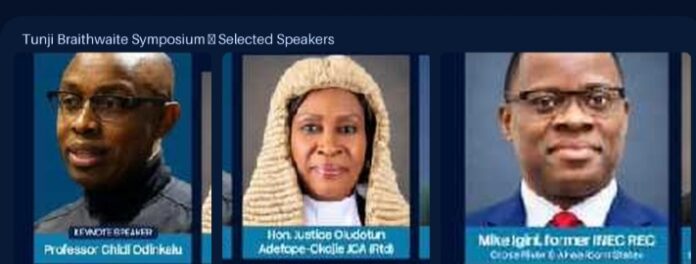
The panel of speakers including retired Court of Appeal Justice Oludotun Adetope-Okojie, renowned law professor and human rights advocate Chidi Odinkalu, and former Independent National Electoral Commission (INEC) Resident Electoral Commissioner Mike Igini among others, unanimously declared that the courts have systematically expropriated popular sovereignty from Nigerian voters.
In her address, Justice Adetope-Okojie (retd.) condemned the practice of nullifying democratic mandates based on minor procedural flaws or name discrepancies, urging the bench to return power to the electorate.
“It is not right,” Adetope-Okojie said. “If one wins the votes, on technicalities you give it to someone else? It’s very wrong. What I consistently say is that all these technicalities that void elections must stop. The will of the people must prevail, and the Electoral Act must be interpreted in favor of the aggrieved party, not to void an election.”
She highlighted deep-seated inconsistencies in judicial precedents, referencing the Supreme Court’s conflicting positions in political party internal disputes, specifically contrasting the majority decision in PDP v. Alhaji Sule Lamido with dissenting opinions that expose a lack of stability in Supreme Court decisions.
“You are seeing inconsistencies, and the problem, if the truth must be told, is that a lot of these laws were interpreted to favor a party at the time,” she explained. “When you interpret laws to favor a party, it brings chaos into the system, because then you have bastardized the law. Nobody knows what precedents to follow.”
Adetope-Okojie also criticized the rigorous procedural burdens placed on petitioners, particularly surrounding the Evidence Act and subpoenas. “Why must you then, only with respect to court, call witnesses to tender? What is the necessity for that? Why should you make it impossible for anybody to be able to prove an electoral error, irregularity? What if the witness is from INEC? Is INEC going to give a deposition that favors the other side? How can you have his deposition when he’s a hostile witness to you, but you need him?” she queried.
To check these anomalies, she highlighted the ongoing monitoring efforts of independent investigative groups like the Independent Judicial Accountability Panel (IJAP) to track judicial decision patterns and hold the bench accountable. “Without vilifying their character, what it did was that it traced their career trajectories, gave their judicial philosophies, decision patterns, public controversies, professional networks so that once you see that, you know where that judge is going,” she added.
Delivering his paper on the posthumous 93rd birthday and 10th anniversary of the passing of legendary activist-lawyer Dr. Tunji Braithwaite, Professor Chidi Odinkalu asserted that Nigerian courts have transformed from interpreters of the law into “market makers in a political marketplace.”
Odinkalu noted that Section 14(2)(a) of the 1999 Constitution explicitly vests sovereignty in the people, not the bench. He warned that the judiciary’s increasing tendency to determine election outcomes through what he termed a “ruse of law” mirrors historical patterns where democratic institutions were weaponized to subvert popular participation.
“Is it still popular sovereignty when judges or courts expropriate and confiscate from the people their constitutional role to decide how and on whom to confer the mandate to rule?” Odinkalu asked. “The jurisprudence of election petitions and political cases in Nigeria can no longer be justified in many ways.”
Citing international observers and scholar Andrew O’Donoghue’s framework on how courts undermine democracy, Odinkalu noted that Nigerian elections are increasingly decided by the skills of lawyers navigating technical pleadings rather than voter arithmetic.
“When you go to vote, do you expect that the election will be decided by the skills of lawyers in drafting pleadings or traversing pleadings. If we end up in a situation where, as a matter of practice, elections end up in the hands of lawyers… it has become perverse, it is no longer an election,” Odinkalu said.
Applying the political Selectorate Theory, he argued that voters have been relegated to nominal bystanders, while judges and security agencies have become the essential power-brokers whom politicians prioritize over the welfare of the public.
“In the political economy of Nigeria, when you take the escalations that have taken place in the salaries of judges over the past two, three years, and compare them with what the voters have got, you must conclude, as an ordinary citizen, that the voters have got a raw deal. The reason voters get a raw deal is quite simple: they no longer matter. The judges do,” he said.
In his intervention, former INEC Resident Electoral Commissioner Mike Igini shifted the spotlight to systemic operational failures, internal sabotage within the electoral umpire, and the compromised execution of election technology like the Bimodal Voter Accreditation System (BVAS).
Igini emphasized that while the judiciary ultimately awards victories, the root cause of electoral rot begins with compromised electoral officers who deliberately manipulate results at the polling units and collation centers to force aggrieved candidates into long, costly legal battles.
“The real tragedy of our electoral system is that the subversion of the people’s will begins long before a file ever reaches the desk of a judge,” Igini stated. “We built technology like BVAS and the IReV portal specifically to eliminate human discretion and fraud at the polling level. But what do we see today? Deliberate non-transmission of results, refusal to upload polling unit data in real time, and deliberate creation of technical snags to justify manual manipulation.”
Igini insisted that the breakdown of public trust in elections is directly linked to the lack of criminal prosecution for corrupt electoral personnel and political thugs who compromise the process.
“Until we begin to send compromised electoral officers and politicians who buy votes or manipulate collation figures to jail, the courtroom will remain the primary market where mandates are bought and sold,” Igini warned. “You cannot fix judicial overreach without first sanitizing the conduct of elections on the field. INEC must clean its house, enforce its own regulations strictly, and ensure that the integrity of the ballot box is preserved so that courts do not have any reason to intervene in the first place.”
Earlier, Executive Director of Tunji Braithwaite Foundation, OlaOluwa Braithwaite Foundation recalled her father’s memorable quote that “a nation that has no courage to confront injustice has no future.”
She said the discussions were aimed at confronting some difficult questions, including “Is this judiciary fit for purpose? Does it have the capacity, the independence, and the public trust to safeguard a free, fair, and credible election? Can it deliver justice without fear, without favor, and without delay?”
Other speakers speakers at the symposium included Arise News Anchors Rufai Oseni and Adesuwa Giwa-Osagei, Program Manager of Action Aid Nigeria, Celestine Okwudili Odo, National Coordinator of Obidient Movement, Mallam Yunusa Tanko and a Priest Rev. Fr. Raymond Anollefo.