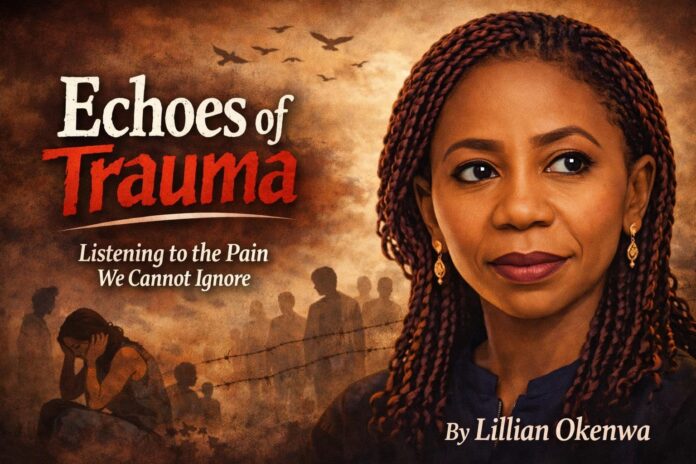
Echoes of Trauma: When a nation repeatedly abandons its children to fear, hunger, violence and hopelessness, it should not be shocked when some eventually grow into angry adults who no longer believe in society, government or humanity itself.
By Lillian Okenwa
A nation that cannot protect its children is not merely losing its future. It is quietly breeding tomorrow’s anger, tomorrow’s bitterness and perhaps tomorrow’s terror.
Three-year-old Sikiru Salami is still somewhere in the forest. So are many of his little schoolmates. Perhaps they are crying for their mothers. Perhaps exhausted from fear. Perhaps too traumatised now to even cry at all.
Names that should ordinarily exist only in nursery registers, birthday cards and school attendance books are now appearing on lists of abducted victims.
Eighteen-month-old Christianah Akanbi was taken alongside her mother, a teacher in the school.
Four-year-old Abdulsalam Toyib.
Four-year-old Emmanuel Oyedele.
Four-year-old Idowu Taiwo.
Four-year-old Soliu Salami.
Four-year-old Waliya Bello.
Five-year-old Testimony Jacob.
Five-year-old Deborah Adebowale.
Five-year-old Muiz Aliyu.
Five-year-old Elizabeth Abadi.
Five-year-old Pius Stephen.
Six-year-old Mary Gabriel.
Six-year-old Jomiloju Ogunlola.
Seven-year-olds Samuel Oyedele, Juwon Sunday, Kehinde Kaosara, Sewa Seyi, Lydia Olohunloluwa, Ahmed Aliyu and Habidat Ayanwale.
Eight-year-olds Ahmed Ramoni, Ojo Joseph, Lydia Adewole, Damilare Oderinde, Balkis Ayanwale and Agune Noah.
Nine-year-old Tosin Abadi.
Ten-year-olds Aisha Oguntowo, Asa David and Shuaibu Aliyu.
Eleven-year-old Rashida Tajudeen.
Twelve-year-old Lege Taiwo.
Thirteen-year-old Joshua Adeleke.
Fourteen-year-olds Hassan Azeez and Hannah Ojo.
Fifteen-year-old Fatimo Jimoh.
Sixteen-year-old Baraka Abioye.
Babies. Toddlers. Children. Teenagers.
All violently dragged into a horror they neither created nor understood.
Somewhere too, their mothers are likely unable to sleep, unable to eat, unable to breathe properly through the crushing weight of fear sitting permanently on their chests.
And perhaps that is one of the greatest tragedies of insecurity in Nigeria. It is not only the people who die. It is the minds that quietly break. The innocence that disappears suddenly. The trust in society that is violently destroyed.
When armed men stormed schools in Ahoro-Esinle, Oriire Local Government Area of Oyo State on May 16, 2026, they did not merely abduct pupils and teachers. They stole childhood itself.
One moment they were pupils.
The next moment they became hostages.
What happens inside the mind of a toddler violently separated from home? What does terror look like through the eyes of a four-year-old?
How does a child process men carrying guns, screaming orders, forcing frightened teachers and pupils into forests?
Frightened children with trembling hearts. Children who probably cried for their mothers as guns thundered around them. Children who may now wake suddenly in fear even if eventually rescued. Children whose minds may never fully return to what they were before that morning.
And perhaps that is the deeper national emergency many do not talk about enough.
What kind of adults emerge from repeated exposure to fear, violence, abandonment and hopelessness?
Many of the terrorists terrorising Nigeria today were once children too. Children who may have grown up angry, neglected, brutalised by poverty, violence, drugs, extremist indoctrination or systemic abandonment. No child is born craving bloodshed. Something often goes terribly wrong along the journey.
A society that continually exposes children to horror without protection should not be shocked when some eventually become hardened by it. Pain changes people. Prolonged trauma changes societies.
When children repeatedly see government fail, when they watch leaders prioritise politics over protection, when they grow up believing nobody is coming to save them, bitterness quietly takes root.
This is why what is happening across Nigeria should terrify everyone.
Just after the Oyo abductions, suspected Boko Haram insurgents reportedly stormed Mussa Primary and Government Day Secondary School in Askira/Uba, Borno State, abducting dozens of children in another horrifying raid that reignited fears over the vulnerability of schools in conflict-prone communities.
Senator Mohammed Ali Ndume disclosed that the victims included four secondary school students, two boys and two girls, 28 primary school pupils and 10 other children kidnapped from nearby homes, bringing the total abducted to 42.
Again, children. Always children.
Their names were not given, but these are not statistics.
And while frightened parents wait endlessly for news, political calculations for 2027 are already dominating conversations across the country. Alliances. Permutations. Defections. Primaries. Endorsements. Victory songs.
In the same Ogbomoso axis where abductions and killings have triggered fear, politicians spent last week harvesting primary votes. Delegates gathered. Convoys moved. Celebrations erupted. Winners danced.
Meanwhile, little children are disappearing into forests while parents whose sons and daughters were taken away can barely breathe.
That contrast is not lost on the younger generation.
Sometimes it feels as though ordinary Nigerians and their pain have become background noise in the nation’s political theatre.
Even more disturbing is that many of the attackers themselves are reportedly very young men. So, what happened? How does a society produce young men who can point guns at toddlers? That question should haunt Nigeria deeply.
Government indifference is creating dangerous anger among observing youths who see extravagance at the top and suffering below. They see waste, corruption, impunity and political obsession while communities bleed endlessly. They see leaders surrounded by convoys while villagers negotiate survival with bandits.
Little wonder some communities in parts of Katsina reportedly resorted to paying protection levies to bandits simply to stay alive. That desperation says everything about the collapse of trust in state protection.
And then there is the disturbing conversation around so-called repentant terrorists.
Citizens watch as some violent actors are rehabilitated and reintegrated while traumatised victims are left to rebuild shattered lives alone. What message does this send to wounded communities? What does justice mean to parents whose children were stolen, murdered or psychologically destroyed?
There is also another painful truth many avoid. A child raised constantly around violence may begin to normalise violence. A child repeatedly exposed to brutality without healing may one day reproduce that brutality on society. Trauma unattended does not disappear. It mutates.
This is why national security is not only about guns and military operations. It is also about schools, food, jobs, mental health support, stable homes, justice, trust in institutions and the dignity of citizens.
And perhaps nowhere is this national failure more visible than in the lives of the countless Almajiri children scattered across many northern cities including Abuja, the nation’s capital with all its wealth and opulence.
These children gather around roadside food sellers carrying small plastic bowls, waiting patiently for leftovers from strangers. Some stand silently beside food vendors hoping someone will spare half-eaten meals. Some wash plates, fetch water or run errands in exchange for food scraps. Others roam from street to street singing traditional begging songs simply to survive another day.
They are children too. Children who should be in classrooms. Children who should be protected, guided, educated and emotionally nurtured.
Instead, many grow up surrounded by hunger, rejection, humiliation and social abandonment while watching political elites display staggering wealth and power with little visible concern for the suffering around them.
What kind of adults does a society expect such children to become?
A child who grows up feeling invisible to society may eventually stop caring about society itself. That is one of the greatest dangers Nigeria is ignoring.
The terrorists and bandits devastating communities across the country did not fall from the sky. Many were once neglected children shaped by poverty, anger, violence, manipulation, illiteracy, hopelessness and years of abandonment.
A country that continually fails its children may eventually become haunted by the wounded adults those children become. Nigeria cannot continue failing its children and expect peace.
Every kidnapped child is not only a victim. That child may also become tomorrow’s deeply wounded adult struggling to trust humanity again.
And nations built on wounded generations eventually begin to bleed from within.
As Nigeria marks Children’s Day alongside Eid al-Adha, a solemn reminder of sacrifice, mercy and redemption, what greater gift can the nation’s leaders offer than the safe return of every abducted child and a future where Nigerian children can grow without fear? In the story of Prophet Ibrahim, a child was spared and restored, not lost. Perhaps the true test of leadership is not in politics or power, but in protecting children, preserving innocence and giving grieving parents a reason to hope again.
- A lawyer and equity advocate, Lillian is the publisher of Law & Society Magazine. She can be reached at Lillianokenwa@gmail.com