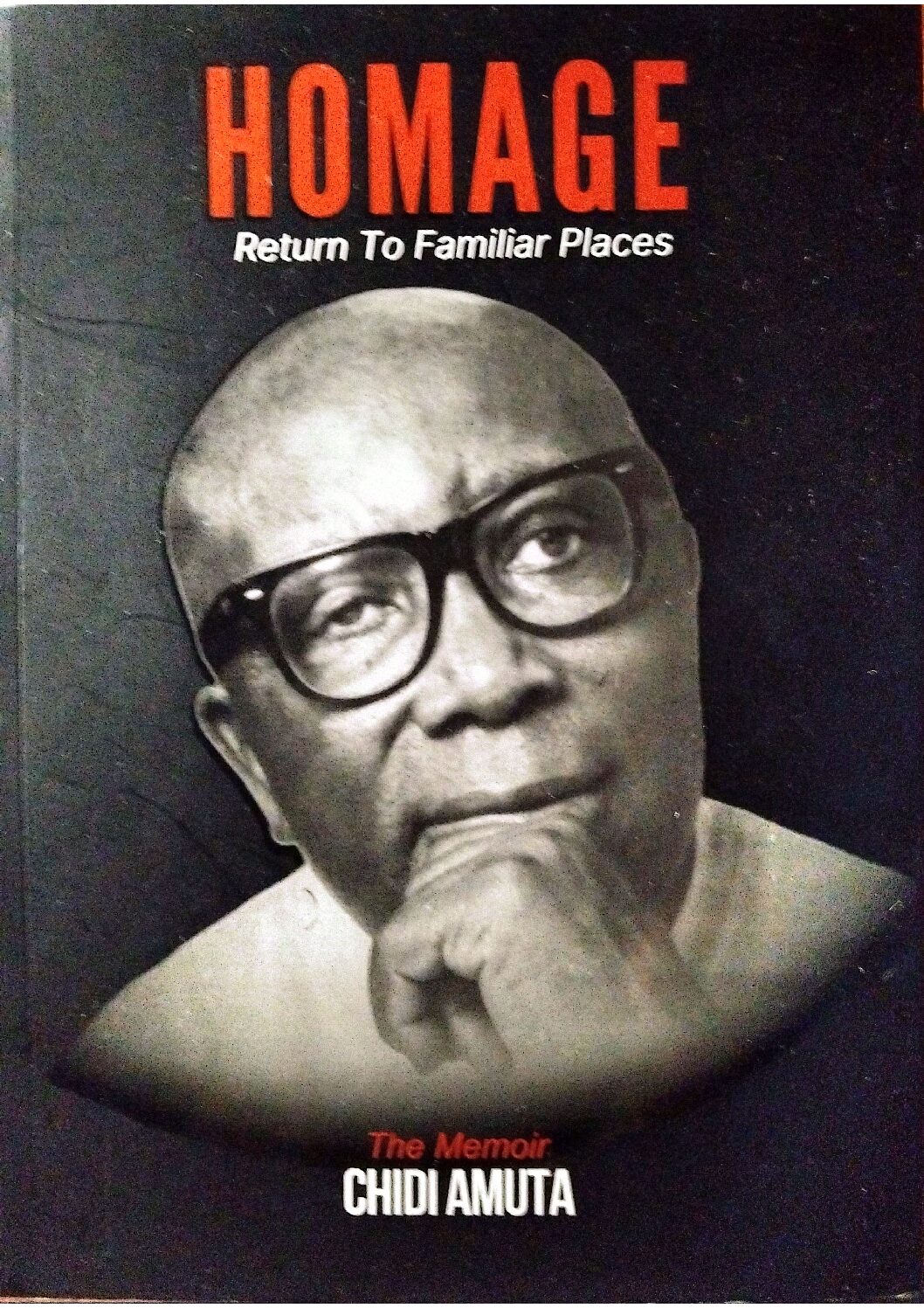
A memoir above all else – Chidi Amuta’s ‘HOMAGE: Return to Familiar Places’
By Donald Thompson
In a market of numerous recent routine memoirs, Chidi Amuta has enlivened the landscape with his memoir… ‘HOMAGE: Return to familiar places.’ From a writer of limitless verbal capacities, this book is likely to awaken the Nigerian literary and journalistic landscape with its fresh insight and stylistic brilliance. To the general reader, this new book offers food for the mind. For the reader with an eye for language at its finest and ears for the resonance of history, here is an irresistible offering. For the perceptive reporter, here is depth and exclusivity wrapped in elegance.
This memoir has been long awaited. It is at once the story of a remarkable life, the historical sketch of a nation in which that life has been possible as well as a vast experiment in the expressive possibilities of a language in which this writer is a celebrated wordsmith and master craftsman.
The book is a poem in places, animated prose in others, emotive historical narrative in some areas and modern journalism in many respects.
This unusual memoir has a liturgical structure because it is an act of personal worship. It follows a religious ritualistic flow. It commences with a ‘processional’, which opens with an ‘Awakening’, progresses to a poetic ‘invocation’ and ends naturally, like all acts of worship, with a ‘recessional’.
The ‘Awakening’ is a sort of ground preparation. It lays the carpet, as it were, of the cultural and emotional landscape of the journey of memory. ‘Invocation’ is a poetic convocation of the major spiritual personae that inspired this work and the writer’s sensibility. The major deities of the author’s ancestry are invoked. The dominant images are those of the powerful gods of thunder, the earth, fertility and other custodians of communal memory. The myths of Amuta’s childhood and the major beliefs of his rural community are all brought to bear through the power of verse. He literally invokes these multiple divinities of his ancestry to come forward and aid his journey into memory land.
Consistently, Amuta pays homage to ancestry, to a place he calls ‘memory land’, a place where most things lie forgotten or are ‘forever remembered’.
Part of this processional sequence addresses the entire memoir to his first child, UZO. The memoir becomes a message sent through UZO as an emissary of her generation to partake in the experiences of the author’s departing generation. It is a reliving of the landscapes of his rural pastoral childhood. It is somehow a subtle lament of his guardian angels, persons who shaped his life’s journey but are now mostly departed and extinct.
He nostalgically recalls the days spent in the farm with his mother, at home with his grandfather at the periodic seasonal rituals of ancestral worship. A childhood of rural innocence and simple ways and means is perennially in our face. The guardian angels of this universe are the departed ancestors, the elders who are high priests and sages rolled into one. They are the custodians of ancient wisdom and communal memory, an invisible library which is also a museum.
The real life story begins with the story of his birth which comes to us through a stylistic ruse.
The story of AMUTA’s beginnings is told not by the author himself since he was just being born but by a more credible source: his maternal grandmother who witnessed these beginnings. She is a medicine woman and medium, a link between the spirits and the living, a woman who communes with departed spirits and converses with plants to extract their medicinal powers and mystic wisdom. She reveals the date, place and circumstances of Amuta’s ‘ordinary’ birth in extraordinary circumstances.
The village rituals that accompany the arrival of a child are relived and captured in their religious essence. The rituals of birth are animated by women adorned with chalk on their faces. Among these people, the welcoming of a child is a combination of worship, dedication and ancient baptism. All are completed for this child whose birth chord is buried with coins beneath the kola nut tree at the back of the family kitchen.
This narrative strategy of the ‘borrowed’ voice outsources the narrative of his beginnings to an adult voice with the experience and cultural depth to locate the birth of this child in its rounded boundless totality. The grandmother holds the narrative in trust until the young child can ‘see’ and speak for himself while growing up in the pastoral innocence of Umuguru village.
READ ALSO: Chinua Achebe’s “Things Fall Apart” makes list of 50 most influential books of all time
From here, the narrator becomes the child himself as he relives life growing up in the village. The ‘I’ of the young protagonist replaces the borrowed voice of experience. We follow him through the narrow village pathways and days in the farm with his mother. We share his ancient fears on dark nights and lonely pathways as his naked feet trudge the muddy pathways of the village.
We accompany him to the village school where he learns to count, read and scribble. We learn of his early disdain for school with the regimentation and overbearing teachers. This boy prefers the shade of forest plants to the lifeless barrenness of the cemented classroom floor. Even this early, his passion for knowledge and excellence come as a form of rebellion to school regimentation. He wants to excel in school exams to ‘bribe’ his parents and teachers to leave him out of the depressing regimentation and oppressive authority of school.
His adolescent years in Aba are full of exploits with peers. The stark contrast between village innocence and the fetid stench of the crowded urban ghetto hit the young boy like a sledge hammer. Electric lamps hide the ugliness of the city which they call ‘modern’!
He recalls the peer group adventures of adolescence and the spatial segregation of the colonial era urban Nigeria .There is ‘European Quarters’. There is ‘Town’ and there is ‘Over Rail’, the dinghy abode of the underclass where he and his friends belong. In this place, everything is shared.
Life among the urban underclass comes across as a self-submergence in urban yard ghetto culture of shared everything – toilet, kitchen, refuse bin and excremental odour. The sweet aroma of peppered fish and yam slices roasted in oil in open Street corners in the evenings mixes freely with the stench of the night soil man’s wares.
Easily the most emotionally fraught part of this book is the author’s recollection of his experiences during the Nigerian civil war. The suspension of schooling and return to the village as the war raged is the most telling part of this book. War is death in abundance. It is also life lived at the limits of reality and existence. Tragedy as daily lived experience, the ever presence of death and its celebration as a grim part of life comes alive. People die. The hums of death and dying meet and mix with the songs of heroic courage and survival. Others live to celebrate survival or just the frequent rituals of passage.
At the political level, the war comes to shatter the illusion of stability and nationhood of childhood founded in the immediate post-independence era. The war ends with a shattering of yet another childhood world, the alternative hopes raised by Biafra. A return to a united Nigeria sounds frightening but real.
The more overtly political aspects of this book belong in the last university experience segments of the story. His post war university days only prepare him for careers in the new Nigeria. His initial fascination with the high culture of the academia gradually gives way to more realistic options.
Amuta recalls his dramatic change of career from academics to high profile journalism. It is through journalism that he experiences what may be called his adult baptism into public life. Journalism hones his talents as a public communicator. Words convey ideas. Ideas communicate influence and influence appeals to those who hold power over men. People of power seek people of ideas so that they can rule the world. The classic relationship between the pen and the sword of power comes alive in the career of this writer.
His exposure to key political figures like Dr. Nnamdi Azikiwe, Moshood AbIola and Ibrahim Babangida are as revealing as his encounters with some world leaders. He comes away from these encounters with one shocking discovery: in spite of titles and political importance, all humanity is one. We all seek validation.
When Amuta recalls his interviews and interactions with statesmen abroad and at home, the memoir reads more like the best of modern journalism. His trips to interview presidents in Harare, Kampala and Banjul read like the travelogues of the best itinerant journalists. His reportage of encounters with Abiola, Babangida and Azikiwe belong in the best traditions of biographical journalism.
As an autobiography, HOMAGE reveals uncommon insights into the personal life of this remarkable writer, public figure and citizen of the world. In ill health and times of adversity he comes across as intensely human and vulnerable. Brief ill health and hospitalization in London reveal his mortal vulnerabilities. His sense of family is rather intense as shown in his love for his children and his wife, Jane.
The chapter on his brief experience of near-death experience is mystical as it is chilling. The transition from life, coma and drift into lifelessness in a London hospital is mystical realism at its best with the intense play with transitional colours, sounds and images; life becoming death and near death transitioning back to life.
In the process of this narrative, Amuta reveals the key persons that have shaped his life so far. These are his maternal grandmother, his father, his mother, his late younger brother and his wife Jane.
This remarkable ‘literary memoir’ ends with a section on ‘Reflections’ on the Nigerian idea. In three very creative pieces drawn from AMUTA’s influential weekly columns, Amuta illuminates, through the power of metaphor, the contradictions that define and have held Nigeria hostage from attaining its manifest destiny. Issues of inclusiveness, diversity, dangerous politics, monumental corruption and atrocious governance are communicated through befitting metaphors.
This very remarkable and unusual book ends on a pseudo fictional note of conditional optimism. The writer as an actively engaged citizen of Nigeria somehow manages to rise above merely hinting at and suggesting his political preferences and ideological slant.
The memoir ends on an interesting creative note. An obviously imaginary passenger plane in its last moments of an evening descent into Abuja depicts the unity of all Nigerians in spite of their diverse origins. The turbulence of our collective national experience compels all of us ‘passengers’ on a national flight to unite in a prayer for safety. The final moment of turbulence and uncertainty as the aircraft descends in turbulence reveals to the passengers in this early evening landing the commonality of their fate as well as the beauty of the land below. When the plane finally touches down safely, all the passengers break into a unanimous song of gratitude and prayers irrespective of their faiths and diversity.
The memoir then ends in a philosophical valedictory sign-off: “As I head out towards the fountain of my being, I behold once again the images of familiar places and hear the receding echoes of the familiar voices that shaped this journey. In the dark silhouettes of forgotten days, I embrace the fulfillment of my journey and the object of my mission. Then I heave the sigh that relieves us all of our earthly burdens “
This is a rounded remembrance. It succeeds as history in hiding. But above all, this is an arresting narrative and a seamless hybrid of poetry, enervating prose and powerful storytelling.
Through the bold and conscious linguistic and stylistic experimentation in HOMAGE, Amuta may have birthed a novel genre in Nigeria’s rich literary heritage. This may be the birth of the ‘literary memoir.’
- Donald Thompson wrote in from the School of Oriental and African Studies, London