



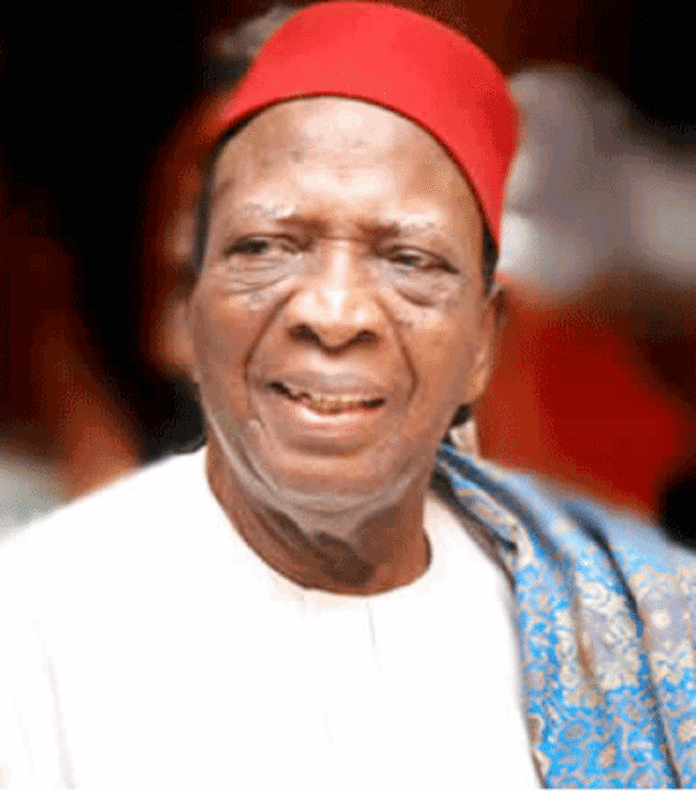
By Professor Ben Nwabueze
From all indicators the candidature of President Buhari at the 2019 general elections must be taken as a foregone conclusion, barring unforeseen circumstances, like incapacitation by ill-health. So the ball is squarely in the court of the Nigerian people – the electorate, guided and aided by the rest of the people.
GOOD PERFORMANCE BY AN INCUMBENT PRESIDENT IS A CRITERION, A CONDITION, SET BY DEMOCRACY FOR RE-ELECTION FOR A SECOND TERM
Democracy is government by the people. In a country of 180 million inhabitants, the entire people cannot, as a practical matter, govern directly. Rule by the people directly, direct democracy, is feasible only in a small community, such as characterised the relatively small Greek city-states of antiquity. In a large country such as ours, rule by the people has, of necessity, to be through representatives chosen, and dismissable, by them at periodic elections, i.e. representative democracy. The meaning of this is that the people only delegate but do not abdicate the power to govern by themselves; they still retain their sovereignty. Our Constitution (1999), affirms this position in a provision (section 14(2)) that states : (a) “sovereignty belongs to the people of Nigeria from whom government through this Constitution derives all its powers and authority”; and (b) “the participation by the people in their government shall be ensured in accordance with the provisions of this Constitution”.
Representative democracy, therefore, involves two types of power, viz power to vote representatives into power initially by means of election for a fixed term of years, and power, at a subsequent election, to vote them back to office or to vote them out if need be. Both powers are critical to the meaningfulness of representative democracy; they pre-suppose a certain amount of knowledge, intelligence, informed and rational judgment on the part of the people, and the way the power is exercised is an index of their ripeness or otherwise for democratic government. The power to vote out an incumbent government involves the exercise of a greater amount of mature and rational judgment because it has to be based on a critical evaluation of performance.
Happily, the Nigerian electorate is not new to the exercise of the power; it voted out an incumbent Federal Government in 2015; and the ground on which it did so was the Government’s poor performance with respect to the fight against corruption rampant in the country. Corruption is acknowledged by all as a pernicious evil, but it is not an evil that threatens our corporate existence as a country, as it is falsely represented to be by President Buhari. The problem confronting us today goes far beyond corruption; it imperils our very existence as one, indivisible sovereign nation. The situation thereby created is far more complex and critical than that on which the electorate based its judgment to vote out the Federal Government in office at the time of 2015 election. The performance evaluation required of the electorate in 2019 election calls for the exercise of mature, informed and rational judgment, taking into account the following:
- The verdict of Transparency International (TI) to the effect that corruption in the country has worsened beyond what it was at the time of the 2015 election, and on the basis of which the then Federal Government was voted out of office. With the guidance of the precedent of the 2015 judgment, the Nigerian electorate seems well equipped to return an informed and rational verdict in 2019.
- The categorisation of Nigeria under President Buhari’s Federal Government by Google as “a failed state”, ranking it the 15th among “the worst failed states” in an exercise in which 180 states across the world were surveyed based on internationally accepted indicia or indicators of state failure including in particular the failure or inability of the Government to provide peace, security and safety for the citizens, resulting in the killing and displacement of thousands of people and destruction of billions of naira worth of properties by Boko Haram insurgents and Faulani herdsmen marauders, the latest incident being the abduction of 110 girls from a school in Yobe State on 20 February, 2018.
- General insecurity caused by widespread incidence of armed robbery, kidnapping, cultism, food insecurity caused by hunger, and job insecurity caused by unemployment.
- The Quit Notice given by the Arewa Youths Coalition to Ndigbo to quit the North by October1, 2017, and the threat it posed to the corporate existence of the country.
- The eruption of a spate of hate songs and hate speeches by individuals and groups against one another across the country, and the threat of genocidal massacres thereby posed.
- Widespread disaffection towards the Nigerian state and the feeling of alienation from it caused by President Buhari’s Northernisation/Islamisation Agenda, as manifested in his unwillingness to create an all-inclusive government to which all Nigerians, irrespective of tribe or religion, can feel they belong and have equal stake.
The situation in the country noted above is well captured in an Address presented to President Buhari by the Catholic Bishops Conference on February 8, 2018, which, embodying the views of an independent, non-partisan body, deserves to be quoted in full as a guide to the 2019 electorate in forming its verdict.
CATHOLIC BISHOPS OF NIGERIA CONFERENCE ADDRESS TO PRESIDENT BUHARI
“We, the representatives of the Catholic Bishops of Nigeria, bring you our cordial greetings and blessings. We desired this meeting, in order to continue the dialogue we initiated with you, even before your election as President.
We, therefore, thank you for granting us this audience, which affords us the opportunity to share with you, once again, our thoughts and concerns on some issues affecting our dear country, Nigeria.
First, we thank God for bringing you back to us after a period of ill-health. We hope and pray that you continue to make progress on the way to full recovery, in order to be able to face the enormous challenges emanating from your exalted office.
Your Excellency, needless to say that, as President, you are the Father of our dear country, Nigeria. It is, therefore, pertinent that as loyal citizens as well as informed members of the society, we come to you from time to time to express not only our willing cooperation with the government in working for the progress of our country, but also to share with you the feelings of the multitude of Nigerians at this moment.
We work with the people at the grassroots and, therefore, have first hand information about what they are going through. There is no doubt that when you came into office, you had an enormous amount of the goodwill of Nigerians, since many saw you are a person of integrity who would be able to bring sanity into a system that was nearly crippled by endemic corruption.
Nearly three years later, however, one has the feeling that this good will is being fast depleted by some glaring failures of government which we have the moral responsibility to bring to your notice, else we would be failing in our duty as spiritual fathers and leaders.
Your Excellency, there is too much suffering in the country: Poverty, hunger, insecurity, violence, fear….the list is endless. Our beloved country appears to be under siege. Many negative forces seem to be keeping a stranglehold on the population, especially the weaker and defenceless ones.
There is a feeling of hopelessness across the country. Our youths are restive and many of them have been driven by unemployment to take to hard drugs, cultism and other forms of violent crime, while many have become victims of human trafficking. The Nation is nervous.
Just as we seem to be gradually emerging from the dark tunnel of an economic recession that caused untold hardship to families and individuals, violent attacks by unscrupulous persons, among whom are terrorists masquerading as herdsmen, have led to a near civil war situation in many parts of the country.
We are saddened that, repeatedly, innocent citizens in different communities across the nation are brutally attacked and their sources of livelihood mindlessly destroyed. Lives are wasted and property, worth billions of Naira, including places of worship, schools, hospitals and business enterprises, are torched and turned to ashes.
We are still more saddened by the recent massacre of unarmed citizens by these terrorists in some communities in Benue, Adamawa, Kaduna and Taraba states which has caused national shock, grief and outcry.
The silence of the federal government in the wake of these horrifying attacks is, to say the least, shocking. There is a feeling of helplessness among the people and the danger that some people may begin to take laws into their hands.
We, therefore, earnestly urge the government to take very seriously its primary responsibility of protecting the lives and property of its citizens and ensure that such mindless killings do not recur. Herdsmen may be under pressure to save their livestock and economy but this is never to be done at the expense of other people’s lives and means of livelihood.
We would like to add our voice to those of other well-meaning Nigerians who insist that a better alternative to open grazing should be sought rather than introducing “cattle colonies” in the country. While thinking of how best to help cattle owners establish ranches, government should equally have plans to help the farmers whose produce is essential for our survival as a nation.
In a similar vein, daredevil kidnappers, who at present are having a field day, with a feeling of invincibility, must be made to understand that there is a government in this country. Government should invest more in equipping our Police Force with modern high-tech devices that will help them track down and arrest these criminals and make them face the wrath of the law.
The Federal Character Principle is enshrined in the 1999 Constitution of the Federal Republic of Nigeria: It says: “The government of the Federation or any of its agencies and the conduct of its affairs shall be carried out in such a manner as to reflect the federal character of Nigeria and the need to promote national unity and also to command national loyalty, thereby ensuring that there shall be no predominance of persons from a few states or from a few ethnic or other sectional groups in that government or in any of its agencies” (Section 14, Sub-section 3 – 4).
Disregard for this Principle in some federal government appointments as well as perceptible imbalance in the distribution of federal amenities has created the loss of a sense of belonging in many parts of the country, hence the constant cries of marginalization, agitation for secession and calls for restructuring.
These and many more such problems are, in our opinion, grave matters that should be worrying all political leaders in our country today, rather than any bid for re-election.”
With the benefit of the views of these men of God and the verdict of international organizations and right-thinking Nigerians, the verdict of the 2019 Nigerian electorate is keenly awaited. But a mature and rational verdict by the 2019 electorate will not come like an omniscience down from the sky. It would be conditioned by certain factors, the most crucial of which is the way the election is organised and conducted, especially as regards the independence of the electoral body, the umpire of the electoral process.
INDEPENDENCE OF THE ELECTORAL BODY AS A CONSTITUTIONAL REQUIREMENT FOR A RATIONAL APPRAISAL OF THE PERFORMANCE OF AN INCUMBENT GOVERNMENT
Our Constitution establishes an electoral body by the name Independent National Electoral Commission (INEC) (emphasis supplied) : section 153(1). The implication of the word “independent” appearing as part of the name of the Commission is that the independence of the Commission is a constitutional requirement. The significance of the requirement is clear. It is a contradiction to think that an electoral commission, which is not independent of the President in terms of the appointment and removal of its members, can be dispassionate on the issue of the evaluation of his performance in office where the President is a candidate for re-election for a second term. The Commission would be other than human if it is entirely free from bias or partiality in the exercise of its functions where the President, by whom its members are appointed and may be removed, is a candidate at an election seeking re-election for a second term.
It is remarkable that the 1999 Constitution contains no specific provision implementing the constitutional requirement about the independence of the Electoral Commission, as did the 1960 and 1963 Constitutions.
First, whilst the provision in the two Constitutions was by no means adequate, they provided that “in the exercise of its functions under this Constitution, the Electoral Commission…..shall not be subject to the direction or control of any other person or authority.” The words “in the exercise of its functions under this Constitution” are italicized to emphasize that the purpose and concern of the provision was to free the Commission from control or direction in the conduct of elections. The provision is thus in the nature of a constitutional guarantee of the independence of the Commission from outside interference in the conduct of elections: it is a constitutional prohibition of such interference. The object was to secure and protect the neutrality of the Commission as an electoral umpire.
The guarantee and prohibition was removed in the 1979 and 1999 Constitutions and replaced by a new provision totally irrelevant to the evil calling to be redressed. The new provision merely states that “in exercising its power to make appointments or to exercise disciplinary control over persons….the Electoral Commission shall not be subject to the direction or control of any other authority or person”; sections 145(1), 1979; 158(1), 1999 Constitution. The removal of the old provision and its replacement by the new one must be one of the several changes unilaterally inserted into the 1979 Constitution by Obasanjo’s absolutist Federal Military Government after the draft of it has been passed by the Constituent Assembly. Freed from the prohibition of the old provision in the 1960 and 1963 Constitutions, President Obasanjo and the ruling PDP were thus able to subject the Commission to manipulation of various kinds. The guarantee and prohibition in the 1960 and 1963 Constitutions should be restored in any review of the 1999 Constitution.
Second, the independence of the Commission from control and direction by the Federal Government was sought to be further secured under the 1960 and 1963 Constitutions through the provision that prescribed the membership of the electoral commission as consisting of a chief electoral commissioner and one person representing each Region of the Federation appointed by the Prime Minister in consultation with the Premier of a Region in the case of the member representing his Region – sections 45(2), (3), (4) & (9), 1960 Constitution; 50(2), (3), (4) & (9), 1963 Constitution. It is common knowledge how ineffective this provision proved in securing the independence of the Commission against control and direction by the FG. The representative of one of the Regions on the Commission protested vehemently against the manipulations of the Commission by FG, using its chairman, and resigned.
With this experience, the issue became a subject of intense debate in 1976 – 78 both in the Constitution Drafting Committee (CDC) and the Constituent Assembly. The idea that overwhelmingly conditioned the discussions and decisions in both bodies was that the unity of the country would be better assured by concentrating so much powers at the centre.
In spite of the prevailing but misguided mood at that time to concentrate powers at the centre, the representation of each State on the Commission by a member nominated by the State Governor was nevertheless retained in the 1979 Constitution as a way to try and reconcile the autonomy of the State Governments with the arrangement of one common electoral commission to conduct the election of the political organs of both the Federal and State Governments : see para 6(a), Third Schedule to the 1979 Constitution. But the representation of the States on the Commission was done away with by the 1999 Constitution enacted by the military, which simply provides that the Commission shall consist of a chairman and twelve members appointed by the President (para 14(i), Third Schedule.)
The issue was considered by the Electoral Review Committee (ERC) set up by the Goodluck Jonathan Administration under the chairmanship of the former Chief Justice of Nigeria, Justice Uwais. The Committee’s recommendation, which the Government rejected is that, as respect the chairman, the deputy chairman and the member representing each of the six geopolitical zones, the National Judicial Council (NJC) should :
- advertise the positions spelling out requisite qualifications;
- receive applications (nominations) from the general public;
- shortlist three persons for each position; and
- send the nominations to the National Council of State to select one from the shortlist and forward to the Senate for confirmation.
As respects the members representing the designated organizations,
(i) each such organisation should send 3 nominees to the NJC for screening;
(ii) the NJC shall screen the nominations and make appropriate recommendations to the National Council of State which shall further screen and recommend one name for each category to the Senate for confirmation.
Except for reasons of personal self-aggrandisement and the selfish desire for power, the FG could have no good genuine reason for rejecting these eminently reasonable and well- considered recommendations. His chairmanship of the National Council of State gives the President ample opportunity to participate fully in the appointment process. Not having good, genuine reason for rejecting the ERC recommendation, it resorted
to the lame, untenable and implausible argument that the recommendations violate the doctrine of separation of powers as its reason for the rejection. The rejection is really baffling and astonishing. Perhaps, the President should be involved further in the process by making him the authority to formally appoint or remove the chairman and members of the commission after the process recommended by the ERC has been complied with.
Conscious of the overwhelming cruciality of the matter, South Africa has devised an elaborate scheme designed to assure the independence of its electoral body, and from which our own ERC drew much of the ideas that formed the basis of its recommendations. The scheme, which has proved effective in practice in securing the independence of the country’s electoral commission, has three components. The first component is concerned with the process of the appointment of members of the Commission, including its chairman. The process is spearheaded by a panel established by law under the chairmanship of the Chief Justice of the Constitutional Court, with one representative each of the Human Rights Commission, the Commission on Gender Equality and the Public Protector. The process begins with the panel calling for nominations by the public. The panel then draws up a short-list from the candidates nominated by the public and conducts a public interview of the short-listed candidates. The short-listing of candidates is required to meet “the principles of transparency and openness” and to have “due regard to a person’s suitability, qualifications and experience.”
After the interviews, a final short-list of not less than eight candidates is drawn up by the panel and submitted to a committee of the National Assembly, which in turn makes its own nominations to the National Assembly from the candidates short-listed by the panel. The National Assembly, by a resolution of a majority of its members, then recommends to the President, candidates on the committee’s list from which to appoint members of the Commission, two of whom are to be designated Chairperson and Vice-Chairperson respectively but the President may not appoint as member a person who is not recommended by the National Assembly, or who has a “high party-political profile.”
Second, the Commission is constituted and designated as an agency, not of the Executive, but of the National Assembly, to which it is made accountable and must report its activities and the performance of its functions at least once a year, which implies that its members owe their tenure of office to the Assembly.
Third, by the express injunction of the Constitution, “no person or organ of state may interfere with the functioning of the Commission”. The members too are expressly enjoined to be impartial and to “exercise their powers and perform their functions without fear, favour or prejudice.”
With the 2019 general election barely one year away, President Buhari has shown no appreciation of the cruciality of the matter, not to talk of taking any action to address it. He is content to install as Chairman of INEC on 21 October, 2015, a fellow moslem from Bauchi State in the far North, Professor Mahmood Yakubu, an outstanding historian, replacing Amina Zakari, a lady and a moslem northerner, whose appointment as acting chairman generated so much controversy. By these appointments, President Buhari is seen as preparing the ground for the 2019 election. In this connection, it may be recalled that Amina Zakari succeeded Professor Attahiru Jega, another moslem northerner.
EXTENT OR LIMITS OF THE POWERS OF INEC UNDER PARAGRAPH 15(a) OF THE THIRD SCHEDULE TO THE 1999 CONSTITUTION
Paragraph 15(a) of the Third Schedule to the 1999 Constitution provides that “the Commission [i.e. INEC] shall have power to (a) organize, undertake and supervise all elections to the offices of the President and Vice-President, the Governor and Deputy Governor of a State and to the membership of the Senate, the House of Representatives and the House of Assembly of each State of the Federation”. The provision lumps together in one sentence elections to offices which are separate and different in the nature of their functions; they should not have been so lumped together. Compartmenalised as they should be, what paragraph 15(a) says is that INEC shall have power –
- to organise, undertake and supervise all elections to the offices of the President and Vice-President and to the membership of the Senate and House of Representatives;
- to organise, undertake and supervise all elections to the offices of Governor and Deputy Governor of a State and to membership of the House of Assembly of each State of the Federation.
The US, usually relied upon in this matter by INEC and others, offers no precedent whatsoever, for the idea of one common electoral body organising and conducting elections for the offices of the President, Vice-President and members of Congress as well as elections to the offices of Governor, Deputy Governor and members of the State Legislative Assemblies. The idea is not only totally unknown in the U.S. but is a complete anathema to true federalism. No question therefore ever arises of a common election timetable or the order or sequence of elections to offices at federal as well as state levels. Our craze for uniformity when our diversity dictates otherwise, as if uniformity is a magic wand for unity, is the force driving the whole unnecessary controversy. If we must continue to have one common electoral commission for federal elective political offices as well as for state elective political offices, then, we must get away from the idea of a common electoral timetable for the two sets of offices, whose functions are separate and different and have nothing linking them together. Besides, the word “organise” in paragraph 15(a) of the Third Schedule means, according to its definition in the Oxford Dictionary, to make necessary arrangements for something, i.e. administrative or logistical arrangements; it does not confer on INEC power to make law by regulations or otherwise, except as it may be authorized to do so by an Act of National Assembly; prescribing the a legally binding timetable for federal and state government elections or the order or sequence in which they are to be held, partakes of the nature of law-making by regulation, not administrative or logistical function.
The issue of order or sequence of elections, whether presidential election should come before the other elections, as decided by INEC, or after them, as proposed by the National Assembly in a bill for a law still pending before the Assembly, should not be the subject of controversy after the decision of the Supreme Court in 2007 in the case of Peter Obi v. INEC (2007) 11 NWLR (Pt 1046) 565 where the Court emphatically rejected the idea of a uniform election timetable for elective political office-holders in both the Federal and State Governments, as urged upon it by INEC in order, as it argued, not to “truncate election timetable in the country”. Aderemi JSC, delivering the lead judgment, said:
“It was argued that if section 180(2)(a) is accorded the interpretation I have given it, supra, it would truncate the election timetable in this country. I do not buy that argument. In the first place, there is nothing in our 1999 Constitution which says all elections into political offices in this country at the Federal and State levels should be held at the same time. If there was a provision to that effect, that would negate the concept of federalism, which we have freely chosen to practice.” (emphasis supplied) at p. 644
Federalism in Nigeria recognizes and is built upon the immense diversity of the country, the demands of which must not be sacrificed on the altar of uniformity of election timetable; a uniform timetable for both Federal and State Government elections would undermine and imperil the foundation of the federal system built, as earlier stated, on the heterogeneous nature of the society comprising peoples of different cultures spread over a huge expanse of territory, which gives rise to situations and circumstances that may make it impracticable to adhere rigidly to a uniform election timetable. The practical operation of such circumstances has resulted in governorship elections in six States – Rivers, Edo, Ondo, Anambra, Ekiti and Bayelsa – being held on various dates different from each other and from the dates of the general elections in the country. And the Heavens have not fallen.
The Bill pending in the National Assembly that slated the presidential election to take place after the other elections is being attacked on the ground that it is aimed at President Buhari; in other words, that it is ill-motived. Whether the ground of attack is true or not, as a fact, it is an elementary principle of constitutional law that motive, however ill, is irrelevant to the validity of a law duly enacted by a competent legislature. “There is”, said Justice Cardozo of the U.S. Supreme Court in U.S. v. Constantine 296 U.S. 287 at p. 299, (1935) “a wise and ancient doctrine that a court will not inquire into the motives of a legislative body”; citing Fletcher v. Peck (1810) 6 Cranch 87 at p. 130, per Chief Justice John Marshall.
The rationale for the rule has been well stated by Cooley in his book, Principles of Constitutional Law, 2nd edn 1891, pp. 160 – 61, quoted with approval by the U.S. Supreme Court:
“The validity of legislation can never be made to depend on the motives which have secured its adoption, whether these be public or personal, honest or corrupt……To make legislation depend upon motives would render all statute law uncertain, and the rule which should allow it could not logically stop short of permitting a similar inquiry into the motives of those who passed judgement. Therefore the courts do not permit a question of improper legislative motives to be raised, but they will in every instance assume that the motives were public and befitting the station.”
The rule has been applied to delegated legislation by the executive, on the ground that delegated legislation is so akin to the exercise of legislative power by the supreme legislature: see Victorian Stevedoring & General Contracting v. Dignan, (1931) 46 CLR 73 at p. 87 per Justice Rich of the Australian High Court.
The Bill pending before the National Assembly is attacked on the further ground that it is not for the “peace, order and good government” of the country, which is the purpose for which the National Assembly is empowered by section 4(2) of the Constitution to make laws. The attack on this ground misconceives the meaning and intention of section 4(2) of the Constitution.The phrase “peace, order and good government,” as the Judicial Committee of the Privy Council has held, does not delimit the extent of the power vested in the National Assembly or the purposes for which it is to be used, in the sense that a law must be for peace, order or good government in order to be valid. It is simply a legal formula for expressing the widest plenitude of legislative power exercisable by a sovereign legislature.
POST SCRIPT
Our dear country should be saved from the tragedy of President Buhari being re-elected for a second term.
Professor Ben Nwabueze
Lagos 8 March, 2018


