



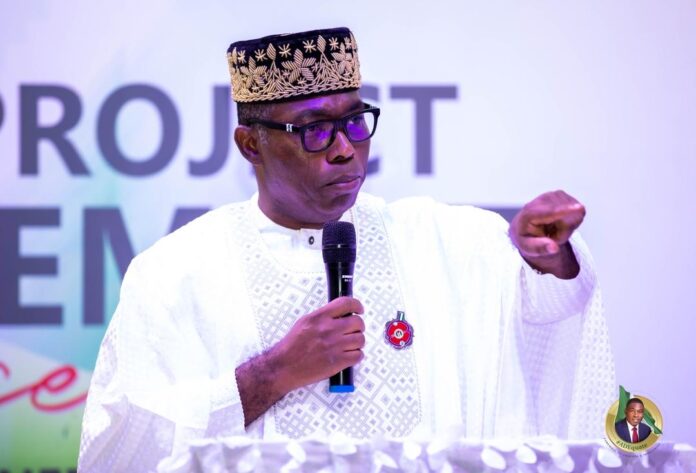
If elected president, I’ll scrap student loan, make education free and compulsory – says Adebayo
Fresh from emerging as the presidential candidate of the Social Democratic Party (SDP) in the 2027 elections, Prince Adewole Adebayo speaks on the party’s internal crisis, alleged political infiltration, education reforms, student loans, and why the SDP believes Nigerians are more concerned about survival than ethnicity. HENRY NNAEMEKA was there.
Excerpts:
Congratulations are in order following your emergence as the SDP presidential candidate for 2027. How does it feel?
It feels good, though challenging. It presents a new opportunity for the country and for Nigerians who deserve a better government and a more effective plan for the future.
Before discussing your manifesto, let’s address the controversy in your party. Your former national chairman is in court and there are reports of divisions within the SDP. What is the way forward?
As a lawyer, I have to be careful because the matter is already before the court. Once someone is facing a criminal trial or risks losing his liberty, it becomes unethical for me to comment extensively. What I hope is that the rule of law will prevail and that a political settlement can happen without encouraging criminality. We should allow the law to take its course.
Has the situation created friction within the party?
Not really. From what I understand, the party is trying to use its disciplinary mechanisms to hold officials accountable. Naturally, some people may disagree or feel procedures were not properly followed. What matters is adherence to the party constitution and due process. Institutions like INEC and the police should remain neutral and perform their duties professionally.
READ ALSO: Adebayo emerges SDP presidential candidate for 2027
Some people wondered why the issue escalated to court instead of being resolved internally.
The law presumes every accused person is innocent until proven guilty. If someone is alleged to have mismanaged funds or breached trust, the proper thing is to allow the legal process to run its course. Politics should not interfere. We cannot continue with a culture where political influence protects wrongdoing.
Did you speak with those supporters seen pulling down the gates of the party secretariat?
No. From what I saw, the police have questions to answer because you do not escort people to destroy property. It appeared the police enabled the situation, and the party has already contacted the Inspector-General of Police over the matter.
What should Nigerians know about the SDP and what it stands for?
SDP is a party built around solving social problems. It is focused on ordinary Nigerians — people thinking about food, transport, jobs, healthcare, education and survival. That is what social democracy is about. In some countries, they call it “kitchen table politics” because it is about everyday realities.
A social democratic government will not make major economic decisions without considering their impact on ordinary people. Our focus is on social progress and improving living standards, not just winning elections.
You emerged by consensus without opposition. Was there resentment within the party?
No. The party understands that we are facing an incumbent government, so unnecessary internal conflict would be counterproductive. Also, the SDP is an ideological party, not a platform built around personalities.
Both you and President Tinubu are from the South-West. Does that concern you politically?
We do not approach politics that way in SDP. A hungry person in the Southwest is still hungry. Someone buying petrol at high prices is not thinking about regional identity. Nigerians are more concerned about survival.
Other opposition parties have accused the APC of planting moles to destabilise them. Has the SDP experienced this?
Yes, we are dealing with that reality. It is obvious that there are efforts to weaken opposition parties because the goal of some people is to dominate the political space completely. But this is not new in Nigerian politics.
Recent education reforms have sparked debate. What is your position?
These are not reforms; they are deformations. Standards are being lowered because an educated population asks questions and challenges bad governance. Education should build critical thinking and national development, not produce mediocrity.
What would your administration do differently about youth unemployment?
The solution begins with fixing education and creating a society that productively engages young people from childhood. Schools should not simply hand out certificates; they should prepare people for meaningful work and innovation.
Would you retain the student loan scheme?
No. Student loans are a crime against the Constitution and against the people. Education should be free, compulsory and qualitative. If you fail to invest in education, you destroy society and increase insecurity because talented young people are abandoned.


