
A war in search of a mission: From nuclear deterrence to maritime brinkmanship – is Washington fighting for strategy or simply reacting to events?
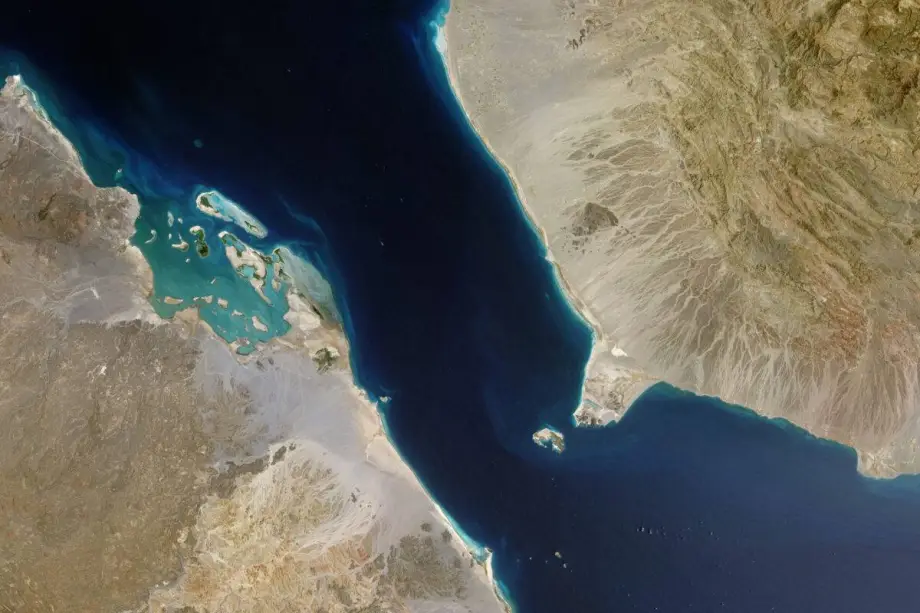
The Bab el-Mandeb Strait has emerged as perhaps the most consequential maritime chokepoint in today’s geopolitical chessboard.
By Uche J. Udenka
A war without an endgame risks becoming a war in search of its own mission.
Wars are supposed to have objectives. They begin with political goals, proceed through military strategy, and end with a negotiated settlement or decisive victory. When a war loses sight of its political destination, it becomes something far more dangerous — a conflict driven not by strategy but by momentum, retaliation, and the illusion that military superiority alone can manufacture political success. That is the uncomfortable question confronting the United States in its confrontation with Iran and the broader Middle East today. What exactly is Washington trying to achieve? If the publicly declared objective was to cripple Iran’s nuclear programme, American leaders have repeatedly claimed significant success. Military strikes, sabotage operations, cyber warfare, sanctions, and covert intelligence campaigns have all been presented as having severely weakened Tehran’s nuclear ambitions. Yet the justification for continued escalation increasingly circles back to the very objective officials previously claimed to have accomplished.
If Iran’s nuclear capability has already been substantially degraded, why does the region appear to be marching toward an even broader confrontation?
The absence of a clearly articulated political endgame is becoming impossible to ignore. Military history offers one enduring lesson: tactical victories do not automatically translate into strategic success. Nations have repeatedly discovered that destroying infrastructure is infinitely easier than constructing political stability. Vietnam, Iraq, Afghanistan, Libya, and countless other conflicts stand as monuments to this painful reality.
Today, Washington appears to be drifting into another conflict where tactical responses are gradually replacing strategic thinking.
The latest signals coming from President Donald Trump, who warned that any attack on shipping could trigger American strikes on Iranian bridges or strategic facilities, illustrate this evolving posture. Whether viewed as deterrence or political messaging, such statements raise difficult questions about escalation. Retaliatory strikes may demonstrate resolve. They may temporarily deter an adversary. But they can also create a dangerous cycle in which every action demands an even stronger reaction, gradually eliminating diplomatic off-ramps while expanding the battlefield.
Punishment is not a substitute for strategy.
The distinction matters. A strategy defines how military actions serve political objectives. Punishment merely demonstrates the capacity to inflict pain. History is filled with powerful nations that confused the two.
Meanwhile, geography is quietly rewriting the rules of the conflict.
READ ALSO: Battle for the Strait of Hormuz: A new endless vicious cycle of escalation
The Bab el-Mandeb Strait has emerged as perhaps the most consequential maritime chokepoint in today’s geopolitical chessboard. Connecting the Red Sea to the Gulf of Aden, this narrow passage carries a significant share of global commerce. Any sustained disruption immediately reverberates across international shipping, insurance markets, energy prices, and global supply chains. Unlike conventional battlefields, maritime choke points impose costs far beyond the immediate participants. Every missile fired near these waters sends ripples through financial markets in London, manufacturing plants in Germany, oil terminals in Asia, and consumer prices across Africa. The conflict is no longer confined to missiles and military bases. It has become an economic war with global consequences. This is precisely why Bab el-Mandeb represents more than another military theatre. Bab el-Mandeb will transform a regional conflict into a global economic battlefield.
It is a strategic game changer.
Unlike traditional military targets, sea lanes cannot simply be “secured” through overwhelming firepower. Commercial shipping depends upon predictability. Insurance companies respond to risk rather than political assurances. Even isolated attacks can produce disproportionate economic consequences by forcing vessels onto longer, more expensive routes around the Cape of Good Hope. In this environment, relatively inexpensive asymmetric attacks can impose enormous costs on vastly superior military powers. This changing strategic equation challenges long-held assumptions about military dominance.
The world’s strongest navy can patrol oceans. It cannot eliminate geography. Nor can it completely eliminate the political motivations driving regional proxy conflicts. That is the uncomfortable reality confronting American policymakers. Military superiority remains overwhelming. Strategic certainty does not. The broader danger lies in allowing tactical successes to create strategic complacency. Every successful strike may eliminate a target. It does not necessarily eliminate the underlying conflict. Indeed, repeated military action can sometimes reinforce the very narratives adversaries use to justify continued resistance, recruit supporters, and expand regional influence.
Military power is indispensable. It is rarely sufficient on its own.
The Middle East has repeatedly demonstrated that conflicts rarely conclude through military force alone. Durable outcomes require political settlements that address the underlying security concerns of all major stakeholders, however uncomfortable those negotiations may be. Without such a framework, today’s victories risk becoming tomorrow’s justifications for renewed confrontation. Washington therefore faces a defining choice. It can continue responding tactically to each new provocation, allowing events to dictate policy one crisis at a time, or it can articulate a coherent political strategy that explains not only how this conflict is being fought, but how it is intended to end. The distinction is critical.
Great powers are not judged solely by their ability to wage war.
They are judged by their ability to know when military force has achieved its political purpose—and when it has not. History rarely remembers nations for the number of targets they destroyed. It remembers whether they built a lasting peace from the conflicts they entered. Without a clearly defined endgame, military operations risk becoming self-perpetuating, each retaliation generating another response, each tactical success creating new strategic complications.
A war without a political destination eventually becomes a war searching for its own justification.
That is the greatest danger facing the current confrontation. Not that America lacks military strength. But that overwhelming strength, without an equally compelling political vision, may gradually become untethered from any clearly achievable objective. The real question is no longer whether America can fight — but whether it knows how this war ends.
The Middle East has seen too many wars that began with confidence and ended in uncertainty.
The world can scarcely afford another.
- Arc. Uche J. Udenka, a social and political analyst – #AfricaVisionAdvancementTrust – is the CEO of Igbo Renaissance Awakening.