



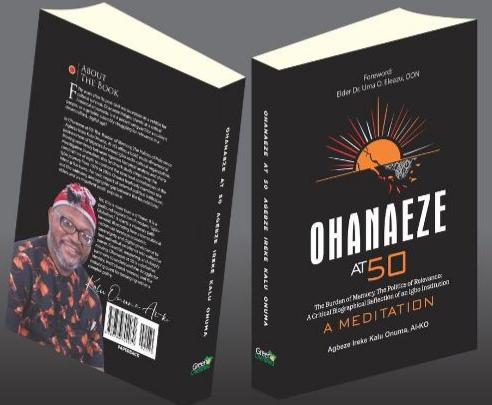
The institution that the Igbo built: A reading of Agbeze Ireke Kalu Onuma’s Ohanaeze @ 50 and a reckoning with what it demands of us
By Johnson Eke
I want to tell you about a conversation I had in Rumuola market, Port Harcourt, sometime around the middle of this year. I was speaking with a woman — let us call her Mama Chizaram, which is what her neighbours call her. She is from Awka. She has been in this city for twenty-three years. She speaks Hausa better than some Hausa people I know, because trade demands it. She has sent three children to university. Her youngest is studying petroleum engineering in Benin. Her eldest runs an electronics shop in Aba. She has a chieftaincy title from her home community that she has never physically returned to collect.
I asked her what she thought of Ohanaeze Ndigbo.
She looked at me for a long moment. Then she said: “When they speak, do they speak for me? When they go to Abuja, do they go for my business, my children, my rent in Port Harcourt? Tell me one thing Ohanaeze has done for me in twenty-three years.”
She was not hostile. She was not bitter. She was asking a fair question. And the fact that I — a political analyst who has spent years observing Nigerian institutions — could not give her a sharp, confident, satisfying answer was the thing that sat with me for the rest of that day.
It is that conversation that I kept returning to as I read Agbeze Ireke Kalu Onuma’s Ohanaeze @ 50: The Burden of Memory, The Politics of Relevance. Because this book is, at its most fundamental level, an attempt to answer the question that Mama Chizaram asked. Not in the language of a market woman in Rumuola — but in the language of history, of political analysis, of institutional assessment. And the answer it arrives at is both sobering and, in the end, hopeful. If you have the patience and the honesty to receive it.
The view from Port Harcourt
I write from Port Harcourt deliberately. Because the story of Ohanaeze is not only the story of Enugu and Owerri and Onitsha and Umuahia, though it lives most loudly in those places. It is also the story of every Igbo person who has made a life outside Igboland — in Lagos, in Kano, in Abuja, in Port Harcourt, in London and Houston and Amsterdam — and who has looked back at Ohanaeze and asked: are you there for me?
Port Harcourt is instructive in this regard. This is a city where the Igbo presence — in business, in the professions, in the informal economy — is one of the most significant facts of daily life. The Igbo built much of what works in this city. They own an enormous proportion of its commercial real estate. Their children fill its schools. Their churches anchor its neighbourhoods. And yet, politically, institutionally, in the rooms where power is distributed, the Igbo in Port Harcourt are perpetually negotiating their legitimacy in a city they have helped to make.
Where was Ohanaeze during those negotiations? Sometimes present. Often not. And when present, often in a form that felt more ceremonial than consequential. This is not a small failure. In a country where political power is the precondition for every other form of security, an apex organisation that cannot consistently convert its membership’s numerical and economic weight into political leverage is failing at its primary function. Ohanaeze @ 50 names this failure. It names it carefully, contextually, and without the cheap satisfaction of blaming everything on one era or one president-general. That precision is part of what makes this book important.
What the book actually says
Let me be specific, because essays about books sometimes hover at altitude without ever landing. This book lands. It covers ground. It makes arguments. And those arguments deserve to be encountered directly.
Onuma traces Ohanaeze from its founding in 1976 through every significant transition of leadership, identifying with documentary rigour the moments when the institution rose to its purpose and the moments when it shrank from it. He does not write in the abstract. When he says that a particular administration failed, he tells you how and why. When he credits a particular moment of institutional courage, he tells you what was actually done, what it cost, and what it achieved.
What emerges from this account is a pattern that is, in retrospect, almost predictable. Ohanaeze has consistently been strongest when it has been most independent — when its leadership drew its authority from the broad mandate of the Igbo people rather than from the patronage of any particular political class. And it has consistently been weakest when it has allowed itself to become an instrument of the political calculations of individuals who were using it rather than serving it.
This observation is not new. But the evidence Onuma assembles for it is more systematic than anything previously available in the public record. He draws on interviews, on internal documents, on newspaper archives, and on the kind of conversations that only someone trusted by multiple sides of the Ohanaeze internal debates could have conducted. The result is a book that feels, in the best sense, exhaustive. Not exhausting — exhaustive. There is a difference.
READ ALSO: BOOK REVIEW: What the Igbo owe themselves: A reading from the outside
BOOK REVIEW: Ohanaeze at 50: The Burden of Memory, The Politics of Relevance
The Igbo are a people whose oral tradition is rich enough to compensate for decades of inadequate written record. Onuma has done the work of putting the oral tradition on paper. That alone would be a service. But he has done more: he has organised it into an argument. That is the difference between an archive and a book.
The chapter — or rather the extended passage, since the book does not always announce its structural moves in conventional ways — dealing with the Ohanaeze election controversies of the recent past is one of the most forensic pieces of institutional analysis I have read in a long time on any Nigerian organisation. Onuma does not reach for conspiracy. He reaches for structure. He asks: what are the incentive systems that produce this behaviour, repeatedly, across different administrations, with different personalities? And the answer he arrives at is both simple and damning: the structure of Ohanaeze rewards those who are able to mobilise godfathers more than it rewards those who are able to mobilise the grassroots. Until that structure changes, the behaviour it produces will not change.
This is the kind of institutional insight that policy people — and Ohanaeze reformers, if they exist and are serious — should be reading carefully. It is not a complaint. It is a diagnosis.
The human cost of institutional failure
I want to stay with Mama Chizaram for a moment longer, because I think the book, for all its sophistication, is ultimately in conversation with people like her. People who do not read political science journals. People who judge institutions not by their constitutions and their mission statements but by what they feel in their daily lives.
What does it cost Mama Chizaram that Ohanaeze is weak? Let me try to be concrete.
It costs her because when Igbo traders in Port Harcourt face organised harassment — and it happens, and it has happened, and it will happen again — there is no institution that can speak in a unified Igbo voice to the relevant authorities and demand accountability. Individual traders make arrangements. Individual community leaders make appeals. But the structural power of a well-organised, respected, politically connected apex body — the kind of power that Afenifere has exercised at various points on behalf of Yoruba interests, the kind of power that Arewa Consultative Forum exercises on behalf of the north — that power is almost entirely absent from the Igbo calculus.
It costs her children because the Igbo have never, in the period covered by this book, successfully converted their remarkable educational investment — they are among the most credentialed peoples in Nigeria, perhaps on the continent — into proportional political representation. An institution that was doing its job would be making this conversion its central mission. A people with this many engineers, lawyers, doctors, and economists should not be as marginalised as the Igbo have been in the federal allocation of power and resources. The gap between what the Igbo have and what they get is the gap that a functioning Ohanaeze was supposed to close.
It costs her sense of belonging, which is perhaps the most intimate cost of all. There is a particular kind of loneliness that attaches to living in a city that is not your homeland when the organisation that is supposed to carry your name in the national conversation cannot articulate why you matter. The Igbo in diaspora — internal diaspora and external — have largely made their peace with this loneliness. But it is a wound. And it did not have to be.
Onuma writes somewhere in this book that the measure of an institution is not what it achieves when conditions are favourable, but what it defends when conditions are hostile. By that measure, Ohanaeze’s record across fifty years is mixed at best. This book says so, clearly, and then asks: what now?
The people in the room on September 22
A book like this one requires a launch that is equal to its seriousness. And the occasion that has been arranged — the public presentation at Dover Hotel, Ikeja, on Tuesday, September 22, 2026 — is precisely that.
I want to say something about the gathering that has been assembled, because the names on the protocol list are not merely decorative. His Majesty the Obi of Onitsha, Agbogidi, will be Royal Father of the Day. He appears in the appendix of this book — in an interview of rare candour — saying things about Ohanaeze that its own leadership has sometimes been reluctant to say publicly. His presence at this launch is therefore not ceremonial. It is a continuation of a conversation he began when he agreed to be interviewed for this project.
Elder U.K. Eke, MFR, who will chair the occasion, brings with him decades of involvement in the intersection of Igbo business life and public affairs. His Excellency Dr. Alex Otti, OFR, the Executive Governor of Abia State, as Chief Host, brings the weight of the only Igbo governorship to have captured power in Abia in circumstances that seemed to vindicate everything this book argues about what is possible when Igbo institutions do their work properly. His Excellency Peter Obi, CON, as Special Guest of Honour, represents something else again: the evidence that the Igbo political story has a national dimension that Ohanaeze has never fully exploited but which still exists as a possibility.
Professor Okey Anueyiagu will review the book officially. Chief John Nnia Nwodo, whose own presidency of Ohanaeze is examined in these pages, will deliver a distinguished address. Elder Dr. Uma O. Eleazu, OON, who wrote the Foreword, will be Grand Patriarch of the Day. Among the Elder Statesmen: Ochiagha Ebitu Ukiwe, General Ike Nwachukwu, and Admiral Allison Madueke — men whose combined service to Nigeria spans the military, the foreign service, and the corridors of the Supreme Headquarters. Senator John Azuta-Mbata, the serving President-General of Ohanaeze, will be present. Chief George Agu, whose ActivEdge Technologies has anchored this occasion, will serve as Principal Patron.
This is not a gathering of people who have come to congratulate one another. It is a gathering of people who have different relationships to the same institution and who are being brought together, by this book, to reckon with that institution honestly and in public. That is a rare thing in Nigerian public life. And it is worth noting.
What this book demands
I am nearly finished, but I want to be direct about something before I close. Because the temptation, after reading a book like this one, is to nod vigorously and then do nothing. To say: yes, Ohanaeze must reform, yes, the Igbo must build better institutions, yes, the next fifty years should be different from the last fifty — and then to return to the various urgencies of daily life and leave the reforming to someone else.
That temptation is what this book is written against. Not explicitly, not in the mode of a manifesto or a political pamphlet, but structurally, in the way it is organised and argued. It does not allow the reader the comfort of spectator status. Every chapter that analyses a failure implicitly asks: and what did you do? Every chapter that identifies a possibility implicitly asks: and what will you do?
For people like Mama Chizaram — the millions of Igbo in the cities of Nigeria and across the world who have stopped expecting anything from Ohanaeze because expectation without return is emotionally unsustainable — this book is an argument for re-engagement. Not naive engagement, not the kind that will be disappointed again by the same structures producing the same outcomes. But informed, demanding engagement. The kind that reads the institution clearly, identifies its pressure points, and refuses to accept that the way things have been is the way things must remain.
For the people who will be in that room on September 22, 2026, this book is a kind of accountability document. Onuma has written the record of fifty years and placed it in their hands. What they do with it — what Ohanaeze does with it — will in time become part of the record that the author of its hundredth anniversary will inherit.
For the rest of us — the analysts, the commentators, the public affairs watchers, the Igbo in Port Harcourt and Lagos and Kano and London who have watched from a distance and sometimes despaired — this book is a reminder that the distance is partly a choice. You can remain a spectator of your own people’s institutional story. Or you can engage it, argue with it, demand of it, and try to make it better.
The book will be formally presented on Tuesday, September 22, 2026, at 10:00 am at the Main Events Hall of Dover Hotel, Ikeja, Lagos. Copies will be available at the venue and through the author’s channels: aiko.writes2424@gmail.com.
Read it. Share it. Argue with it. That is how a book like this does its work.
I called Mama Chizaram after I finished reading this book. I told her that someone had finally tried to write down an honest answer to her question. She said: “Will the people who need to read it, read it?” I told her I hoped so. She said: “Hope is not enough. Tell them.” I am telling you.
- Johnson Eke is a political analyst and commentator based in Port Harcourt. He writes on governance, institutional reform, and the politics of ethnic identity in Nigeria.


