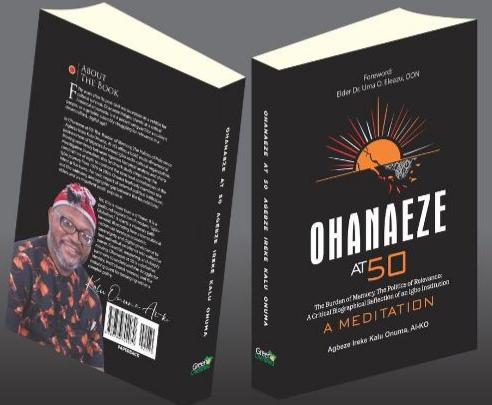
What the Igbo owe themselves: A pre-presentation review of “Ohanaeze at 50: The Burden of Memory, The Politics of Relevance”
By Dapo Adeniyi
Let me say at the outset what I am: a Yoruba man, born in Ibadan, resident for most of my adult life in Lagos, and someone who has spent the better part of two decades thinking and writing about Nigerian institutions. I am not an Igbo insider. I have no ancestral claim on Ohanaeze Ndigbo’s story, no family connection to its founding debates, no personal stake in the outcome of its presidential elections. What I have is a reader’s relationship with this book — and the particular angle of vision that comes from standing close to a fire without being in it.
I read Agbeze Ireke Kalu Onuma’s Ohanaeze at 50: The Burden of Memory, The Politics of Relevance over the course of two weeks in July. I read it slowly. I returned to passages. I argued with the margins. And I came away convinced that this is not an Igbo book in the narrow sense — the sense in which a book is merely the private grievance of its ethnic constituency, dressed up in the language of institutional analysis. This is a Nigerian book. It happens to be written by an Igbo man about an Igbo institution. But its argument, at the level where arguments actually matter, is addressed to every Nigerian who has ever lived inside the gap between what an institution was supposed to be and what it actually became.
That gap is where I live professionally. That gap is where most serious Nigerians live, regardless of ethnicity. And it is why I am reviewing this book.
The problem of beginning
Onuma does something that surprised me in the opening chapters of this book. He refuses to begin with Ohanaeze. He begins instead in 1930s Lagos — in the exact terrain that I, as a Lagos resident with Yoruba eyes, know most intimately. The Igbo in colonial Lagos. The labourers and houseboys and cooks who migrated south in search of livelihood and found themselves at the bottom of a hierarchy that included Yoruba, Indians, and Europeans above them. He names what they were called — derisively, publicly, by people who should have been their neighbours.
“The story begins long before the formal inauguration, in the early 1930s in Lagos, where our people had migrated in search of livelihood only to find themselves relegated to the margins — employed as labourers, houseboys, cooks, and stewards to Europeans, Indians, and even Yoruba families. We were looked down upon, derisively called ‘omo kobo kobo aje ayo,’ the equivalent of cannibals from the backwaters. Some of our people, deflated by this humiliation, began to dissociate from their identity, refusing to identify as Igbo, even changing their names to camouflage themselves.”
I stopped at that passage for a long time. Not because the history was unfamiliar to me — Lagos history is Lagos history, and what the Igbo experienced in colonial Lagos has been discussed before — but because the author’s use of it is so purposeful. He is establishing, from the very beginning of the story, that the Igbo’s organised institutional life emerged from humiliation. From the desire to be seen. From the pain of a people who had to build an association just to assert that they existed and deserved respect in a city that was not theirs.
That origin story matters because it tells you what the institution was supposed to be an answer to. Not merely a social club. Not merely a political lobby. A defence against erasure. And when you understand what an institution was born to do, you can begin to measure whether it has done it.
Onuma is measuring. Across 600 pages and 15 years of research, he is measuring. And the measurement is not comfortable.
The Afenifere mirror
I should confess that the sections of this book that held my attention most ferociously were the comparative passages — the moments when Onuma holds Ohanaeze up against Afenifere and the Arewa Consultative Forum and asks the obvious question that only an honest book would ask: why is Ohanaeze, by any serious comparative measure, the weakest of Nigeria’s major ethnic apex organisations?
READ ALSO: BOOK REVIEW: Ohanaeze at 50: The Burden of Memory, The Politics of Relevance
As a Yoruba man, I read those passages with a complicated mixture of recognition and discomfort. Recognition because Onuma is right: Afenifere, for all its controversies, its generational squabbles, its occasional descent into electoral horse-trading, has maintained something that Ohanaeze has repeatedly failed to maintain. He calls it ‘embeddedness.’
“The contrast with other regional formations is not just instructive; it is damning. I watch Afenifere, for all its internal contradictions and generational squabbles, and I see something Ohanaeze has lost: embeddedness. Afenifere grew out of something real — the Action Group, the politics of the Western Region, the institutions that Awo built. It has roots that go deep into the soil of Yoruba life: the Obas in their palaces, the market women in Ibadan, the cocoa farmers, the professionals in Lagos who still remember what accountability looks like. When Afenifere speaks, it speaks from within a network. Its voice carries not because its leaders are eloquent (though some are) but because it is attached to things that people touch every day.”
This is a precise and generous observation. As a Yoruba person, I can confirm that what Onuma is describing is real. Afenifere’s embeddedness is not accidental — it is the product of the Action Group era, of the First Republic’s Western Region institutions, of an Awolowo who built schools and hospitals and a university before he built a political party, and who understood that an organisation without material roots in people’s daily lives is always one bad election away from irrelevance.
But the discomfort: Onuma’s generosity to Afenifere is perhaps slightly more charitable than current Afenifere deserves. The organisation he describes — the one rooted in the obas and the market women — is the Afenifere of Pa Fasoranti, of the resistance to Abacha, of the June 12 struggle. The Afenifere of 2023, which stumbled badly on the presidential question and found its voice muffled precisely when the Igbo were speaking loudest through Peter Obi’s candidacy, is a somewhat different organisation. He might have pushed the comparative harder. But this is a minor quibble about a passage that is otherwise analytically sharp.
The more important point Onuma makes, and makes well, is that Ohanaeze lacks not just embeddedness but the functional architecture that embeddedness produces. He writes elsewhere that:
“The Afenifere, for all its internal debates, has maintained a consistent public presence that commands respect. The Arewa Consultative Forum has structures that allow it to engage with the center without losing its soul. When issues arise that affect the Yoruba or the Hausa-Fulani, the public knows where to go for an authoritative voice. For the Igbo, we have a carnival of claimants, each shouting louder than the last, and the public is left to guess who actually represents whom.”
‘A carnival of claimants.’ That phrase will stay with me. It is not just descriptive; it is diagnostic. What produces a carnival of claimants? The absence of agreed rules. The absence of legitimacy that is not contingent on who last paid for the convention hall. The absence of structures so deeply embedded in the life of the community that no individual can credibly claim to have captured them.
The question that honest books ask
The section of the book that I found most powerful is also, I think, the section that most squarely puts this work in the canon of serious institutional writing. It is the passage in which Onuma refuses to offer easy answers to the questions that 50 years of Ohanaeze demand:
“Any honest reckoning with Ohanaeze at fifty must ask uncomfortable questions that the organization’s leadership has often preferred to avoid, questions not asked in a spirit of hostility or disrespect but in the conviction that an institution approaching its golden jubilee deserves the kind of searching examination that only genuine friendship can provide. Has Ohanaeze been, across its fifty-year history, the voice of the voiceless or the echo of the powerful… a question that admits of no simple answer because there have been moments when the organization has spoken truth to power and articulated the grievances and aspirations of ordinary Igbo people with courage and clarity, and there have also been moments when it has functioned as little more than a transmission belt for elite interests.”
This is rigorous. It refuses the temptation of the anniversary book, which is to celebrate even as it pretends to assess. It insists on the dual reality: that Ohanaeze has had genuine moments of courage (its resistance to some of the worst of military federalism, its articulation of Igbo economic grievances at various national conferences) and genuine moments of capture (its periodic subordination to the partisan calculations of Igbo politicians who needed it as a platform rather than a people’s institution that needed them as servants).
A Yoruba reader recognises this pattern. We have lived it with our own organisations. The distinction between an ethnic apex body as servant of the people and the same body as instrument of the politicians who dominate it is one of the defining tensions of Nigerian political life across all three major groups. Onuma is not describing a peculiarly Igbo failure. He is describing the most common failure mode of Nigerian institutional life, examined through the lens of its most visible Igbo instantiation.
The civil war and its long shadow
No review of this book can avoid the Civil War. Onuma does not avoid it. He places it at the structural centre of the story, arguing that everything Ohanaeze has been — its urgency, its fragility, its susceptibility to elite capture, its periodic paralysis in the face of federal power — is intelligible only against the backdrop of January 1970, when the Igbo emerged from a war of secession into a federation that had defeated them and was now asking them to reintegrate on the federation’s terms.
He writes of that moment with a restraint that is itself a kind of eloquence: that January 1970 sits in the Igbo imagination like a wound that never fully scabbed over — not merely the end of a war, but the beginning of a silence so heavy it altered the texture of their breath.
This is where I, as a Yoruba reader, must be most careful about the limits of my understanding. The Yoruba were not neutral in the Civil War. The Yoruba political class of that era made choices whose consequences extended far beyond the war’s end. Chief Obafemi Awolowo’s role as Federal Commissioner for Finance and his management of post-war reconstruction policy — the abandoned property question, the currency exchange that wiped out Igbo savings, the reconstruction priorities — is part of the war’s aftermath that sits uncomfortably in any honest Yoruba-Igbo conversation.
Onuma does not dwell on this — his focus is institutional, not polemical. But his account of why Ohanaeze was necessary, and what it was necessary against, is partly an account of what the Igbo faced in a federal system that they had lost the war in. A Yoruba reader with historical honesty must sit with that context even when it is not fully elaborated. The book’s discretion on this point is commendable. But it is the reader’s job to supply what the book’s generosity omits.
The book’s argument for the next 50 years
Onuma is not only a critic. The book’s final movement — which he himself describes as ‘a blueprint in embryo’ — is a reform programme:
“This book is both a mirror and a blueprint in embryo. It reflects the fractures that have weakened our collective voice and sketches the repairs that might restore it. Readers will find personal observations about how Ohanaeze has acted in moments of crisis and calm. They will find practical suggestions for reform: more youth and women in leadership, clearer policy work, better use of the diaspora, and stronger transparency. They will find concrete goals that can be measured over time, from language programs in schools to mentorship networks linking home and abroad.”
Reading this from outside the Igbo community, I am struck by two things. The first is how similar these prescriptions are to the reform arguments that have been made, unsuccessfully, within Afenifere for 20 years. Youth leadership. Diaspora engagement. Transparency. Language preservation. These are the structural problems of all three major Nigerian ethnic apex bodies, and the solutions proposed within each community have been remarkably convergent. There may be a lesson in that convergence: that these are not ethnically specific failures but Nigerian institutional failures that require Nigerian institutional thinking. Onuma’s prescriptions for Ohanaeze might be worth discussing with reformers in Afenifere and the ACF simultaneously.
The second thing that strikes me is the degree to which the reform programme depends on a precondition that the book identifies but cannot itself produce: the willingness of Igbo elites — politicians, businesspeople, professionals — to subordinate their individual calculations to the collective interest. This is the same precondition that has defeated reform in every Nigerian institution I have observed. Onuma knows this. He does not pretend that writing the prescription is the same as administering it. But the gap between the diagnosis and the cure remains, and it is the gap that every honest institutional reform argument must sit with.
What a Yoruba reader takes away
The 2023 presidential election created something unusual in Nigerian political history: a significant alignment of Yoruba and Igbo political energy behind a single candidacy. Peter Obi’s campaign — whatever its ultimate outcome — revealed that there is a constituency across ethnic lines for a different kind of Nigerian politics: disciplined, accountable, institution-focused rather than personality-driven. Onuma’s book, in its deepest ambition, is an argument for that kind of politics applied to the Igbo’s own internal institutional life.
A Yoruba reader of goodwill — and I consider myself one — can only welcome that argument. Not because the Igbo’s institutional strength is the Yoruba’s business in any proprietary sense, but because a Nigeria in which one of its three major peoples lacks a credible, functional, nationally respected apex institution is a Nigeria in which the conversation about federalism, restructuring, and national belonging is permanently impoverished. The Igbo have a voice in that conversation that the country needs. Ohanaeze, at its best, is supposed to be that voice.
This book argues, with more evidence and more rigour than anything I have read on the subject, that Ohanaeze has not consistently been that voice — and that the failure is structural, not merely a function of inadequate personnel. It argues that the repairs are possible, that the next 50 years do not have to repeat the pattern of the first. And it makes both arguments without despair and without the kind of ethnic triumphalism that would make a non-Igbo reader feel like a trespasser in someone else’s conversation.
That last quality — the generous address, the civic rather than ethnic register — may be the book’s most important achievement. It is a book about the Igbo, written by an Igbo man, that speaks to all Nigerians who care about institutions. That is not a small thing. In this country, at this moment, it is almost a rare thing.
A final note
Ohanaeze at 50: The Burden of Memory, The Politics of Relevance will be formally presented to the public on Tuesday, September 22, 2026, at Dover Hotel, Ikeja, Lagos, in the company of some of the most consequential figures in Nigerian public life. His Majesty the Obi of Onitsha, the Governor of Abia State, Peter Obi, senior Igbo statesmen and leaders — the occasion matches the seriousness of the work.
A book launch is a performance, and its value as a cultural statement depends on whether the book behind it deserves the occasion. This one does. I say that as a Yoruba public affairs commentator who came to this text as an outsider and left it feeling that I had been admitted to a conversation that was both specifically Igbo and broadly Nigerian — and richer for both qualities simultaneously.
Read this book. If you are Igbo, read it as the account of your own institutional inheritance and what you must do with it. If you are not Igbo — if you are Yoruba, or Hausa, or Ijaw, or any of the rest — read it as a mirror that is pointed at others but reflects, if you are honest, something of your own face in it too.
- Dapo Adeniyi is a public affairs commentator based in Lagos. He writes on Nigerian governance, institutional design, and the politics of ethnicity.