
The issues in contention are industry-wide and not peculiar to any airline, in this case, Air Peace. Now, this is not to pass any value judgement on the merits of the subject matter. But the accompanying developments have provided grounds to warrant the question, ‘why the Air Peace’. If the issues in contention are of industry-wide dimensions, how justified are they as reasons for obstructing the business of a particular enterprise?
By Emeka Alex Duru
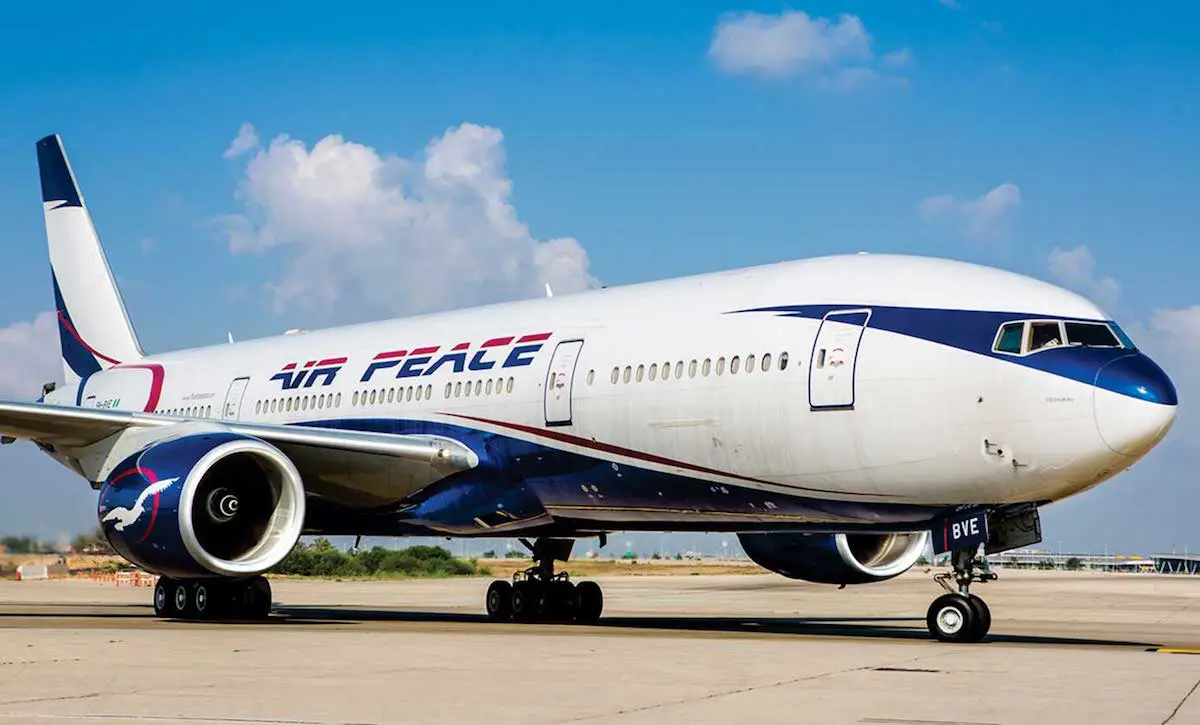
For some days during the week, Nigeria and West Africa’s largest airline, Air Peace, was in the news, contending with obvious attempts at demarketing its brand and reputation. The battle commenced with Aviation workers union disrupting flight operations on Tuesday morning, leaving passengers stranded. Among the victims were passengers scheduled to travel with the airline. Due to the protest, Air Peace flight, scheduled to depart Lagos at 6:30am, could not take off as passengers waited amid the disruption. The development sparked frustration among passengers, some of whom lamented the uncertainty surrounding their travel plans.
In reaction, Air Peace management, apologised to the stranded passengers for the disruption and inconvenience, stressing that the development was caused by circumstances beyond its control. According to the Chief Operating Officer (COO), Mrs. Oluwatoyin Olajide, the unions had cited two major reasons for their action: the 5% Ticket Sales Charge (TSC) indebtedness by airlines to the Nigeria Civil Aviation Authority (NCAA), and failure of airlines to unionise their employees. For emphasis, Olajide stated; “On the 5% TSC, the Director General of the Nigeria Civil Aviation Authority has publicly stated that the airlines, and not Air Peace alone, are complying with the directives of the NCAA regarding the applicable payment.” On unionization, she disclosed that more than 98 per cent of Nigerian airlines do not have unions. Air Peace employees, she said, had voluntarily chosen not to belong to any union. The labour unions picketing the organisation, she said, was a violation of existing laws and a subsisting judgement of the Federal High Court obtained on April 26, 2024, by Air Peace employees against the Nigeria Labour Congress (NLC), Trade Union Congress (TUC), NUATE, the Inspector-General of Police and other unions. The judgement, according to her, declared unlawful any attempt by the unions to coerce Air Peace employees into membership against their will.
READ ALSO:
From Olajide’s explanations which have not been refuted, the flight disruptions of last Tuesday, caused Air Peace more than ₦2 billion in financial losses. Equally, the issues in contention are industry-wide and not peculiar to any airline, in this case, Air Peace. Now, this is not to pass any value judgement on the merits of the subject matter. But the accompanying developments have provided grounds to warrant the question, ‘why the Air Peace’. If the issues in contention are of industry-wide dimensions, how justified are they as reasons for obstructing the business of a particular enterprise? This was the crux of the posers raised by Air Peace COO in her encounter with the media on Wednesday, August 11. Versatile journalist and public affairs analyst, Fred Chukwuelobe, has also thrown similar challenge in his robust piece, titled; “Why Air Peace? The selective targeting of Nigeria’s largest airline must stop”, in a follow-up to the decision by the unions to picket and disrupt the operations of Air Peace in Lagos and Abuja.
The tendency of Air Peace being regularly affected by uncanny developments within the sector even without its making, demands serious interrogation. Tuesday disruption of its flights, was not the first time Air Peace had found itself at the receiving end of what appeared to be disproportionate industrial action. In the recent past, when the Nigeria Labour Congress (NLC) was embroiled in a dispute with the Imo State Government over welfare of workers, Air Peace was picketed despite having nothing to do with the dispute. There have been other occasions of the airline bearing the brunt of an action it was not instrumental to. Thus, the rapidity of misplaced aggression against the airline has given cause to ask if it has become the metaphoric scapegoat of Nigeria’s aviation sector. In African Traditional Religion (ATR), the scapegoat is a male goat upon whose head are symbolically placed the sins and transgressions of an entire community. It carries the burden of atonement for sins it did not commit. The recurrent onslaughts against Air Peace, seem to approximate to this. Or even more! They appear programmed for purposes that are devious.
The ‘sins’ of the airline can better be understood from the street lingo, ‘Big Man, Big Problem’. Indeed, Air Peace is big and has become the proverbial Iroko tree that attracts matchet cuts from passers-by. If you read envy in the entire drama, you may not be far from the truth. In its eventful 12 years of operation, Air Peace has grown to become not just Nigeria’s largest carrier but the biggest airline in West African subregion, carrying with it, a phenomenal story of vision and consistency. It has further soared into international skies where it is spreading its wings and competing favourably on the global stage. At the last count, the organisation has over 38 aircraft conveying passengers to more than 20 local destinations and 10 regional and international airports. Its latest routes – Nnamdi Azikiwe International Airport, Abuja (ABV) to London Heathrow (LHR); ABV to London Gatwick (LGW), up to the Caribbeans, add to the success story.
Such remarkable growth and expansion are bound to attract attention and envy in a sector that has consumed 21 airlines that ventured into its space in the last 26 years, hence the persistent campaigns to weaken the brand’s reputation for safety and reliability. The antics include amplifying and creating negativity around service failures that the airline has no control of. Take for instance, recent video clips in social media platforms openly calling on Nigerians to boycott the airline, while others portrayed the carrier as incompetent, insensitive, or incapable of managing its operations. A closer look at the videos however revealed that they were one-sided old clips recycled and repackaged to create the impression of an airline perpetually in crisis.
Recall also the indiscretion by the Nigerian Safety Investigation Bureau (NSIB) in its tardy reports over an excursion incident involving Air Peace flight at the Port Harcourt Airport, on July 13, 2025. In aviation terms, an aircraft excursion entails an airplane veering off or overshooting the runway during landing, due to factors including miscommunication, faulty gear, pilot’s error or potholes on runway. In such situation, blood and urine samples of the flight crew – the captain, co-pilot and cabin crew member are taken to determine what exactly went wrong. Air Peace crew responded promptly in providing the samples.
The tests were reportedly conducted in a government hospital in Port Harcourt, not in a specialist hospital as required by established protocols. Ordinarily, the results ought to be out in a matter of hours. But it took NSIB officials about two weeks to release their findings. And even after they did, the results were not communicated to Air Peace, the employer of the flight crew. They were rather made media issues. There can be no better definition of bad faith on the part of NSIB and its officials.
Other incidences of orchestrated campaign of calumny against the airline included the last April dubious ranking of “top Nigerian airlines,” with a certain carrier that is yet to find its feet in the industry, coming tops. It was clearly an exercise that smacked of incredulity and astonishment, given that those behind the mischief claimed that the ranking was based on market presence, operational performance, passenger visibility, fleet expansion and growing regional influence – factors that Air Peace has overwhelming handle on. Thankfully, a more credible continental ranking of 15 airlines by Gambella Media Network ranked Air Peace as the eighth best in Africa and the highest ranked carrier in the entire West and Central African sub-region. Further attestation by the International Air Transport Association (IATA), the trade association for the world’s airlines, which confirmed that Air Peace stands on equal footing with aviation giants such as British Airways, KLM and Delta Airlines, on global safety standards, having successfully attained its sixth consecutive International Air Transport Association Operational Safety Audit (IOSA) certification, validates the class the airline belongs. The smear campaigns may therefore not be hitting the target among perceptive minds.

But beneath the outrage and sensational headlines lies a deeper question: Are the critics being fair to Air Peace? Put in other form, are there tangible issues against the airline? The idea is not to suggest that Air Peace or indeed any other airlines should not fulfill their obligations to the relevant government regulatory agencies and their employees. Workers, for example, have a constitutional right to freedom of association. Historically, trade unions are known to have come handy in playing important and legitimate role in protecting workers, negotiating better conditions for them and defending their rights. But membership of the unions should not be imposed on employees. The instant case where one of the union leaders, Comrade Aminu Suleiman, was quoted to have stated: “We can choose to join or not. It’s not by force”, demands more tact and wisdom in approaching the matter, not the raw action of picketing the airline, causing it to lose revenue and forcing passengers to miss their flights.
Of particular note of importance is that aviation is a global and high-risk sector that readily responds to shocks. It is one area that a flip in action, regulation and communication can cause massive damage to investment, safety and reputation. It therefore needs to be handled with adequate care. Singling out Air Peace for regular flagellation and outright demarketing, is certainly not the way to go.
To be sure, in the African continent where turbulence has too often defined both politics and economics, Air Peace has offered a sense of stability, offering thousands of direct and indirect jobs to Nigerians and massively contributing to the national economy. Air Peace also rises as a beacon of national pride, when it matters most. It has on occasions, evacuated stranded Nigerians in times of crisis – from South Africa, during the most recent and previous xenophobic attacks; Sudan, in the heat of civil unrest – often at little or no cost to the evacuees. Back in the COVID-19 pandemic in 2019 and 2020, Air Peace made Nigeria proud, flying the country’s flag, as it were, to bring medical supplies to the country and delivering also to other nations. Few airlines in the world wear that badge of social responsibility so boldly. These are considerations those pushing the smear campaigns against Air Peace, should give thoughts to and desist from their unpatriotic agenda.