
Drones: The new game changer in warfare – What we are witnessing today is only the beginning. Artificial intelligence is rapidly being integrated into drone systems. Future drones will be faster, smarter, more autonomous, and more lethal. Swarm technologies will allow hundreds or thousands of drones to coordinate attacks simultaneously. Human operators may supervise operations rather than control every action. The battlefield of tomorrow may resemble a contest between intelligent networks rather than traditional armies. Countries that fail to adapt risk strategic irrelevance.
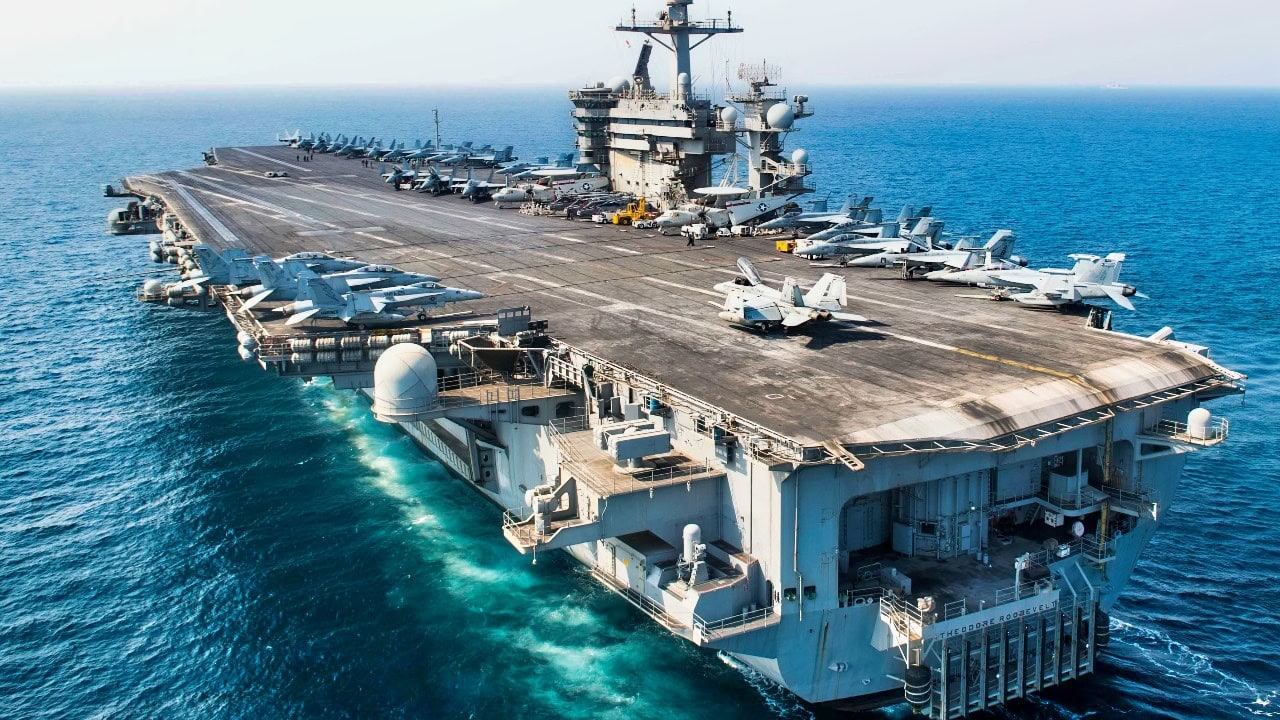
A massive U.S. aircraft carrier
By Uche J. Udenka
The age of expensive military dominance is ending
A $5,000 drone can destroy a $5 million weapon. There is a shift in the dynamics of the battlefield. Military power is no longer measured by aircraft carriers alone. The future of war belongs to those who can swarm, not those who can merely spend. For more than a century, military power was measured by the size of armies, the number of tanks, the sophistication of fighter jets, and the imposing presence of aircraft carriers sailing across the world’s oceans. Nations invested trillions of dollars in military hardware believing that technological superiority and expensive arsenals guaranteed security and victory. Today, that assumption is being shattered. A new era of warfare has arrived, and its symbol is not the aircraft carrier, the stealth bomber, or the nuclear submarine. It is the drone.
Cheap, adaptable, mass-produced, and deadly, drones are transforming the nature of warfare in ways military strategists are only beginning to understand. The wars in Ukraine, Russia, the Middle East, and elsewhere have demonstrated a hard truth: expensive military systems can be overwhelmed by swarms of inexpensive unmanned weapons.
The age of military prestige is giving way to the age of military efficiency.
The death of traditional military assumptions
For decades, military planners believed that dominance required overwhelming technological superiority. The United States alone spent trillions of dollars developing stealth aircraft, missile defense systems, aircraft carriers, and advanced naval fleets. Other powers followed similar paths. The result was a global military culture built around increasingly expensive platforms. But drones have changed the equation. A drone costing a few thousand dollars can destroy armored vehicles worth millions. A swarm of low-cost drones can overwhelm air defense systems designed to intercept a handful of sophisticated missiles. Military planners who once focused on quality over quantity are now discovering that quantity itself can become a powerful weapon. The battlefield has become a contest between affordability and extravagance. Increasingly, affordability is winning.
Iran’s lesson to the world
The recent conflicts involving Iran have revealed a profound military reality. For years, analysts focused on Iran’s limitations. Compared to Western powers, Iran lacked massive aircraft carrier fleets, stealth bomber programs, and global military bases. Yet Iran invested heavily in missiles, drones, proxy networks, and asymmetric warfare capabilities. The logic was simple. Why compete directly against stronger powers when you can force them to fight on terms they did not choose? Rather than matching adversaries tank for tank and ship for ship, Iran developed the ability to saturate defenses through volume. Swarms of drones and missiles create a challenge that even sophisticated defense systems struggle to manage economically. A defender may spend hundreds of thousands or even millions of dollars intercepting threats that cost only a fraction of that amount to produce. This is not merely a military challenge; it is an economic one. The mathematics of warfare is changing.
Ukraine and Russia: The drone laboratory
No conflict better illustrates the power of drones than the war between Russia and Ukraine.
What many expected to be a short conflict has evolved into a prolonged struggle where drones play a central role. Both sides use reconnaissance drones, attack drones, kamikaze drones, naval drones, and increasingly autonomous systems. Trenches, tanks, artillery positions, command centers, and supply lines are constantly exposed to aerial surveillance. The result is unprecedented battlefield transparency. Movement is detected quickly. Concealment is increasingly difficult. Traditional advantages are being neutralized. The drone has become the eyes, ears, and often the striking fist of modern armies. Perhaps the most remarkable lesson is that despite enormous expenditures of military resources by both sides, decisive victory remains elusive. The drone has strengthened defense as much as offense. The consequence is strategic stalemate. Four years into the conflict, the world is witnessing a new form of warfare where technological adaptation often matters more than sheer military size.
READ ALSO: Trump’s goals for the Iran war and what he’s saying now
Aircraft carriers: Giants under threat
For decades, aircraft carriers represented the pinnacle of military power. They projected force across oceans and symbolized national prestige. Yet drones are raising uncomfortable questions about their future. A modern aircraft carrier costs billions of dollars to build and maintain. It carries thousands of personnel and serves as a floating military city. However, the emergence of long-range drones, loitering munitions, anti-ship missiles, and autonomous attack systems means these enormous assets are increasingly vulnerable. Military strategists now face a difficult question: How do you justify deploying a billion-dollar platform into an environment where relatively inexpensive unmanned systems can threaten its survival? The same question applies to tanks, warships, and many traditional military assets. The future may belong not to a few expensive platforms but to thousands of intelligent, networked systems operating simultaneously.
Asymmetric warfare has become the norm
The greatest impact of drones may not be technological but strategic. Drones have empowered weaker actors. Historically, smaller nations had little chance of competing against major military powers. The gap in resources was simply too large. That gap is shrinking. Today, a nation with limited resources can develop substantial deterrent capabilities through drones, cyber warfare, electronic warfare, and precision missiles. Military power is becoming decentralized. This shift is reshaping global geopolitics. Middle powers and even non-state actors now possess capabilities that once belonged exclusively to great powers. The monopoly of military force is being challenged. The battlefield is becoming flatter. The barriers to entry are falling.
Exporting war away from home
Another revolutionary aspect of drone warfare is its ability to project power without risking large numbers of personnel. Drones can travel hundreds or even thousands of kilometers. They can strike strategic targets while keeping operators safely distant from the battlefield. This allows states to influence conflicts beyond their borders while minimizing political costs at home. Governments no longer need massive troop deployments to create strategic effects. War can be projected remotely. Influence can be exercised from afar. The political consequences are enormous. Leaders may become more willing to engage in military operations when the risk of casualties is reduced. The threshold for conflict could become lower. Paradoxically, technology designed to reduce losses may increase the frequency of confrontation.
The coming drone arms race
What we are witnessing today is only the beginning. Artificial intelligence is rapidly being integrated into drone systems. Future drones will be faster, smarter, more autonomous, and more lethal. Swarm technologies will allow hundreds or thousands of drones to coordinate attacks simultaneously. Human operators may supervise operations rather than control every action. The battlefield of tomorrow may resemble a contest between intelligent networks rather than traditional armies. Countries that fail to adapt risk strategic irrelevance. Military doctrines developed in the twentieth century may prove inadequate for the twenty-first. The drone revolution is advancing too quickly for complacency.
The new reality
The lesson emerging from modern conflicts is unmistakable. Military power is no longer defined solely by the ability to build aircraft carriers, stealth fighters, or massive armored formations. Power increasingly belongs to those who can innovate, adapt, and deploy technology at scale. The drone has become the great equalizer. It has altered the economics of warfare, challenged traditional military hierarchies, empowered smaller actors, and forced strategic planners to rethink long-held assumptions. The age when military supremacy could be purchased solely through expensive hardware is fading. A new era has arrived. An era where a swarm can defeat a giant. An era where ingenuity can rival wealth. An era where the drone has become the defining weapon of modern warfare. The generals of yesterday built armies for industrial wars. The generals of tomorrow must prepare for algorithmic wars.
In that future, the drone is not merely a weapon. It is the symbol of a military revolution that is reshaping global power before our eyes.
- Arc. Uche J. Udenka, social and political analyst, #AfricaVisionAdvancementTrust, is the C.E.O. Igbo Renaissance Awakening.