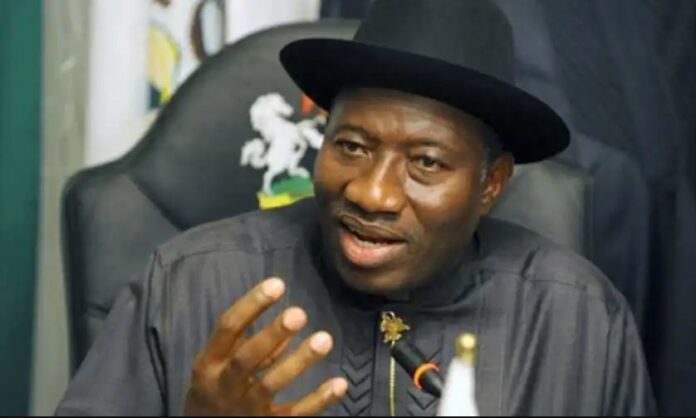
As speculation builds around the 2027 Nigerian presidential contest, a palpable bid is gaining momentum. Of course – not from former President Goodluck Jonathan himself – but from selfish political elite seeking a stopgap candidate. Interestingly, history, principle, and political prudence offer strong reasons he should resist the allure and bait.
By Azuh Arinze
As speculation builds around the 2027 Nigerian presidential contest, a palpable bid is gaining momentum. Of course – not from former President Goodluck Jonathan himself – but from selfish political elite seeking a stopgap candidate. Interestingly, history, principle, and political prudence offer strong reasons he should resist the allure and bait.
The first is what I want to call legacy over becoming a political pawn. Jonathan’s legacy today rests on the dignity of conceding defeat in 2015 – an unprecedented peaceful transition in Nigeria’s history. He has since then operated as an elder statesman, promoting democratic values across Africa. Well-meaning voices, expectedly, have argued that he should maintain that dignity instead of re-entering partisan politics. Accepting another run, simply put, would risk undercutting the respect he currently commands and enjoys.

READ ALSO:
ADC asks APC to pull Tinubu’s premature re-election posters countrywide for violating Electoral Act
The second reason is because a one-term “placeholder” lacks authority. Critics of the so-called “Jonathan-for-2027” calculus argue that putting him on the ballot at the behest of elite reduces governance to elite compromise rather than strategic vision. And as one commentator noted, “he will be a lame duck, a president with no political capital, no mandate for bold reforms.” In today’s climate – marked by insecurity, inflation, and public frustration – Nigeria needs a full-term, reform-driven leader, not a transitional caretaker.
The third reason is simple – if trust could be betrayed in 2015, why believe now? Sources close to Jonathan, however, indicate he remains reluctant to contest due to the betrayal of former allies in 2015 – many from the North – especially those that abandoned him vociferously in the re‑election bid. The very cohorts now promoting his candidacy were the same people whose political loyalty was fickle five years ago. Re-engaging with them would be strategically unwise and dangerous.
The next reason is constitutional eligibility. Ordinarily, Jonathan could be said to be eligible for one more four-year term under Nigeria’s constitution – having been only elected in 2011 and served less than eight years in office. But compatibility doesn’t equal suitability. He has also been sworn in for the presidency twice. Running and winning in 2027 would mean swearing him in for the same office, thrice. That would amount to going against the provisions of the constitution. Besides, legions of Nigerians – particularly across elite circle – believe re-running would confuse a history of service with a grasp of power.
The next is destabilizing zoning and succession norms. Zoning conventions in Nigerian politics expect power to shift to the North after Asiwaju Bola Tinubu’s term. Jonathan’s southern Christian identity therefore makes his candidacy a disruption, even as it appeals symbolically to southern voters. His candidacy would most likely produce a combination of backlash and polarisation, undermining long-held tenure rotation arrangements.
A better path, no doubt, would be to adorn the toga of a statesman. Just like Olu Fasan recently described the concept of a Jonathan return as “theoretical” and “far-fetched” given not just his personal reservations, but geopolitical realities. He further emphasized that Jonathan’s wife publicly affirmed he would not run – or even campaign against President Tinubu. Above all, Jonathan’s continued impact will likely be more powerful outside partisan electoral contests, as a voice of moderation, democratic principle, and continental goodwill.
Lastly, he should say no, not just because he can’t, but because he shouldn’t.
Azuh Arinze is Publisher/Editor-in-Chief of YES INTERNATIONAL! Magazine and author of important books like The CEO’s Bible 1 and 2, Success Is Not Served A La Carte, Anything and Everything Journalism, Conversations With Showbiz Stars, Encounters: Lessons From My Journalism Career, My Story of Many Colours, etc