Why Africa remains energy poor despite abundant oil, gas and renewables – World Energy Council chief
Africa’s vast oil, gas and renewable energy resources have not translated into energy security for the continent because of inadequate infrastructure, limited investment, dependence on imported refined products and failure to develop diversified energy systems, the Regional Chairman for Africa of the World Energy Council, Dr Omar Farouk Ibrahim, has said.
Ibrahim said Africa must move beyond resource ownership to building resilient energy infrastructure, expanding access to electricity and developing systems capable of withstanding global geopolitical shocks.
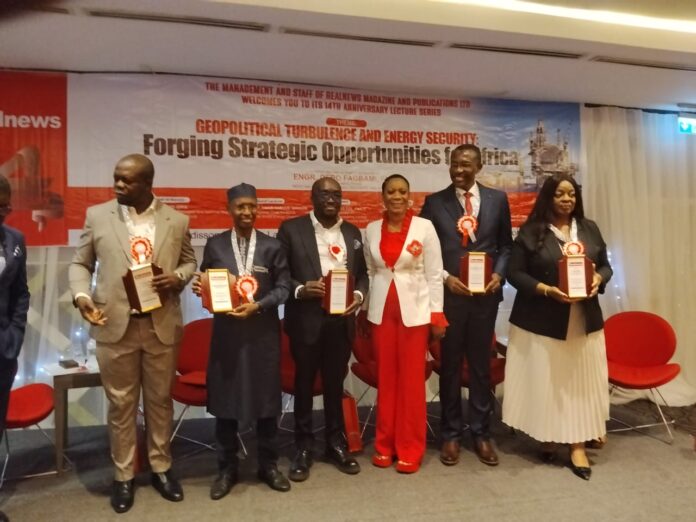
He spoke on Thursday as guest lecturer at the 14th anniversary lecture of Realnews Magazine in Lagos, where he examined the relationship between geopolitical turbulence and energy security.
He said recent international crises, including the Russia-Ukraine conflict and tensions in the Middle East, had demonstrated how disruptions to global energy supply routes could affect prices, trade, investment and economic stability across countries.
According to him, disruptions around strategic corridors such as the Strait of Hormuz, through which about 20 million barrels of crude oil and petroleum products transited daily in 2025, could have far-reaching consequences for economies worldwide.
Ibrahim noted that while higher oil prices could increase revenue for African oil-producing countries, the gains were often offset by rising costs of imported fuel, food, equipment and transportation.
For oil-importing countries, he said, the consequences could include increased import bills, exchange rate pressures, inflation and tighter public finances.
He stressed that even oil-producing countries remained vulnerable where they depended on imported refined petroleum products or lacked adequate storage and distribution infrastructure.
“Energy security cannot be defined merely as the ownership of oil wells or gas fields,” he said, adding that it required reliable supply, infrastructure resilience, diversified energy sources, affordability and the capacity to withstand external shocks.
Ibrahim said Africa must also position itself to benefit from the global energy transition, noting that renewable energy, storage systems, electricity networks and energy efficiency technologies were attracting increasing investment.
He cited projections of about $3.4 trillion in global energy investment in 2026, with approximately $2.2 trillion directed towards clean energy technologies and infrastructure, while Africa’s share was estimated at $110 billion, representing about 3.3 per cent.
He called for increased investment in Africa’s energy sector, arguing that the continent’s development needs differed significantly from those of industrialised economies.
According to him, African countries must pursue a just energy transition that recognises their need to expand electricity access, industrialise and develop modern transportation systems.
He said the transition should allow countries to expand renewable energy and reduce emissions while utilising oil and gas for electricity generation, fertiliser production, petrochemicals and industrial development.
“Our objective should not be to defend any particular fuel indefinitely. It should be to defend Africa’s right and responsibility to pursue development with a realistic, diversified energy mix,” he said.
“Africa’s energy transition must be a transition from energy poverty to energy prosperity—not from energy poverty to deeper deprivation.”
In her welcome address, Publisher of Realnews, Maureen Chigbo, said the lecture was focused on geopolitical turbulence and energy security, particularly the strategic opportunities available to Africa.
She recalled Nigeria’s experience during previous Gulf Wars, when increased global demand for oil and gas created opportunities for higher revenues, but questioned how the country managed the windfall.
“We have had missed opportunities in the past during the Gulf War when demands for oil and gas escalated, and we ended up wondering till today what happened to the windfall of the revenue that accrued to the country, and whether it was properly managed,” she said.
Chairman of the occasion, Dabon Fagbami, commended Realnews for 14 years of professional journalism, describing the magazine’s anniversary lecture as an important platform for informed debate on national and developmental issues.
He said the media had a critical responsibility to uphold truth, accuracy, fairness and public trust, particularly in an era of rapidly spreading information.
Fagbami, who spoke on behalf of Nedogas Development Company Limited, urged participants to contribute to discussions capable of generating practical solutions to Nigeria’s economic and developmental challenges.